


Quick answerVrindavan is sometimes called the “city of widows” because thousands of widowed women, many from Bengal, have come here over generations to live out their lives in devotion, singing bhajans in the town’s ashrams. Some came by choice, drawn to Krishna; many came after being left alone or unwelcome at home. For a long time their lives were ones of white saris, hardship and exclusion from festivals. In recent years that has begun to change: a 2012 Supreme Court directive, the work of organisations such as Sulabh International and local temples have brought pensions, better care and, movingly, a return to colour, with the widows now playing Holi and celebrating Diwali again. Visitors should treat them with dignity and support genuine ashrams. To visit Vrindavan thoughtfully, call or WhatsApp +91-7302265809. |
Among all that Vrindavan is famous for, there is one part of its story that is quieter and more tender and that every thoughtful visitor should understand: its widows. For generations this town of Krishna has been a refuge for widowed women with nowhere else to turn and it earned the sad name “the city of widows.” But the story is changing and the change is one of hope. Here, from a guide born in Braj, is a respectful account of who they are, why they came and how colour is returning to their lives, with the key points in tables. For the wider town, see our guide to why Vrindavan is famous.
Key takeaways
- Vrindavan is called the “city of widows”; thousands of widowed women live in its ashrams.
- Many come from Bengal and elsewhere, some by devotion, many after being left alone.
- They traditionally lived in white saris, singing bhajans for a meal and a small payment.
- A 2012 Supreme Court directive pushed for better conditions and inclusion.
- Organisations such as Sulabh International have brought pensions, care and dignity.
- Widows now play Holi and celebrate Diwali again, reclaiming colour long denied them.
- Visitors should treat them with respect, never as a spectacle and support genuine ashrams.
I am Gurudutt, born in Gokul in the Mathura district, guiding pilgrims through Braj since 2018, more than 50,000 of them. The widows are part of Vrindavan’s living story and I believe visitors should understand them with respect rather than stare, so let me tell it honestly.
The widows of Vrindavan at a glance
| Detail | Information |
| Known as | The “city of widows” |
| Who | Widowed women, many from Bengal, living in devotion |
| Where they live | Bhajan ashrams and widow homes across Vrindavan |
| Traditional life | White saris, hours of bhajan, a meal and a small payment |
| Turning point | A 2012 Supreme Court directive for better conditions |
| Reform by | Sulabh International and other organisations, local temples |
| The change | Pensions, care and a return to Holi and Diwali |
Why the widows come to Vrindavan
To understand the widows, you have to understand both devotion and hardship, because both brought them here.
For some, it was faith. Vrindavan is Krishna’s town and a widow who had lost everything could still give her days to him, singing his name, living simply in his dham. To spend one’s last years in Vrindavan is, for a devout Vaishnava, a blessing.
For many others, though, the reason was sadder. In parts of India and especially in old Bengal, a widow was once treated as inauspicious, barred from colour and celebration and too often seen by her own family as a burden once her husband was gone. Some were abandoned; some left on their own rather than be a weight on their children. Vrindavan, with its ashrams and its charity, became the place they came to or were sent to. That is how a town of devotion also became a town of the forgotten.
The life of white
For generations the pattern was the same and it was hard. A widow would live in a bhajan ashram or a rented corner of a room, dress only in a plain white sari and sing devotional songs for several hours a day, for which she received a simple meal and a very small payment. Festivals, above all Holi with its colours, were considered not for her. Many lived in real poverty and the system around them was not always kind.
I say this plainly, not to sensationalise it, because a visitor who does not know this will misread the white saris and the ashrams. This was, for a long time, a genuine social hardship and it is part of Vrindavan’s truth.
The return to colour
Here is the hopeful turn and it is real. Over the last decade and more, the lives of Vrindavan’s widows have begun to change for the better.
| Change | What it meant |
| 2012 Supreme Court directive | Ordered attention to the widows’ living conditions and dignity |
| Sulabh International and NGOs | Brought stipends, medical care, better housing and training |
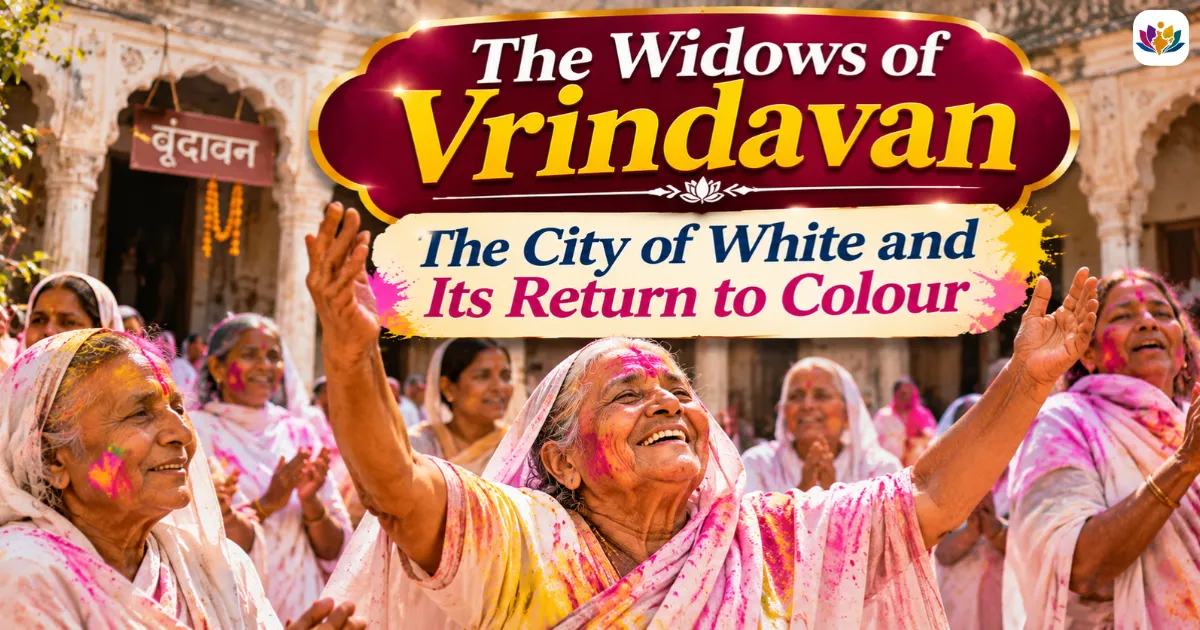
| Reclaiming festivals | Widows began to play Holi and celebrate Diwali again |
| Temple celebrations | Events such as the Gopinath temple Holi, with 200-plus widows |
| Changing attitudes | What was once seen as rebellion is becoming accepted tradition |
The image that captured it for the whole country was the sight of Vrindavan’s widows, once forbidden colour, throwing flower petals and gulal at a temple Holi, smiling in a riot of colour. It is not a full solution and hardship remains, but it is a true and moving change, dignity and joy returning to women who were long denied both.
Takeaway: the widows of Vrindavan are not a curiosity to photograph. They are women of devotion and resilience whose story is slowly, rightly, turning toward colour again.
How to visit respectfully
If your visit to Vrindavan brings you near the widows or their ashrams, here is how to behave with the dignity the moment deserves.
- Do not photograph them without consent. A white sari and a lined face are not a tourist shot. Ask and accept no for an answer.
- Do not treat the ashrams as an attraction. They are homes and places of worship, not a sightseeing stop.
- Give through genuine organisations. If you wish to help, donate to established, reputable ashrams or NGOs rather than handing cash in the street, where it may not reach those in need.
- Offer respect first. A quiet “Radhe Radhe,” a bow, a moment of genuine regard, means more than a coin dropped in passing.
- Learn the story. Understanding why they are here is itself a kind of respect.
The honest bit
Honest words from one born in Braj. Please do not come to Vrindavan to “see the widows,” as some do, cameras ready, as though they were a sight on a list. They are women who have lived through loss and many through real cruelty and they deserve to be met as people, not photographed as subjects. I have turned down visitors who wanted me to take them to an ashram for pictures and I always will.
At the same time, do not look away or pretend the hardship is not there. The kind response is neither to gawk nor to ignore, but to understand, to give through proper channels if you can and to carry the knowledge that Krishna’s town has sheltered the abandoned for centuries and is, at last, learning to give them their colour back. That understanding will deepen your whole Vrindavan pilgrimage.
Why Experience My India is the right choice
I was born in Gokul in the Mathura district and I guide Vrindavan as a living town with a real human story, not a set of photo stops. Guiding since 2018, more than 50,000 pilgrims, 4.5 stars on Google, WhatsApp first, 8 AM to 9 PM daily. We show you the Vrindavan that matters, tell its stories, including this one, with honesty and respect and if you wish to help its widows we can point you to genuine, reputable organisations rather than to anything that treats them as a spectacle. One clear fare and never a charge for free darshan.
Tip from Gurudutt: if the widows’ story moves you and you want to help, ask us for the names of established ashrams and NGOs doing real work and give them to us. A thoughtful donation through the right hands does far more good than anything offered in the street.
Plan your Vrindavan visit
Tell me your dates and how you are arriving and I will plan a thoughtful Vrindavan darshan, for one clear price from ₹1,999 per person.
| Book Your Mathura – Vrindavan Trip Today
We Reply in 30 Minutes 📞 +91-7302265809 💬 WhatsApp: +91-7302265809 Packages start from ₹1,999/ person | Top Rated 4.5★ Explore all: Vrindavan Mathura Tour Packages Jai Shri Krishna 🙏 |
Frequently asked questions
Why is Vrindavan called the city of widows?
Vrindavan is called the “city of widows” because thousands of widowed women, many from Bengal, have come here over generations to live in devotion, singing bhajans in the town’s ashrams. Some came drawn to Krishna, many after being left alone or unwelcome at home. It is a tender part of Vrindavan’s story. Experience My India guides the town with respect for it, call +91-7302265809.
Why do widows go to Vrindavan?
For two reasons. Some come out of devotion, wishing to spend their last years in Krishna’s town, singing his name. Many others came after hardship: in old traditions, especially in Bengal, a widow was treated as inauspicious and sometimes abandoned or sent away by her family and Vrindavan’s ashrams and charity became the place she could go. Both devotion and hardship brought them here.
How many widows live in Vrindavan?
Vrindavan is home to thousands of widows living in its bhajan ashrams and widow homes, though exact figures vary between surveys. For celebrations such as the recent temple Holi, groups of 200 or more widows have taken part together. The number has drawn national attention and reform efforts over the years. Experience My India can explain the story thoughtfully on a visit.
How has life changed for Vrindavan’s widows?
It has begun to change for the better. A 2012 Supreme Court directive pushed for better conditions and organisations such as Sulabh International, with local temples, have brought pensions, medical care, better housing and dignity. Most movingly, widows now play Holi and celebrate Diwali again, reclaiming the colour long denied them. Hardship remains, but the change is real and hopeful.
Can visitors help the widows of Vrindavan?
Yes, thoughtfully. The best way is to donate to established, reputable ashrams or NGOs that care for the widows, rather than handing cash in the street, where it may not reach those in need. Above all, treat the widows with dignity, never as a photo opportunity. Experience My India can point you to genuine organisations doing real work, call +91-7302265809.
Is it respectful to photograph the widows?
No, not without their consent. A widow in a white sari is not a tourist photograph and the ashrams are homes and places of worship, not attractions. Always ask first and accept no for an answer. A quiet, respectful greeting means far more than a picture. Experience My India will never take visitors to an ashram simply for photographs.
What is the Vrindavan widows’ Holi?
In recent years, Vrindavan’s widows, once forbidden the colours of Holi, have begun to celebrate it again, throwing flower petals and gulal at temple events such as the Gopinath temple Holi, with 200 or more taking part. Encouraged by organisations like Sulabh International, it has become a powerful symbol of dignity and inclusion returning to their lives. It is deeply moving to learn about.
Should the widows be part of a Vrindavan tour?
Only with great care and respect. Their story is an important part of understanding Vrindavan, but they are not a sightseeing stop. A good visit means learning the story, meeting anyone you encounter as a person and helping through proper channels if you wish, never gawking or photographing. Experience My India guides this part of Vrindavan honestly and with dignity.