

Quick answerSanjhi is the GI-tagged folk art of Braj, a devotion made by cutting the finest paper stencils and filling them with natural coloured powders or by floating stone colours on still water, to form pictures of the pastimes of Radha and Krishna. Tradition says Radha and the gopis began it, making patterns on the ground to please a sulking Krishna. The name comes from sandhya, dusk, the hour the art was made as the cows came home. Its living temple tradition in Vrindavan is more than 500 years old, shown most fully during a fifteen-day festival in Ashwin (September to October). You can still see it at a few old temples including Radha Raman. To plan a Vrindavan visit around the Sanjhi season, call or WhatsApp +91-7302265809. |
Most visitors to Vrindavan see the temples and the ghats but never learn about one of its most delicate treasures: Sanjhi, the paper-cut art that priests here have kept alive for five centuries. A single Sanjhi can take a month to cut and is wiped away in a morning, its colours given to the Yamuna. It is devotion as art, made to be let go. Here, from a guide born in Braj, is the verified story, how it is made and where to see it, with the key details in tables. Plan your visit with our Mathura Vrindavan tour package.
Key takeaways
- Sanjhi is the GI-tagged paper-cut and powder art of Braj, picturing Radha and Krishna’s pastimes.
- Tradition says Radha and the gopis began it, making patterns to please a sulking Krishna.
- The name comes from sandhya, dusk, the hour it was traditionally made.
- It is made with fine paper stencils filled with natural colours or floated on water as Jal Sanjhi.
- The temple tradition is over 500 years old, tied to the Bhakti movement and the Vallabhacharya sect.
- It is shown most fully in a fifteen-day festival in Ashwin (September to October).
- A few old Vrindavan temples still keep it, including the Radha Raman temple.
I am Gurudutt, born in Gokul in the Mathura district, guiding pilgrims through Braj since 2018, more than 50,000 of them. Sanjhi is the kind of quiet treasure I love showing to travellers who want more than a temple checklist, so let me set out its story and where to find it, in tables.
Sanjhi art at a glance
| Detail | Information |
| What it is | The GI-tagged paper-cut and coloured-powder art of Braj |
| Name meaning | From sandhya, dusk, the hour it was traditionally made |
| Subject | The pastimes of Radha and Krishna; cows, peacocks, groves |
| Begun by | Radha and the gopis, by tradition, to please Krishna |
| Main forms | Powder Sanjhi on a platform; Jal Sanjhi floated on water |
| Age of temple tradition | More than 500 years |
| Peak season | A 15-day festival in Ashwin (September to October) |
| Where to see | A few old Vrindavan temples, including Radha Raman |
The story: an art begun by Radha
Like everything in Braj, Sanjhi begins with a love story. Tradition, drawing on the Srimad Bhagavatam, says that Radha and her sakhis first made Sanjhi to please Krishna when he was in a mood of feigned anger, gathering flowers and coloured powders to lay beautiful patterns on the ground and coax a smile from him. That theme of loving play runs right through the art. The name itself comes from sandhya, the dusk, because the patterns were made in the evening hour when the cows returned home and the lamps were lit.
So Sanjhi was never merely decoration. It is a form of seva, of worship and meditation, an offering laid before the divine couple and then surrendered. That is the spirit to carry when you see it.
How Sanjhi is made
The craft is astonishing in its patience. Here are the main forms you will come across.
| Form | How it is made |
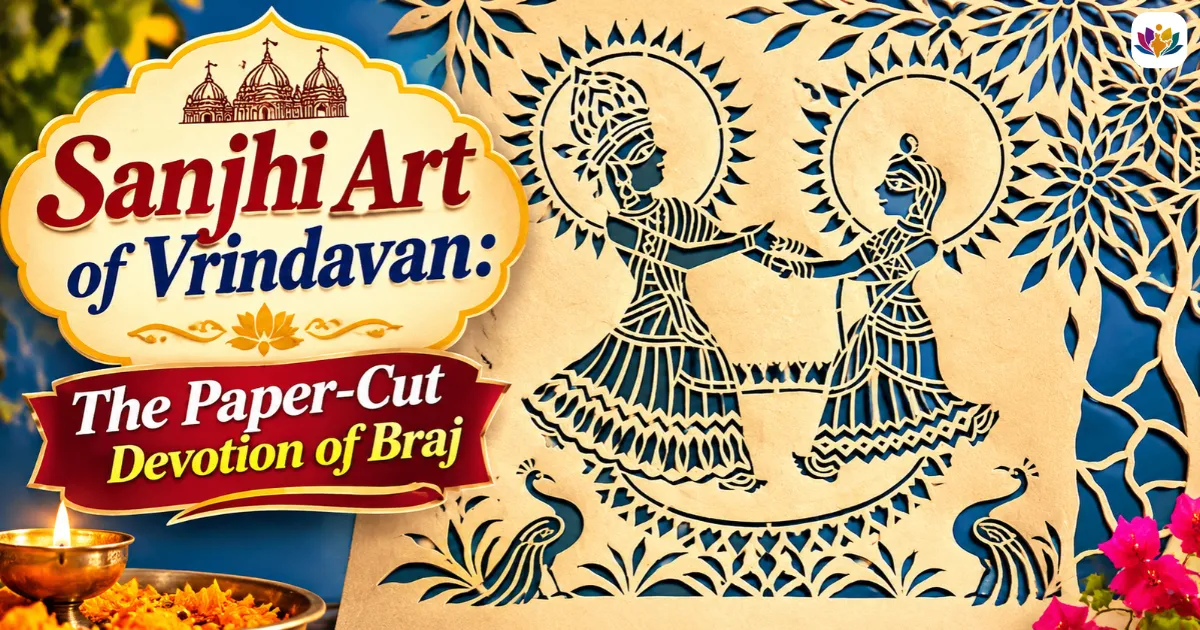
| Paper-cut Sanjhi | A design is cut into fine paper with tiny custom scissors, laid on a platform and the openings filled with natural coloured powders |
| Jal Sanjhi | Powdered stone colours are gently floated on the surface of still water to form a picture |
| Flower Sanjhi | Patterns built from fresh flowers and petals |
| Temple Sanjhi | Layered paper cuttings on an earthen platform, a Radha-Krishna scene at the centre ringed by ornament |
In the temple tradition, priests trained from childhood prepare the design on an earthen platform, often shaped as an eight-petalled lotus, laying the stencil and filling it so carefully that the finished picture looks painted. An elaborate Sanjhi can take anywhere from an hour to a full month to cut. The colours were traditionally natural and the Mughal era added the fine jaali and geometric borders you still see.
Takeaway: watch a Sanjhi being made, not just a finished one. The cutting and the careful filling are the devotion; the picture is only the result.
The art made to be let go
Here is the part that moves people most. In the old temple festival, a new Sanjhi is created every single day, displayed during the evening worship and then, the next morning, it is cleared away and its colours are offered to the Yamuna. Nothing is kept. A month of a priest’s skill may live for a single evening.
For a pilgrim this is the whole teaching of Braj in one image: beauty offered with full heart and then released, holding on to nothing. It is why Sanjhi feels less like a craft and more like a prayer.
Where and when to see Sanjhi in Vrindavan
The living temple tradition of Sanjhi is shown most fully during a fifteen-day festival in the dark fortnight of Ashwin, in September or October, when a fresh design appears each evening. A handful of old Vrindavan temples have kept the 500-year-old practice, among them the Radha Raman temple, the Bhatta Ji temple and the Shahjahanpur temple.
| To see Sanjhi | Note |
| Best season | The 15-day Ashwin festival (September to October) |
| Daily rhythm | A new design each evening, cleared the next morning |
| Temples keeping it | Radha Raman and a few other old Vrindavan temples |
| Year-round | Some artists and shops display and sell paper-cut Sanjhi |
Because the finest temple Sanjhi is seasonal and the places are not sign-posted for tourists, this is one experience where a local guide genuinely helps. For the wider town, see our guide to why Vrindavan is famous.
The honest bit
Honest words from one born in Braj. Do not arrive in Vrindavan expecting a “Sanjhi museum” with set hours and a ticket counter, because there is not one. The real, living Sanjhi is a temple seva, shown mainly in the Ashwin festival, in old shrines down narrow lanes, at the discretion of the priests. If you come at the right season and with someone who knows which temple is displaying it that evening, you will see something unforgettable. If you come in the wrong month expecting it on demand, you may miss it entirely.
Outside the season, you can still meet artists and buy genuine hand-cut Sanjhi, which supports the craftspeople directly, but please do not treat a working temple ritual as a photo shoot. Watch quietly, ask before photographing and give the art the respect of silence.
Why Experience My India is the right choice
I was born in Gokul in the Mathura district, so I grew up around the crafts and rituals of Braj, not just its temples. Guiding since 2018, more than 50,000 pilgrims, 4.5 stars on Google, WhatsApp first, 8 AM to 9 PM daily. We can time a Vrindavan visit for the Sanjhi season, find which temple is showing a design that evening, introduce you to genuine Sanjhi artists rather than mass-made copies and tell you the story so the art means something. One clear fare and never a charge for free darshan.
Tip from Gurudutt: if Sanjhi matters to you, plan your Braj trip for the Ashwin festival in September or October and keep an evening free for it, since the designs are made for the evening worship. Ask us the night before which temple to head to, as it changes.
Plan your Vrindavan visit
Tell me your dates and how you are arriving and I will build Vrindavan and the Sanjhi season if it suits your dates, into your trip, for one clear price from ₹1,999 per person.
| Book Your Mathura – Vrindavan Trip Today
We Reply in 30 Minutes 📞 +91-7302265809 💬 WhatsApp: +91-7302265809 Packages start from ₹1,999/ person | Top Rated 4.5★ Explore all: Vrindavan Mathura Tour Packages Jai Shri Krishna 🙏 |
Frequently asked questions
What is Sanjhi art of Vrindavan?
Sanjhi is the GI-tagged folk art of Braj, made by cutting fine paper stencils and filling them with natural coloured powders or by floating stone colours on still water, to picture the pastimes of Radha and Krishna. It is a form of temple worship more than 500 years old, kept alive in a few Vrindavan temples. Experience My India can plan a visit to see it, call +91-7302265809.
Who started Sanjhi art?
Tradition, drawing on the Srimad Bhagavatam, says Radha and her sakhis began Sanjhi, laying patterns of flowers and colours on the ground to please Krishna in a mood of feigned anger. From that loving play it grew into a folk and temple art of Braj. The name comes from sandhya, dusk, the hour it was made as the cows returned home.
How is Sanjhi made?
In the main form, a design is cut into fine paper with tiny scissors, laid on an earthen platform often shaped as an eight-petalled lotus and the openings filled with natural coloured powders. In Jal Sanjhi, stone colours are floated on still water. Flower Sanjhi uses petals. An elaborate design can take from an hour to a month to cut. Experience My India can show you the process.
When is the best time to see Sanjhi in Vrindavan?
The living temple tradition is shown most fully during a fifteen-day festival in the dark fortnight of Ashwin, in September or October, when a fresh design is made each evening and cleared the next morning. This is the time to come if Sanjhi is your aim. Experience My India can time your Braj trip for the Sanjhi season.
Where can I see Sanjhi in Vrindavan?
A handful of old Vrindavan temples still keep the Sanjhi tradition, among them the Radha Raman temple, the Bhatta Ji temple and the Shahjahanpur temple, mainly during the Ashwin festival. The shrines are down narrow lanes and not sign-posted, so a local guide helps greatly. Experience My India finds which temple is displaying a design that evening, call +91-7302265809.
Why is Sanjhi cleared away each day?
In the temple tradition a new Sanjhi is made every evening for worship and then cleared the next morning, its colours offered to the Yamuna. Nothing is kept. For devotees this is the heart of it: beauty offered with full heart and then released, holding on to nothing. It is what makes Sanjhi feel more like a prayer than a craft.
Can I buy Sanjhi art or learn it?
Outside the temple festival, you can meet Braj artists and buy genuine hand-cut paper Sanjhi, which supports the craftspeople directly and some will show you the cutting. The temple art itself is passed down priest to priest through the guru-shishya tradition rather than taught as a class. Experience My India can introduce you to genuine artists rather than mass-made copies.
Is Sanjhi only found in Vrindavan?
Sanjhi belongs to the whole Braj region, Vrindavan and Mathura above all and the paper-cut style has since spread into homes, lanterns, greeting cards and public art across India. But its deepest living home is the temple tradition of Vrindavan, more than 500 years old. Experience My India can include the Sanjhi temples in your Braj visit.