| QUICK ANSWER
Krishna Janmasthan in Mathura is the exact prison cell where Lord Krishna was born to Devaki and Vasudeva approximately 5,253 years ago. The complex includes the Garbha Grih shrine, the Keshav Dev Temple and a mosque-all within the same compound. Entry is free but all electronics are banned inside. The temple opens at 5:00 AM. Janmashtami 2026 falls on 4 September. Experience My India has guided 50,000+ pilgrims here since 2018. Tours from ₹1,999. WhatsApp +91-7302265809. |
What Is Krishna Janmasthan? – Significance & Why It Matters
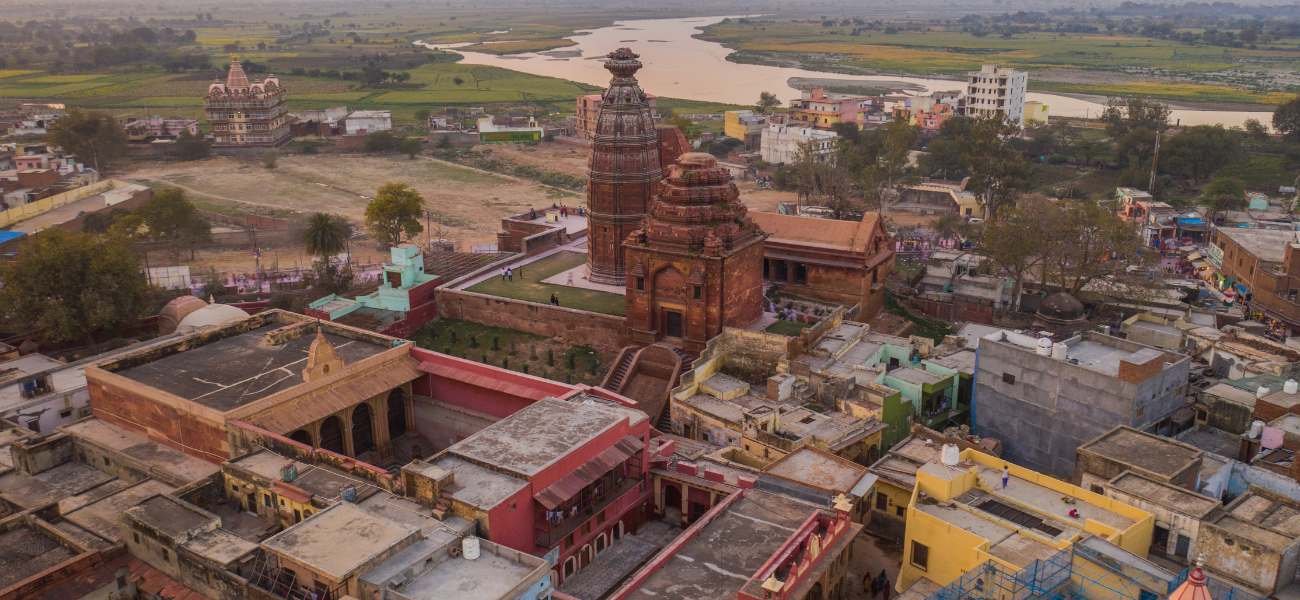
Of all the sacred sites in India’s pilgrimage map, Krishna Janmasthan in Mathura holds a position that is genuinely singular. It is not a temple built in honour of a divine event-it is the specific location where that event took place. The small chamber inside the complex, known as the Garbha Grih, marks the prison cell where Devaki gave birth to Lord Krishna in the presence of his father Vasudeva, under armed guard, at midnight. That is not mythology standing in for an unknown location-it is a site that has been continuously identified, worshipped, built upon, destroyed and rebuilt across more than two thousand years of documented history.
I am Gurudutt, born and raised in Braj Bhoomi and since 2018 I have brought 50,000+ pilgrims through Krishna Janmasthan in Mathura as part of Experience My India’s guided tours. What I have noticed, consistently, is that the visitors who understand the site’s history before they arrive have a qualitatively different experience inside the complex. They are not looking at a room-they are standing at a convergence point. This guide is for those visitors.
By the end of this guide, you will know the complete history of Krishna Janmasthan from its ancient origins to the present structure, the practical logistics of the darshan (including the electronics ban that catches 30% of first-time visitors off guard), the verified Janmashtami 2026 dates with midnight puja timings and how to combine your Janmabhoomi visit with Dwarkadhish Temple and Vishram Ghat on the same day. Call Experience My India at +91-7302265809 if you want us to plan it for you. So you can see our Mathura Vrindavan Tour Packages for divine journey.
Why Was Krishna Born in Mathura?-The Story Behind the Birthplace
The Srimad Bhagavatam and the Vishnu Purana both give a specific account of why Krishna’s birth took place in Mathura’s prison rather than in Gokul or Vrindavan where he spent his childhood. The answer lies in the circumstances of his parents’ imprisonment.
Kansa, the king of Mathura and Devaki’s cousin, had been warned by a divine prophecy at the time of his sister Devaki’s wedding to Vasudeva: the eighth child of this couple would be responsible for his death. Kansa responded by imprisoning both Devaki and Vasudeva in a cell within his palace complex in Mathura and killing each of their first seven children at birth. Krishna-the eighth child-survived through a combination of divine intervention and Vasudeva’s crossing of the Yamuna river at midnight to reach Nanda Maharaj’s home in Gokul.
Mathura was chosen, in this tradition, not as an ideal birthplace but as the exact location of the trial-the city of the tyrant the child was destined to defeat. The prison cell is central to the story in a way that makes it a site of both suffering and liberation simultaneously. This dual character-prison and birthplace of God-is what gives the Garbha Grih its concentrated spiritual atmosphere that most pilgrims describe as unlike any other shrine in India.
The location of Mathura itself: Mathura sits on the western bank of the Yamuna river in Uttar Pradesh, approximately 160 km south of Delhi and 65 km north of Agra. It is the seat of Braj Bhoomi-the larger sacred region connected with Krishna’s life, which includes Vrindavan (12 km), Govardhan (26 km), Barsana (45 km) and Gokul (15 km).
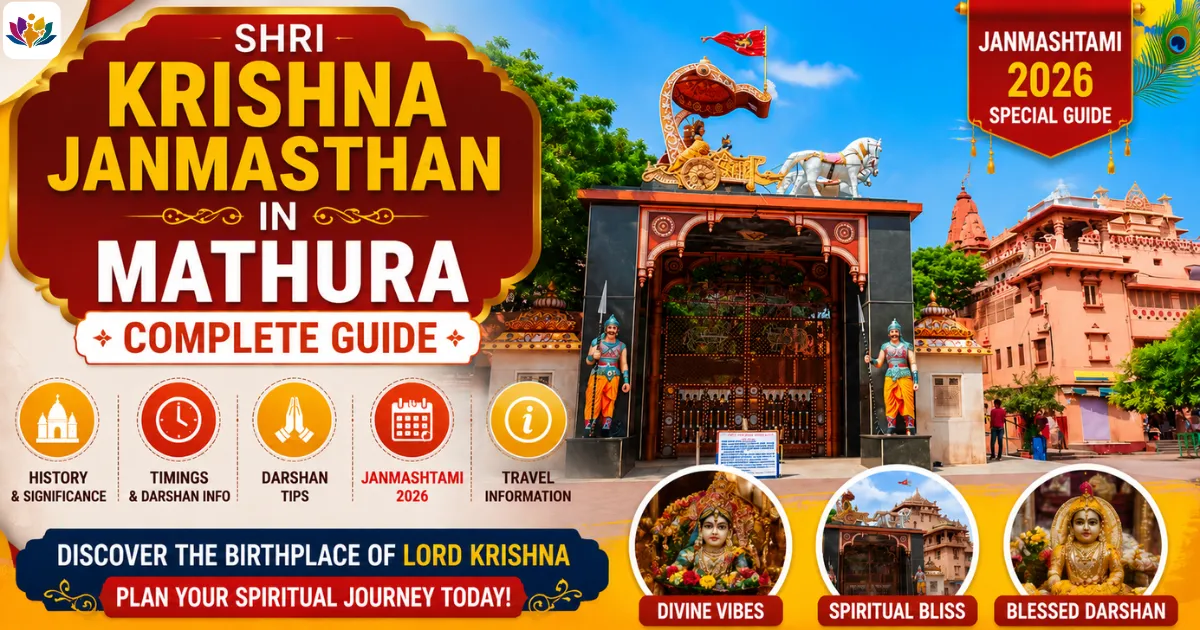
History of Krishna Janmabhoomi-From Ancient Times to Present
The history of the Janmabhoomi site is long, layered and at times painful-and understanding it gives the current complex its full weight.
Ancient and Medieval Period
The earliest documented temple at the Janmabhoomi site was built by King Vajranabha-grandson of Krishna-according to tradition. Archaeological evidence of continuous worship at the site begins from at least the 5th century BCE. By the 1st century CE, the Greek ambassador Megasthenes had already noted Mathura as a city of great religious significance. The Jataka tales and early Buddhist texts reference Mathura as a major centre of devotional practice.
The first major temple structure on the site was built by Vikramaditya in approximately the 4th-5th century CE. This temple was destroyed by Mahmud of Ghazni in 1017 CE during his raid on Mathura. It was rebuilt and destroyed multiple times across the medieval period-by Sikandar Lodi in 1500 CE and most significantly, by Aurangzeb in 1669 CE, who demolished the then-standing Keshava Deva temple (built in 1618 CE by Vir Singh Bundela) and constructed the Shahi Eidgah mosque on a portion of its grounds.
The Legal History-A Dispute That Shaped the Site
The Katra Keshav Dev land, on which the Janmabhoomi complex stands, has been the subject of one of India’s longest-running property disputes. In 1951, the Shri Krishna Janmabhoomi Trust was legally established to manage and develop the site. The current complex-which includes both the Hindu temple structures and the adjacent Shahi Eidgah mosque-reflects a negotiated arrangement that has been the subject of ongoing legal proceedings.
The current temple complex, including the Garbha Grih, was consecrated in 1982 following major reconstruction work. The site is managed by the Shri Krishna Janmabhoomi Seva Sansthan. The complex’s current structure represents the most recent layer of a site that has been rebuilt at least five times across 2,000+ years.
The Present Complex
The current Krishna Janmasthan in Mathura consists of three primary structures: the main Bhagavata Bhavan (the large modern temple hall), the Garbha Grih shrine (the prison cell chamber) and the Keshav Dev Temple. The adjacent Shahi Eidgah mosque shares the compound wall. The total complex area is approximately 13.37 acres. Within this area, the Bhagavata Bhavan houses a museum, a meditation hall and the main deity hall in addition to the Garbha Grih.
The Garbha Grih-Krishna’s Prison Cell Birth Chamber
The Garbha Grih is the spiritual core of the entire Janmasthan complex. It is a low-ceilinged chamber-modest in size, perhaps 4 metres by 4 metres-that marks the exact prison cell where Devaki is believed to have given birth to Krishna. The chamber is simple: stone walls, a small deity installation and an atmosphere of concentrated devotion that the larger temple hall cannot replicate.
What makes the Garbha Grih unusual compared to most temple sanctums is its deliberate restraint. Unlike grand temple halls with elaborate decoration and loud rituals, the prison cell shrine is small, quiet and austere. The deliberate simplicity is the point-this was a prison, not a palace and the space maintains that character. Pilgrims typically spend 5-15 minutes inside, many in silent prayer or tearful darshan.
Practical detail: The Garbha Grih is accessible as part of the general darshan circuit. There is no separate ticket or VIP access-all pilgrims enter through the same path. The queue leading to the Garbha Grih can be 20-30 minutes on weekdays and 60-90 minutes on Sundays or festival days. Experience My India guides know the optimal arrival window (before 8:00 AM on weekdays) that minimises this queue while still allowing access during morning darshan hours.
Krishna Janmabhoomi Temple Timings- Latest Darshan Schedule
Timings verified by Experience My India’s local team-June 2025. Always call +91-7302265809 on the morning of your visit for the day’s schedule, as festival days cause significant variation.
| Session | Opens | Closes | Notes |
| Morning Darshan (Summer: Apr-Sep) | 5:00 AM | 12:00 PM | Best darshan window: 5:30-8:00 AM (before tourist buses arrive) |
| Morning Darshan (Winter: Oct-Mar) | 5:30 AM | 12:00 PM | Carry a light jacket for dawn visits in Dec-Jan |
| Afternoon Break | Closed | — | 12:00 PM to 3:00 PM-complex sealed |
| Evening Darshan | 3:00 PM | 9:30 PM | Reopens at 3:00 PM (earlier than most Mathura temples) |
| Janmashtami Night (special) | All night | All night | 4 Sep 2026: midnight puja 12:00-12:45 AM; gates open continuously |
Janmabhoomi vs Key Nearby Temples-Timing Comparison
| Temple | Morning Opens | Afternoon Break | Evening Opens | Closes |
| Krishna Janmabhoomi | 5:00 AM | 12:00-3:00 PM | 3:00 PM | 9:30 PM |
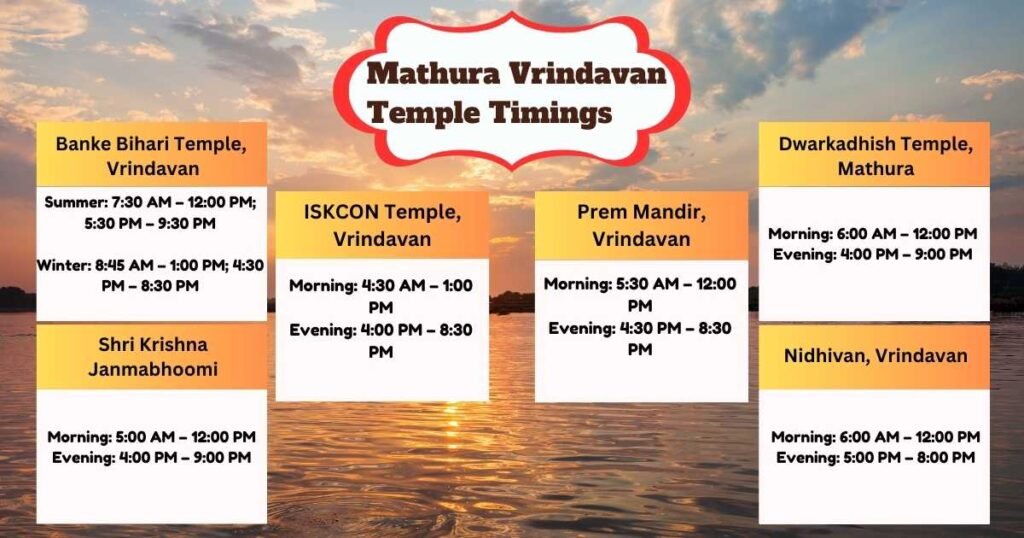
| Dwarkadhish Temple | 6:30 AM | 12:30-5:00 PM | 5:00 PM | 9:00 PM |
| Vishram Ghat (aarti) | All day | No break | Aarti 6:30 PM | All night |
| Banke Bihari (Vrindavan) | 7:45 AM (summer) | 12:00-5:30 PM | 5:30 PM | 9:30 PM |
| Mathura Museum | 10:30 AM | Closed Mon | — | 4:30 PM |
Entry Rules-Electronics Ban, Security Procedures and What to Carry
Krishna Janmasthan in Mathura has the most comprehensive security protocol of any temple in Braj-more thorough than most airports in terms of what is not allowed inside. Understanding this before you arrive is the single most time-saving piece of information in this guide.
Complete Electronics Ban-What Is Prohibited
| Item | Allowed? | Notes |
| Mobile phones (any type) | NOT ALLOWED | Must be deposited at the cloak room before entry. No exceptions. |
| Cameras (DSLR, compact, disposable) | NOT ALLOWED | Cloak room deposit required |
| Smartwatches (Apple Watch, Galaxy Watch etc.) | NOT ALLOWED | Often missed by first-time visitors-remove before the security gate |
| Bluetooth earbuds / wireless devices | NOT ALLOWED | Remove and deposit |
| Kindle / tablets | NOT ALLOWED | Any electronic reading device |
| Leather bags, belts, leather jackets | NOT ALLOWED | Standard for most Braj temples; wear non-leather belt on darshan days |
| Large backpacks | NOT ALLOWED | Small cloth bags are permitted |
| Cash, small cloth bag, water bottle | ALLOWED | Carry only essentials inside |
| Entry fee | Free | No ticket required at any point in the darshan |
The cloak room queue reality: The cloak room at Janmabhoomi is the most time-sensitive point in any Mathura visit. Between 8:00 AM and 11:00 AM on weekdays, the queue takes 15-20 minutes. On Saturdays and Sundays between 9:00 AM and 12:00 PM, the queue can take 35-50 minutes. On festival days, it can exceed 60 minutes. Arriving before 7:30 AM on weekdays means a 5-10 minute wait. Experience My India builds this buffer into every Janmabhoomi itinerary. The best strategy is to leave all electronics in the cab or hotel before setting out for the temple-not at the cloak room gate.
Security Checkpoints
The Janmabhoomi complex has multiple security checkpoints staffed by CRPF (Central Reserve Police Force) personnel. Bags are X-rayed, visitors are frisked and documentation is occasionally requested. Women and men are processed through separate security lines. The process typically takes 5-10 minutes if you arrive without electronics.
Krishna Janmashtami 2026-Official Dates, Tithi & Midnight Celebration Guide
Janmashtami is the most significant annual event at Krishna Janmasthan in Mathura-the 5,253rd birth anniversary of Lord Krishna. The 2026 celebration will be particularly significant. Here is the complete verified schedule:
| Event | Date & Time | Details |
| Ashtami Tithi Begins | Evening of 3 Sep 2026 | Tithi opens; fasting begins for many devotees |
| Krishna Janmashtami (Official-Smarta) | Friday, 4 Sep 2026 | Main festival day-5,253rd birth anniversary of Lord Krishna |
| Janmashtami Vrat (Fasting Day) | 4 Sep 2026 | Observed from sunrise through midnight puja |
| Nishita Kaal Puja (Midnight Puja) | 12:00 AM – 12:45 AM (night of 4-5 Sep) | Most auspicious 45-minute window; bells ring; abhishek, aarti, processions begin at Janmabhoomi |
| Krishna Birth Celebration (Janmotsav) | Midnight, 4 Sep 2026 | Prison cell shrine; conch shells; flower showers; Keshav Dev aarti |
| Ashtami Tithi Ends | Night of 4 Sep 2026 | Fasting period concludes for Smarta devotees |
| Parana (Breaking the Fast) | Morning of 5 Sep 2026 | After sunrise, once Ashtami Tithi and Rohini Nakshatra both conclude |
| Gokul Nandotsav | Saturday, 5 Sep 2026 | Celebration of Nanda’s joy; Dahi Handi; processions across Mathura |
| ISKCON / Vaishnava Janmashtami | Saturday, 5 Sep 2026 | Observed when Ashtami aligns with Rohini Nakshatra at sunrise |
What Happens at Janmabhoomi During Janmashtami?
Janmashtami at Krishna Janmasthan is unlike any other temple festival in India in its concentrated intensity. The Janmabhoomi area of Mathura sees 200,000-400,000 visitors over the two-day period. Here is what actually happens:
- The Garbha Grih darshan during the day of 4 September: Queue times reach 3-5 hours by mid-afternoon. Experience My India recommends arriving at the complex by 5:00 AM at the latest for a relatively manageable queue.
- The Nishita Kaal Puja (midnight of 4-5 September): This 45-minute window-from 12:00 AM to 12:45 AM-is the most auspicious period of Janmashtami. The prison cell shrine is at the centre of the celebration. Bells, conch shells, flower showers and a special abhishek (ritual bathing) of the deity mark the moment of Krishna’s birth. The atmosphere inside the Janmabhoomi complex at midnight during Janmashtami is one of the most intense devotional experiences available in India.
- Processions and illuminations: The entire Mathura city is decorated with lights; processions of the Janmashtami tableau move through the main streets. The Vishram Ghat area and the Holi Gate bazaar are both lit and active through the night.
- Practical note for Janmashtami visitors: Experience My India’s Janmashtami packages are planned 3-4 months in advance. Hotel availability in Mathura for 3-5 September 2026 is already tightening. Call +91-7302265809 now if you are planning a visit to the Janmashtami Tour Package.
Is It a Good Time to Visit During Janmashtami?
Spiritually, Janmashtami is the best possible time to visit Janmabhoomi-the energy of the entire city is concentrated on Krishna’s birth in a way that no regular day can replicate. Practically, it is the most demanding visit of the year. The queues are long, the heat in September is significant (32-36°C) and accommodation requires advance planning. Experience My India’s Janmashtami package includes all of this-accommodation secured 3 months ahead, a guide who manages the queue timing and an itinerary built around the midnight puja as the centrepiece.
Dwarkadhish Temple Mathura-The Natural Next Stop After Janmabhoomi
Once you exit the Janmabhoomi complex, the natural next stop is Dwarkadhish Temple-700 metres away on Vishram Ghat Road. These two temples together form the foundation of any Mathura darshan and they complement each other both devotionally and logistically.
Dwarkadhish Temple was built in 1814 CE by Seth Gokuldas Parikh of Gwalior. The temple is dedicated to Lord Krishna in his form as Dwarkadhish-the King of Dwarka, the city Krishna established after leaving Mathura. The architecture of Dwarkadhish is significantly more elaborate than Janmabhoomi’s current structure-the facade is covered in detailed carvings and the inner sanctum hall is unusually spacious.
Why visit Dwarkadhish after Janmabhoomi: The two temples represent different phases of Krishna’s story-Janmabhoomi is where his life in Mathura began, Dwarkadhish is the title he carries after it concluded. The evening aarti at Dwarkadhish (opens 5:00 PM, aarti approximately 5:30-6:00 PM) is one of the finest in Mathura-more focused and accessible than the Janmabhoomi evening session.
Timings: 6:30 AM – 12:30 PM and 5:00 PM – 9:00 PM. Entry: Free. Distance from Janmabhoomi: 700 metres. Distance from Vishram Ghat: 100 metres.
Experience My India’s Same Day Mathura Vrindavan Tour covers Janmabhoomi, Dwarkadhish and Vishram Ghat aarti in a single morning-to-evening sequence starting from ₹1,999 per person.
Ground Truth-What Nobody Tells You Before Visiting Janmabhoomi
These are the five realities that catch first-time visitors to Krishna Janmasthan off guard, based on 7 years of guiding 50,000+ pilgrims through this site:
- The electronics ban is stricter than most published guides state. ‘No cameras’ is what most articles say. The reality is: no mobile phones, no smartwatches, no Bluetooth earbuds, no tablets, no any electronic device whatsoever. Visitors who arrive with a smartwatch on their wrist have to go back to the cloak room, re-queue and re-enter.
- The ‘VIP darshan’ entrance exists but requires knowing where it is. There is a separate entrance on the left side of the main gate designated for special darshan-it is not advertised on the main gate signage. This queue is typically 30-40% shorter than the main general darshan queue on busy days. Experience My India’s guides use this entrance for every group.
- The afternoon closure starts at 12:00 PM sharp, but the evening reopening is 3:00 PM-2 hours earlier than most Vrindavan temples. This means the afternoon temple-closure gap at Janmabhoomi is shorter than elsewhere. Pilgrims who know this can build a tighter itinerary: museum from 10:30 AM to 12:00 PM, lunch and Gita Mandir 12:00-3:00 PM, return to Janmabhoomi for evening session at 3:00 PM. Most travel guides list Janmabhoomi’s evening opening as 4:00 PM-which is incorrect for the 2025 schedule.
- Janmashtami accommodation in Mathura books out by July for the 4-5 September 2026 dates. This is not an exaggeration-hotels within 2 km of Janmabhoomi are typically fully booked 8-10 weeks before Janmashtami. If you are reading this in July 2026 or later and have not yet booked accommodation for Janmashtami, call +91-7302265809 immediately. Experience My India keeps a block of rooms reserved for tour groups through the Janmashtami season.
Know Before You Plan-Janmabhoomi Visitor Checklist
- Leave all electronics-phones, smartwatches, cameras, earbuds-in your cab or hotel before approaching the Janmabhoomi gate. This eliminates the cloak room queue and the 10-15 minute delay it causes.
- Arrive before 7:30 AM on weekdays for a 5-10 minute cloak room queue. Arriving between 9:00 AM and 11:00 AM on weekdays means 20-30 minutes. Arriving on a Saturday morning means 35-50 minutes.
- Dress code: shoulders and knees covered, no leather items. Cotton kurta for men and salwar kameez for women is the recommended combination. Available outside the temple for ₹100-₂00.
- The Garbha Grih is inside the complex, not a separate building. Follow the darshan circuit through the Bhagavata Bhavan-the signs direct you to the prison cell shrine. Do not exit the complex before reaching the Garbha Grih. Many first-time visitors think the main hall is the full visit.
- Carry small denomination notes: ₹10, ₂0, ₅0 for shoe counter (₹5-₁0), e-rickshaws (₹20-₄0) and donations.
- The Keshav Dev Temple inside the complex and the Bhagavata Bhavan are both part of the Janmabhoomi darshan circuit. Budget 60-90 minutes for the full visit on a weekday morning.
- Photography is not permitted inside any part of the Janmabhoomi complex. Your phone is deposited at the cloak room, so this is automatic-but be aware even pointing a phone-shaped object will draw attention from security.
- For Janmashtami 2026 (4 September): arrive in Mathura by 4:00 AM if you want Garbha Grih darshan during the morning. The midnight puja (12:00-12:45 AM on 5 September) requires being inside the complex by 11:00 PM. Experience My India provides Janmashtami-specific logistics planning-call +91-7302265809.
- Combine with Dwarkadhish Temple and Vishram Ghat on the same day. The three sites form a natural half-day morning circuit within 1 km of each other.
How to Reach Krishna Janmasthan in Mathura
| From | Mode | Travel Time | Practical Detail |
| Delhi / NCR | Road (Yamuna Expressway) | 160 km · 2.5-3 hrs | AC cab from hotel, airport or station. Experience My India pickups from Noida, Gurgaon, Faridabad. +91-7302265809 |
| Delhi | Train (Vande Bharat / other) | 1.5-2.5 hrs | Mathura Junction on Delhi-Agra line. Vande Bharat fastest at 1.5 hrs from H. Nizamuddin. |
| Agra | Road | 65 km · 1.5 hrs | Mathura-Agra combo packages by Experience My India cover both cities |
| Lucknow | Road or Train | 480 km · 7-8 hrs | Experience My India’s Lucknow-Mathura Vrindavan package from ₹3,499. +91-7302265809 |
| Mumbai / Bangalore / Hyderabad | Fly to Delhi + road | Flight + 2.5 hrs | Delhi airport pickup direct to Mathura/Vrindavan by Experience My India |
Mathura Junction to Janmabhoomi: 2.5 km. E-rickshaw ₹20-₃0 (shared), auto ₹80-₁20 (private), cab ₹150-₂00. Travel time 15-25 minutes. The Janmabhoomi complex is in the Katra Keshav Dev area of old Mathura-ask any driver for ‘Janmabhoomi’ or ‘Katra’.
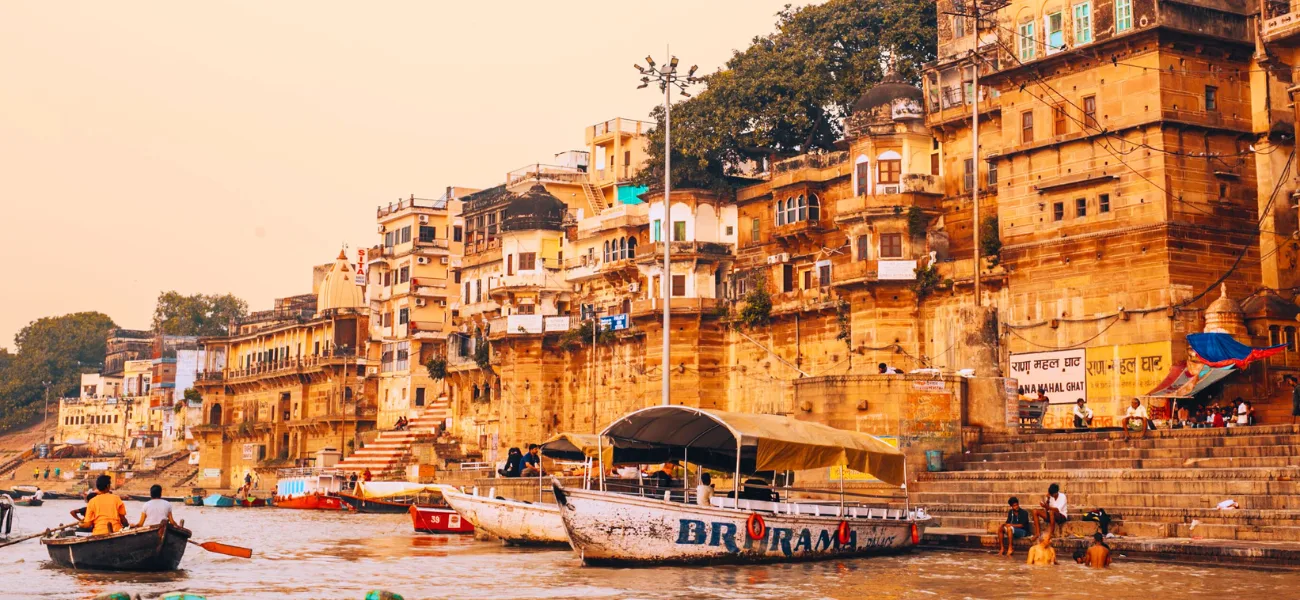
Walking from Vishram Ghat: 700 metres. 10-15 minutes on foot. Recommended for pilgrims who want to combine Vishram Ghat, Dwarkadhish and Janmabhoomi on foot.
Tour Packages by Experience My India-Including Janmabhoomi
All packages include AC cab, Braj-born local guide, real-time temple timing updates and hotel (multi-day). Rating: 4.5★ from 204+ pilgrims.
Same Day Mathura Vrindavan Tour-From ₹1,999 per person
Covers Janmabhoomi, Dwarkadhish, Vishram Ghat aarti, Banke Bihari (Vrindavan) and Prem Mandir in one guided day. Janmabhoomi is the morning centrepiece. Ideal for Delhi, Agra or one-day visitors.
2-Day Mathura Vrindavan Tour-From ₹3,499 per person
Day 1 covers Mathura in depth: Janmabhoomi, Dwarkadhish, Vishram Ghat, Gita Mandir and Mathura Museum. Day 2 covers all of Vrindavan including Nidhivan, ISKCON and Prem Mandir light show.
3-Day Mathura Vrindavan Govardhan Tour
Adds Govardhan Hill, Radha Kund and the Govardhan Parikrama to the 2-day circuit. Day 1 Mathura (Janmabhoomi as centrepiece), Day 2 Vrindavan, Day 3 Govardhan.
Janmashtami Special Package (4-5 September 2026)-Call for pricing
Experience My India’s Janmashtami package includes accommodation secured 3 months ahead, Janmabhoomi midnight puja access planning, Garbha Grih morning darshan sequencing and full 2-day Mathura Vrindavan coverage. WhatsApp +91-7302265809 immediately if your dates are 3-7 September 2026.
WhatsApp Experience My India at +91-7302265809-we reply within 30 minutes. Tell us your group size, dates and whether you want Janmashtami.
Frequently Asked Questions-Krishna Janmasthan in Mathura
Why was Krishna born in Mathura?
Krishna was born in Mathura because his parents, Devaki and Vasudeva, were imprisoned in the city by King Kansa-Devaki’s cousin. A divine prophecy warned Kansa that Devaki’s eighth child would cause his death, so he kept the couple under guard in his palace prison. Krishna-the eighth child-was born in that prison cell. The Garbha Grih at Krishna Janmasthan in Mathura marks the exact cell. Experience My India’s guided visits explain this story in full context.
What is the history of Krishna Janmasthan?
Krishna Janmasthan in Mathura has a 2,500+ year documented history. The site has had at least five major temple structures built upon it since the 4th-5th century CE. It was destroyed by Mahmud of Ghazni in 1017 CE, by Sikandar Lodi in 1500 CE and by Aurangzeb in 1669 CE, who built the Shahi Eidgah mosque on part of the grounds. The current complex was consecrated in 1982 and managed by the Shri Krishna Janmabhoomi Seva Sansthan. Experience My India covers this history on every guided visit.
What is the significance of Janmabhoomi in Hindu tradition?
Janmabhoomi-literally ‘birth land’-is considered among the most sacred categories of sacred site in Hinduism. The birthplace of a divine figure is not merely a memorial; it is understood as a location where the divine manifested into the physical world. In Krishna’s case, the prison cell is additionally significant because the birth took place in conditions of extreme vulnerability-divine power choosing to appear in a place of confinement and danger. Experience My India guides explain this theological context before every Garbha Grih darshan.
What are the Janmashtami 2026 dates?
Krishna Janmashtami 2026 official date is Friday, 4 September 2026-the 5,253rd birth anniversary. Ashtami Tithi begins on the evening of 3 September. The most auspicious period-the Nishita Kaal Puja-runs from 12:00 AM to 12:45 AM on the night of 4-5 September. ISKCON and Vaishnava Janmashtami falls on Saturday, 5 September 2026, when Ashtami aligns with Rohini Nakshatra at sunrise. Experience My India’s Janmashtami package covers both dates-call +91-7302265809.
Is it a good time to visit Vrindavan and Mathura during Janmashtami?
Spiritually, Janmashtami is the best time to visit-the Garbha Grih darshan during the midnight celebration is an experience that has no equivalent on any other day of the year. Practically, it requires significant advance preparation: hotel booking 8-10 weeks ahead, queue timing managed carefully and an itinerary built around the midnight puja. Experience My India handles all of this. Without a guide, Janmashtami in Mathura can be overwhelming. With one, it is the most complete Braj experience available. Call +91-7302265809 for Janmashtami 2026 packages.
What is the secret of Krishna’s birth?
The Srimad Bhagavatam describes several events at the moment of Krishna’s birth: the prison chains of Devaki and Vasudeva fell off spontaneously, the prison guards fell asleep and the locked prison doors opened on their own. Vasudeva then carried the newborn Krishna across the Yamuna river-which the text describes as parting to allow their passage-to the home of Nanda Maharaj in Gokul. Experience My India’s guides narrate this account in full detail during the Garbha Grih visit at Krishna Janmasthan in Mathura.
Who are the 8 wives of Krishna?
According to the Srimad Bhagavatam, Krishna’s eight principal wives-the Ashtabharyas-were Rukmini (his first and primary queen, daughter of Bhishmaka), Satyabhama, Jambavati, Nagnajiti, Kalindi, Mitravinda, Bhadra and Lakshmana. Rukmini was abducted from her own wedding at her request, when she sent Krishna a letter asking him to rescue her from a marriage arranged with Shishupala. The stories of these eight marriages are described in the Dashama Skandha of the Bhagavatam.
What are the entry rules for Krishna Janmabhoomi?
The entry rules at Krishna Janmabhoomi are strictly enforced. All electronics must be deposited at the cloak room before entry-this includes mobile phones, cameras, smartwatches and Bluetooth earbuds. Leather items (bags, belts) are not permitted. Large backpacks are not allowed. Dress code requires covered shoulders and knees. Entry is free. Security checkpoints with CRPF personnel process all visitors through X-ray and frisk. Experience My India briefs every pilgrim on these rules before the visit.
How much time is required for a complete Janmabhoomi darshan?
A complete Janmabhoomi darshan-cloak room, security, Bhagavata Bhavan, Garbha Grih (prison cell) and Keshav Dev Temple-takes 60-90 minutes on a weekday morning before 9:00 AM. On weekends, add 30-45 minutes for the cloak room queue. On Janmashtami, the full circuit can take 4-6 hours due to crowd volume. Experience My India’s guided visits are timed for the 60-minute window, then continue to Dwarkadhish and Vishram Ghat on the same morning block.
Visit Krishna Janmasthan with Experience My India
Krishna Janmasthan in Mathura is not just the most important temple in Braj-it is the starting point of Krishna’s entire story. The Garbha Grih, small and austere as it is, holds more concentrated devotional significance per square metre than almost any other physical location in India. Understanding its history-the centuries of destruction and reconstruction, the layered legal and religious complexity, the midnight celebration that has happened here every Janmashtami for thousands of years-transforms the visit from a queue-and-darshan exercise into something genuinely profound.
Experience My India’s guided Mathura tours are built around Janmabhoomi as the morning centrepiece. We manage the electronics logistics, the queue timing, the Garbha Grih approach and the natural continuation to Dwarkadhish and Vishram Ghat-so your attention is on the site itself, not on logistics.
|
Book Your Mathura Vrindavan Tour |
|
WhatsApp / Call: +91-7302265809 |
|
4.5★ / 204+ reviews · 50,000+ pilgrims since 2018 · Reply within 2 hours |
|
Mathura Vrindavan tour from ₹1,999 |
|
Explore all Mathura Vrindavan Tour Packages |
|
Jai Shri Krishna 🙏 |