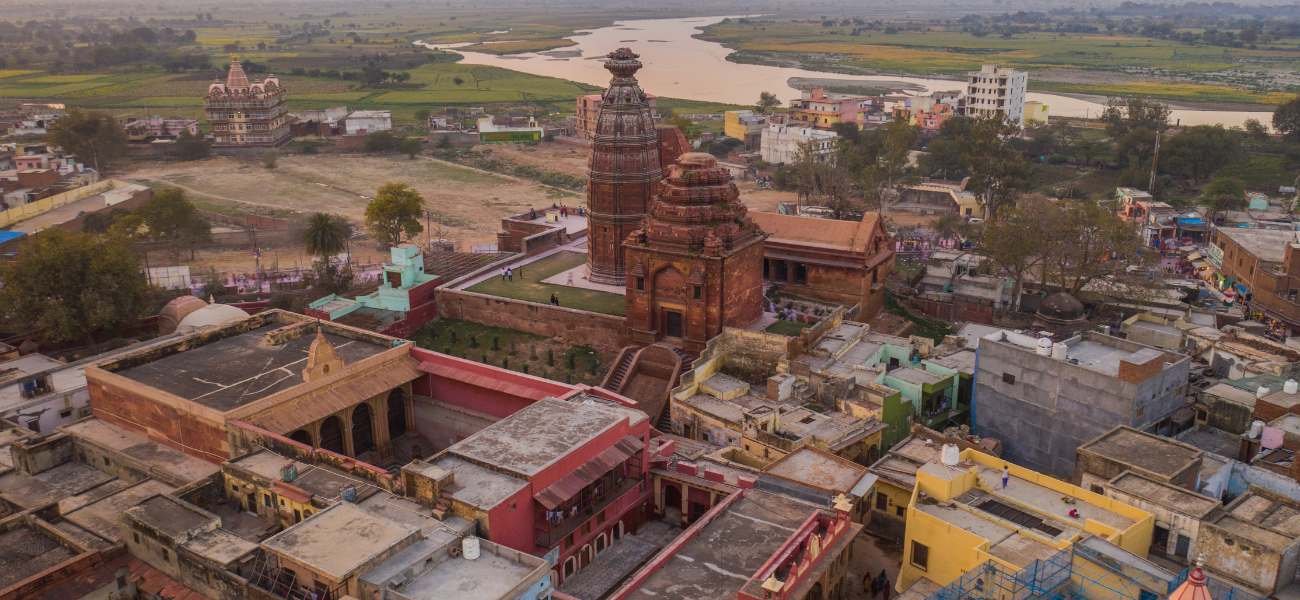




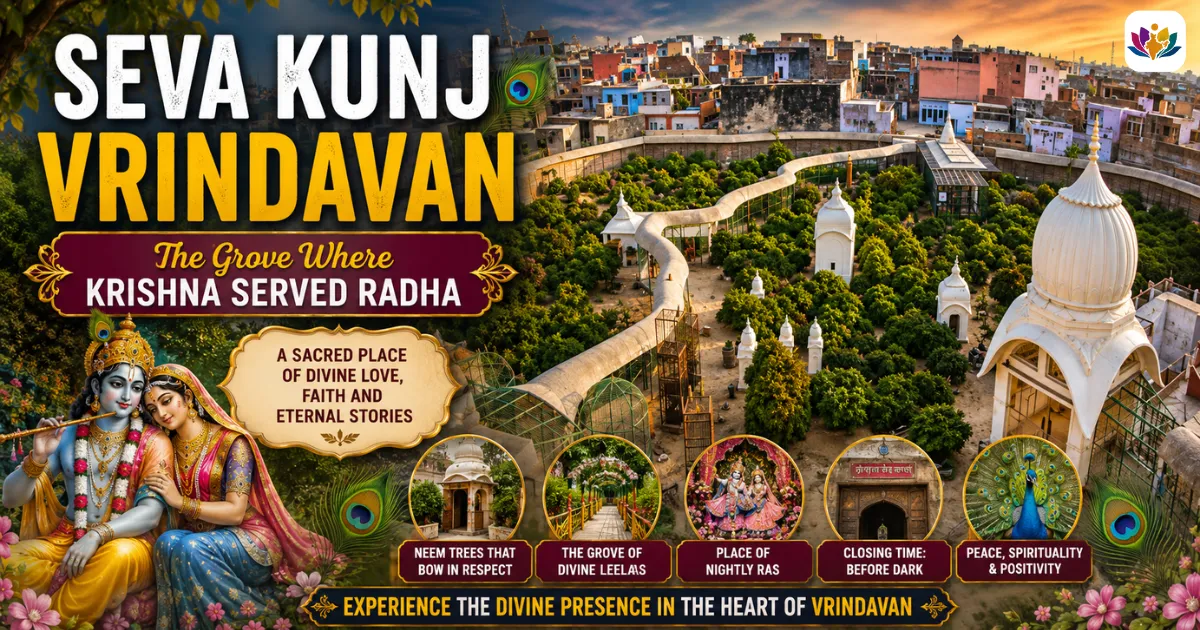
| Quick answer. Seva Kunj is a walled sacred grove in the heart of old Vrindavan, near Banke Bihari and Radha Vallabh temples. Its name means the Grove of Service, because tradition holds that here, after the Rasa Lila, Krishna personally served Radha, arranging her hair and tending her feet. Like the adjacent but separate Nidhivan, Seva Kunj closes strictly before sunset, because the Rasa Lila is believed to continue in the grove each night after all humans, even the priests, have left. Inside is the Rang Mahal, where Radha and Krishna are said to rest. Entry is free, photography is not allowed, and it takes about an hour to visit. Experience My India has guided 50,000 plus pilgrims since 2018, rated 4.5 stars. WhatsApp +91-7302265809. |
Introduction
Vrindavan is full of temples where thousands of devotees pour their love toward Krishna. Seva Kunj is different, and it is the difference that makes it unforgettable. This is the one place in Braj where the love flows the other way, where the Lord himself kneels to serve his beloved.
It is a small walled grove, dense with strange bent trees, tucked into the old lanes near Banke Bihari. By day it is quiet and green. By dusk it is sealed shut, because of a belief so old and so fiercely held that not even the priests will stay inside after dark.
I am Gurudutt. I was born in Braj Bhoomi and I have brought pilgrims to Seva Kunj since 2018. This guide tells you what the name really means, how it differs from the Nidhivan it is so often confused with, and why the gates close every single evening before the sun goes down.
For the temples all around it, our Vrindavan temple timings guide covers them, and the grove where Banke Bihari appeared is in our Banke Bihari temple guide.
Seva Kunj Timings
| Timing | |
| Morning opening | Around 6:00 to 7:00 AM |
| Closes strictly | Before sunset, every day |
| Reopens | The following morning |
| Time needed | About 45 minutes to 1 hour |
| Entry | Free, donations accepted |
The single most important thing about Seva Kunj timings is that it closes strictly before sunset and does not reopen until morning. This is not an ordinary temple schedule. The gates are shut firmly at dusk for a reason explained below, and once closed, no one is allowed in until the next day.
Because sunset shifts through the year, the exact closing time changes with the season, earlier in winter. Visit in the morning to be safe, and confirm the day’s timing before you go. Call +91-7302265809 and we will tell you the current hours.
The Meaning of the Name, the Grove of Service
Here is the fact that makes Seva Kunj unlike anywhere else in Vrindavan, and it is hidden in plain sight, in the name itself.
Seva Kunj means the Grove of Service. And the service it refers to is not the devotees’ service to God, which is what every other temple in Braj is about. It is Krishna’s service to Radha.
The tradition tells it beautifully. After the Rasa Lila, the great circular dance, Radha was tired. And Krishna, the Lord of all creation, personally attended to her: he arranged her hair, decorated it with flowers, applied alta, the red dye, to her feet, and tended to her with his own hands. He served her.
This is theologically extraordinary. Everywhere else, the devotee serves the Lord. Here, the Lord serves his devotee, because his love for Radha places her above even himself. That reversal is the whole meaning of Seva Kunj, and it is why, for those who understand it, this small grove holds a sweetness that the grandest temple cannot match.
Seva Kunj or Nidhivan, What Is the Difference
People confuse these two constantly, and it is worth clearing up, because they are next to each other and share the same night mystery.
| Seva Kunj | Nidhivan | |
| What it is | A walled grove of service | A larger sacred grove |
| Central story | Krishna served Radha here after the Rasa Lila | Where Banke Bihari appeared to Swami Haridas |
| Inner shrine | Rang Mahal | Rang Mahal, with the nightly bed |
| The mystery | Closes before dark, Rasa Lila continues at night | Closes before dark, Rasa Lila continues at night |
| Distinct? | Yes, a separate site | Yes, adjacent but separate |
They are two different places, adjacent to each other in old Vrindavan, and both close before nightfall for the same reason. The simplest way to remember it: Seva Kunj is about Krishna’s service to Radha; Nidhivan is where the Banke Bihari deity was found by Swami Haridas. Most visitors see both together, and a guide walks you from one to the other explaining which story belongs to which grove. The Nidhivan connection to Banke Bihari is in our Banke Bihari temple guide.
The Rang Mahal
At the heart of Seva Kunj stands the Rang Mahal, and it is the emotional centre of the grove.
The Rang Mahal is a small, decorated inner shrine where, tradition holds, Radha and Krishna rest after the Rasa Lila. Its walls are painted with scenes of their pastimes: Krishna combing and decorating Radha’s hair, Krishna tending her tired feet, the two of them playing Holi, Krishna enchanting her with the flute. Each painting is a moment of their divine love, and together they tell the story the grove is named for.
Like the Rang Mahal of Nidhivan, tradition holds that a bed is prepared here and found disturbed by morning, a sign to devotees of the divine presence through the night. It is a place people stand before quietly, because the air itself feels intimate.
Why It Closes Before Sunset
This is the question that draws most people to search for Seva Kunj, so let me answer it honestly and with respect.
Seva Kunj closes strictly before sunset every day, and is not reopened until morning. The reason, in the fiercely held belief of Braj, is that the Rasa Lila continues in the grove every night. After all humans leave, tradition holds that Radha, Krishna and the gopis return and the divine dance resumes, and no human being is permitted to witness it.
The closure is complete. The gates are shut, no electric lights are installed inside the grove, and even the resident priests leave the premises entirely before dark. Local belief holds that anyone who dared to hide and watch was struck blind or lost their power of speech, unable ever to describe what they saw.
I share this the way I would share any deeply held belief of my homeland: as the living faith it is, neither mocking it nor claiming to prove it. What is certainly, observably true is that the grove empties at dusk, that the closure has been kept without exception for centuries, and that standing at the gate as it is locked in the fading light is one of the most atmospheric moments in all of Vrindavan. Whatever you believe, treat the grove and its rule with complete respect.
The Trees That Are Said to Be Gopis
Seva Kunj is dense with unusual trees, and they are part of its mystery. Their branches grow in strangely intertwined patterns, bending low and twisting together in pairs to form natural canopies and archways, quite unlike ordinary garden trees.
Devotees believe these trees are the gopis themselves, in botanical form, and that each night, when the grove returns to its divine state, they resume their original forms as celestial maidens to join the eternal Rasa Lila. Whether one sees this as literal or as a beautiful poetry of faith, the trees really are remarkable to look at, hollow, twisted, ancient, growing as if reaching toward one another. Walking among them in the quiet morning, it is easy to feel why people have believed what they believe here for so long.
Lalita Kund and Imli Tala Nearby
Two more sacred spots sit right beside Seva Kunj and complete the visit.
Lalita Kund is a small sacred water pond near the grove. Tradition holds that Lalita, one of Radha’s closest sakhis, became thirsty during the Rasa Lila, and Krishna created this well by playing his flute, drawing water to quench her thirst. It is a lovely, quiet spot tied directly to the story of the grove.
Imli Tala, just north of Seva Kunj, holds an ancient tamarind tree said to date from the time of Krishna himself. The tradition is deeply moving: Krishna would sit beneath this tree, and in his ecstatic longing during separation from Radha, his dark body is said to have turned golden, the same golden hue that later appeared in Chaitanya Mahaprabhu. The tree stands in the courtyard of a Radha Krishna temple.
Both are within a short walk and are covered when we guide the old-town grove cluster.
The History of Seva Kunj
Seva Kunj is one of the ancient sacred groves of Vrindavan, tied to the Rasa Lila described in the tenth canto of the Srimad Bhagavatam, the scripture that records Krishna’s pastimes in Braj.
In the devotional revival of the 16th century, when the great saints rediscovered and re-established the sacred sites of Vrindavan, Seva Kunj was recognised and its worship formalised. It is closely associated with Swami Hit Harivansh, the founder of the Radha Vallabh tradition, whose own temple stands nearby, and whose Sampraday places exactly this kind of emphasis on Radha’s supremacy and Krishna’s loving service to her, the very theme the grove embodies.
So Seva Kunj is not a built monument with an architect and a date so much as a living sacred site, a place the tradition holds was always here, in the eternal Braj of Krishna’s play, and which devotion has tended and protected ever since. For the wider set of the town’s temples, see our places to visit in Mathura and Vrindavan guide.
How to Reach Seva Kunj
| From | Distance | Travel time |
| Banke Bihari Temple | Very close, a short walk | A few minutes |
| Radha Vallabh Temple | Adjacent | A minute |
| Radha Raman Temple | Nearby | A short walk |
| Vrindavan Railway Station | About 1 km | A few minutes |
| Mathura Junction | About 12 km | 30 to 40 minutes |
Seva Kunj sits in the heart of old Vrindavan, right among Banke Bihari, Radha Vallabh and Radha Raman, so it slots naturally into a walk through the old-town temples. As everywhere in this part of town, cars cannot reach it; you walk the lanes or take an e-rickshaw to the nearest point. From Mathura, the route is in our Mathura to Vrindavan distance guide, and it fits into the plan in our Vrindavan sightseeing guide.
The Best Time to Visit
| When | What it is like |
| Early morning | The best, cool, quiet, the grove at its most peaceful |
| Late afternoon before closing | Atmospheric, watch the strict dusk closure |
| Midday in summer | Avoid, hot and less pleasant |
| Festivals | Open as usual but more crowded |
Come early in the morning, ideally before the day heats up, when the grove is quiet and green and you can walk among the trees in peace. The other memorable time is the late afternoon, when you can be present as the gates are closed before sunset, which is genuinely moving. Avoid the summer midday. October to March is the best season overall, as our best time to visit guide explains.
Rules and Etiquette
Seva Kunj is one of the most sacred and intimate spots in Vrindavan, and it asks for real respect.
- Leave before the grove closes. Never attempt to stay after the dusk closure. This is the one rule that matters most, and it is non-negotiable.
- Photography is not allowed inside the sacred areas. Put your phone away.
- Dress modestly, with shoulders and knees covered.
- Keep silence and calm. This is a place of deep devotion, not a picnic garden.
- Do not disturb the trees or take anything from the grove.
- Watch for monkeys, which are active here as across old Vrindavan and can snatch phones and glasses.
Ground Truth, What Nobody Tells You
- The name means the Grove of Service, and the service is Krishna’s to Radha. This is the single most beautiful and most missed fact about the place. Everywhere else you serve God; here God serves his beloved.
- Seva Kunj and Nidhivan are two different places. Adjacent, sharing the same night mystery, but distinct. Seva Kunj is about the service; Nidhivan is where Banke Bihari appeared.
- It closes strictly before sunset, and that is the whole point. The Rasa Lila is believed to continue at night. Even priests leave. Come in the morning.
- The trees are the attraction, not a building. Twisted, paired, ancient. Believed to be gopis. Walk among them slowly.
- Lalita Kund and Imli Tala are right there. Do not miss the flute-made well and the tamarind tree where Krishna turned golden in longing.
- Photography is not allowed and monkeys are active. Keep your phone away for both reasons.
Know Before You Go
- Seva Kunj means the Grove of Service, where Krishna served Radha after the Rasa Lila.
- It closes strictly before sunset every day and reopens the next morning.
- It is a separate site from the adjacent Nidhivan, though they share the night mystery.
- The Rang Mahal inside is where Radha and Krishna are said to rest.
- Entry is free, photography is not allowed, and it takes about an hour.
- The trees grow in intertwined pairs, believed to be gopis.
- Lalita Kund and Imli Tala are a short walk away.
- It sits among Banke Bihari, Radha Vallabh and Radha Raman in the old town.
- Come early morning, and never try to stay after the dusk closure.
- For the neighbouring grove, see our Banke Bihari and Nidhivan connection.
Tour Packages by Experience My India
Seva Kunj is best understood with someone to tell you which story belongs to which grove, and we include it in the old-town cluster on every Vrindavan tour.
| Package | Price per person | Covers |
| Same Day Mathura Vrindavan Tour | From ₹1,999 | The old-town groves and temples |
| 2 Days Mathura Vrindavan Tour | ₹3,999 | Unhurried, with time to walk the grove |
| 3 Days Mathura Vrindavan Tour | ₹5,999 | Adds Govardhan and Barsana |
| 4 Days Mathura and Vrindavan Tour | ₹7,999 | Full circuit, senior friendly pacing |
Call or WhatsApp +91-7302265809.
Related Guides
- Banke Bihari Temple Vrindavan
- Radha Raman Temple Vrindavan
- Vrindavan Temple Timings 2026
- Keshi Ghat Vrindavan
- Vrindavan Sightseeing Guide
Frequently Asked Questions
What are the Seva Kunj timings?
Seva Kunj opens in the morning, around 6:00 to 7:00 AM, and closes strictly before sunset every day, reopening only the next morning. Because sunset shifts through the year, the exact closing time changes with the season, earlier in winter. Visiting takes about 45 minutes to an hour, and entry is free. The strict evening closure is central to the site, so come in the morning to be safe. Experience My India confirms the day’s timing. Call +91-7302265809.
What does Seva Kunj mean?
Seva Kunj means the Grove of Service. Uniquely among Vrindavan’s sacred sites, the service it refers to is Krishna’s service to Radha, not the devotees’ worship of Krishna. Tradition holds that after the Rasa Lila, Radha was tired, and Krishna personally arranged her hair, decorated it with flowers, applied alta to her feet and tended her with his own hands. This reversal, where the Lord serves his devotee, is the whole meaning of the grove. Experience My India guides explain it on site.
What is the difference between Seva Kunj and Nidhivan?
They are two different but adjacent sacred groves in old Vrindavan that share the same night mystery. Seva Kunj is the Grove of Service, where Krishna served Radha after the Rasa Lila, centred on the Rang Mahal. Nidhivan is the larger grove where the Banke Bihari deity appeared to Swami Haridas. Both close strictly before sunset because the Rasa Lila is believed to continue at night. Most visitors see both together. Experience My India guides which story belongs to which.
Why does Seva Kunj close before sunset?
Seva Kunj closes strictly before sunset because, in the fiercely held belief of Braj, the Rasa Lila continues in the grove every night after all humans leave, and no one is permitted to witness the divine dance. The closure is complete: the gates are shut, no lights are installed inside, and even the priests leave before dark. Local belief holds that those who dared to watch were struck blind or lost their speech. Experience My India shares this respectfully as living faith.
What is the Rang Mahal in Seva Kunj?
The Rang Mahal is the small decorated inner shrine at the heart of Seva Kunj, where tradition holds Radha and Krishna rest after the Rasa Lila. Its walls are painted with scenes of their pastimes, Krishna decorating Radha’s hair, tending her feet, playing Holi and enchanting her with the flute. Like Nidhivan’s Rang Mahal, a bed is said to be prepared and found disturbed by morning. Experience My India includes it on the grove visit. Call +91-7302265809.
Is photography allowed in Seva Kunj?
No, photography is not allowed inside the sacred areas of Seva Kunj, as the grove is considered extremely sacred. Please keep your phone away entirely. Modest dress, with shoulders and knees covered, is expected, and visitors should maintain silence and calm. Watch also for monkeys, which are active here and can snatch phones and glasses. Experience My India briefs every group on the etiquette before the visit. Call +91-7302265809.
Is there an entry fee for Seva Kunj?
No, there is no entry fee for Seva Kunj. It is a free sacred grove, though donations for its maintenance are accepted. Anyone charging you for entry is not official. The only rules are the strict evening closure, the ban on photography, and the expectation of modest dress and respectful conduct. Experience My India charges for transport, hotel and guiding, never for entry to sacred sites. Call +91-7302265809.
What are the trees in Seva Kunj?
The trees of Seva Kunj grow in unusual, intertwined pairs, bending low and twisting together into natural canopies quite unlike ordinary garden trees. Devotees believe these trees are the gopis themselves in botanical form, resuming their celestial forms each night to join the eternal Rasa Lila. Whether taken literally or as poetry of faith, they are genuinely remarkable to see. Walking among them in the quiet morning is the heart of the visit. Experience My India includes it.
What is Lalita Kund near Seva Kunj?
Lalita Kund is a small sacred water pond near Seva Kunj. Tradition holds that Lalita, one of Radha’s closest sakhis, became thirsty during the Rasa Lila, and Krishna created the well by playing his flute to quench her thirst. It is a quiet, lovely spot tied directly to the story of the grove, and it sits within a short walk. Nearby Imli Tala, with its ancient tamarind tree, completes the cluster. Experience My India covers all three. Call +91-7302265809.
How much time do I need for Seva Kunj?
About 45 minutes to an hour is enough to walk the grove, see the Rang Mahal, pause at the trees and visit the nearby Lalita Kund and Imli Tala. Because Seva Kunj sits right among Banke Bihari, Radha Vallabh and Radha Raman in the old town, it combines naturally with them into a morning of old-town darshan. Experience My India sequences the whole cluster efficiently on foot and by e-rickshaw. Call +91-7302265809.
Where is Seva Kunj located in Vrindavan?
Seva Kunj is in the heart of old Vrindavan, right among Banke Bihari, Radha Vallabh and Radha Raman temples, about 1 km from Vrindavan Railway Station and roughly 12 km from Mathura Junction. Like the whole old town, cars cannot reach it, so you walk the lanes or take an e-rickshaw to the nearest point. It combines naturally with the surrounding temples. Experience My India includes it in every Vrindavan itinerary. Call +91-7302265809.
Conclusion
Of all the sacred places in Vrindavan, Seva Kunj asks you to understand just one idea, and it changes everything: here, the Lord serves his devotee. In a small walled grove of twisted trees, Krishna knelt to tend Radha’s tired feet and decorate her hair, and the whole place is named for that act of love turned upside down.
Come in the quiet morning. Walk among the paired trees. Stand before the Rang Mahal. Visit the flute-made well and the golden tamarind tree. And leave, as everyone must, before the sun goes down, so that whatever happens in that grove at night can happen undisturbed.
Since 2018, Experience My India has brought more than 50,000 pilgrims to Seva Kunj and the groves around it, and we are rated 4.5 stars by the families who trusted us. We tell you which story belongs to which grove, so the darshan means something.
|
Book Your Mathura – Vrindavan Trip Today We Reply in 30 Minutes 📞 +91-7302265809 💬 WhatsApp: +91-7302265809 Packages start from ₹1,999/ person | Rated 4.5★ / 204+ Reviews Explore all: Vrindavan Mathura Tour Packages Jai Shri Krishna 🙏 |