



| Quick answer- Banke Bihari Temple is the most visited temple in Vrindavan, established in 1864 by the Goswami lineage of Swami Haridas. Summer timings are 7:45 AM to 12:00 PM and 5:30 PM to 9:30 PM. Winter timings are 8:45 AM to 1:00 PM and 4:30 PM to 8:30 PM. There is no Mangala Aarti, no bells and no conch, because Bihari Ji is allowed to rest like a child. Darshan is through jhanki, a curtain that opens and closes every few minutes. Entry is free, there is no official VIP pass, and photography inside is banned. Experience My India has guided 50,000 plus pilgrims since 2018, rated 4.5 stars. WhatsApp +91-7302265809. |
Table of Contents
ToggleIntroduction
There is a temple in Vrindavan with no bells. No conch. No grand morning aarti to wake the deity. Instead, a curtain opens for a few seconds, you see the face of Bihari Ji, and then it closes again, and in that brief glimpse people who have travelled a thousand kilometres often find they cannot speak.
This is Banke Bihari, the most beloved temple in Vrindavan, and it does everything differently from what you expect a great temple to do.
I am Gurudutt. I was born in Braj Bhoomi and I have brought pilgrims through these lanes to Bihari Ji since 2018. This guide is the complete one: the timings that catch so many people out, the jhanki tradition, the honest truth about VIP darshan, the history, and how to have the calmest, closest darshan of the most crowded temple in Braj.
For the other temples of the town, our Vrindavan temple timings guide covers them all, and the wider list is in our places to visit in Mathura and Vrindavan guide.
Banke Bihari Temple Timings 2026
| Session | Summer (March to October) | Winter (November to February) |
| Morning darshan | 7:45 AM to 12:00 PM | 8:45 AM to 1:00 PM |
| Evening darshan | 5:30 PM to 9:30 PM | 4:30 PM to 8:30 PM |
| Entry | Free | Free |
Read the winter row again, because it is the single most common mistake pilgrims make. Banke Bihari opens a full hour later in winter, at 8:45 AM instead of 7:45 AM, and closes a full hour earlier in the evening. A pilgrim who arrives at 7:45 AM in December stands at a locked gate for an hour. Almost every website quotes only the summer timing, which is why this catches so many people.
Timings also shift by 15 to 30 minutes on Ekadashi, Janmashtami, Radhashtami, Holi and other festival days, and crowd management schedules can change without much notice during Kartik month and around Holi. Always confirm on the morning of your visit. My team does this before every tour. Call +91-7302265809 on the day.
Why This Temple Is Unlike Any Other
Three things make Banke Bihari genuinely different from almost every other major temple in North India, and understanding them changes your whole visit.
No fixed morning wake-up ritual. Most temples perform a Mangala Aarti at dawn to wake the deity. Bihari Ji is allowed to rest, so the temple simply opens later in the morning.
No bells and no conch. Swami Haridas believed that loud, sudden sounds were not suitable for the peace of a child, so to this day there are no bells and no conch shells here. The worship is a soft devotional song instead.
No continuous darshan. Instead of an open view of the deity, a curtain opens and closes every few minutes. This is the jhanki tradition, and it is the whole experience.
These are not quirks. They are a 500 year old tradition, deliberately preserved by the Goswami family who have looked after Bihari Ji since 1864, and who have refused, right up to today, to install a public address system, to introduce paid darshan, or to ring bells.
The Jhanki Darshan Explained
If you understand one thing before you visit, make it this, because visitors who do not know the jhanki tradition are often confused at the gate.
Darshan at Banke Bihari happens through a parda, a curtain, in front of the deity, which opens for a brief moment every few minutes and then closes again. You do not get one long, continuous view. You get a series of short, precious glimpses.
There is a beautiful reason for this. The tradition holds that the charm in Bihari Ji’s eyes is so overwhelming, so full of divine love, that unbroken eye contact would completely overpower the devotee. The curtain protects you from being lost entirely. Devotees speak of the deity’s gaze meeting theirs in that brief opening, and it is why so many people are moved to tears in a darshan that lasts only seconds.
So do not be surprised or disappointed when the curtain closes. The opening and closing is not an interruption of the darshan. It is the darshan.
Why There Is No Mangala Aarti or Bells
People arrive at 5:00 AM expecting a dawn Mangala Aarti, as at other temples, and find the gates shut until 7:45 AM in summer or 8:45 AM in winter. Here is why.
Banke Bihari Ji is worshipped as a form of Krishna who spends his nights in the Rasa Lila, the divine dance. Waking him early with a loud Mangala Aarti would disturb his rest, so Swami Haridas established that the deity should be allowed to sleep and wake naturally, which is why the temple opens later than any other major shrine in Vrindavan.
The absence of bells follows the same logic. Sudden loud sounds are considered inappropriate for a resting child, so the temple has never had them. If you want a dawn aarti, ISKCON opens at 4:30 AM, as our Vrindavan temple timings guide explains. At Banke Bihari, the gentleness is the point.
The Aarti and Seva Schedule
Rather than one grand aarti, the temple observes seva and darshan at points throughout the day. The main ones are:
| Seva | When |
| Shringar Darshan | Morning, after opening, when the deity is dressed and adorned |
| Rajbhog | Around midday, before the morning session closes |
| Evening darshan and seva | Through the evening session |
| Shayan | Before the temple closes at night, when the deity is put to rest |
The Shringar in the morning, when Bihari Ji is freshly dressed and decorated, is the most beautiful time to have darshan. Arrive at the opening hour to see it before the heaviest crowds build.
The History and Swami Haridas
The story of Banke Bihari begins not with the temple but with a saint and a forest.
Swami Haridas was a saint-musician of the 16th century, so great a singer that he was the guru of Tansen, the legendary court musician of Akbar. He lived and sang in the sacred grove of Nidhivan, and it was there, according to temple tradition, that the deity of Banke Bihari appeared to him, drawn out of the earth by the power of his devotional song.
For a long time the deity was worshipped in Nidhivan. The present temple was built later, in 1864, to house Bihari Ji, and it has been cared for ever since by the Goswami descendants of Swami Haridas, the same family to this day.
This unbroken lineage is why the temple has kept its traditions so purely. The Goswamis have resisted every pressure to modernise the worship, to add bells, to install loudspeakers, or to sell priority darshan. The grove where it began, Nidhivan, is a short walk away and closes before dark, as our Vrindavan temple timings guide notes.
The Deity, and the Veiled Feet
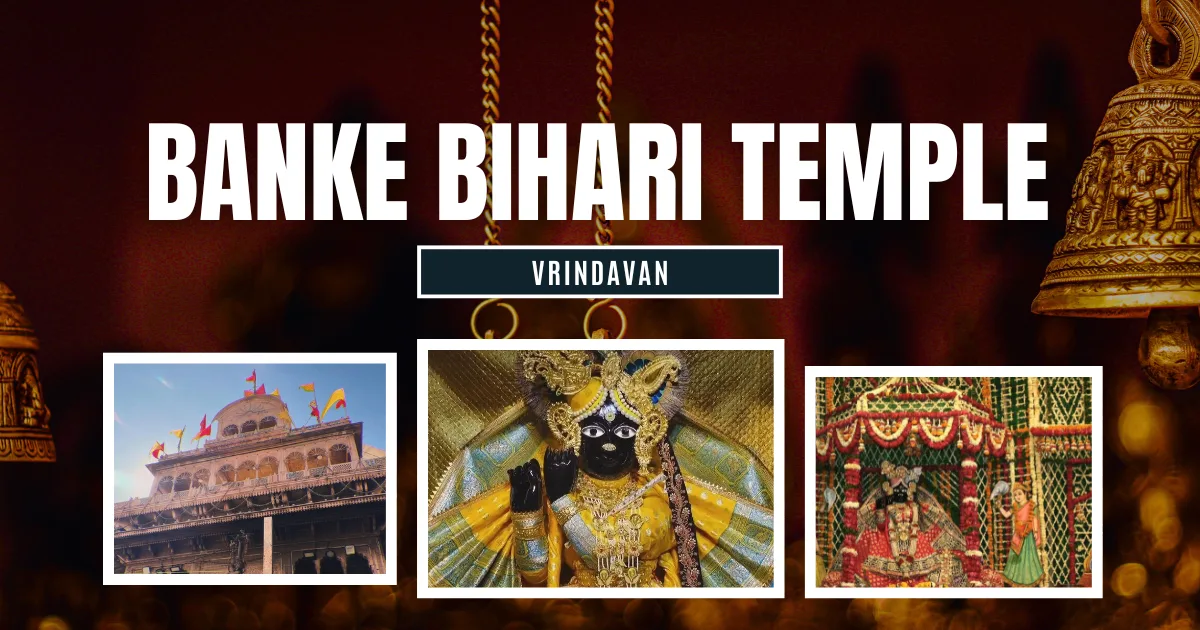
The deity of Banke Bihari is Krishna in the Tribhanga posture, the body curved gracefully in three places, which is considered one of the most beautiful forms of Krishna in all of Braj. The name itself tells you this: Banke means bent in three places, and Bihari means the enjoyer, the one who delights.
The idol is dark, a captivating black, and it is worshipped in a mood that combines Radha and Krishna together.
There is one detail that surprises everyone. The lotus feet of Banke Bihari Ji are kept permanently covered with a cloth. The tradition says that whenever devotees were allowed to glimpse the feet, they became so transfixed that they were unable to leave, so the feet are veiled and revealed only on rare, special occasions such as Akshaya Tritiya. It is one more way the temple guards the overwhelming intimacy of Bihari Ji’s darshan.
Entry Fee and the VIP Darshan Truth
Let me be completely direct, because this is where visitors are most often cheated.
Entry to Banke Bihari is free. There is no ticket, no entry charge, for anyone.
There is no official VIP darshan, no paid priority queue, and no online booking. As of 2026, the temple provides no online VIP pass, no premium darshan ticket, and no official booking portal. Darshan is walk-in only, the same traditional open-darshan system for everyone. The Goswami family who manage the temple have deliberately refused to introduce paid darshan.
So when someone in the lane offers to arrange VIP darshan, skip-the-queue access, or a special pass for a fee, they are selling you something that does not exist. During major festivals or specific temple-organised seva, a few special access slips are occasionally issued, but these are rare and are not a VIP pass you can buy on the street.
I want to be equally clear about ourselves. Experience My India does not sell VIP darshan of Banke Bihari, because it is not a real thing. What we do is time your visit to the opening hour on a weekday, brief you on the tradition, and manage the crowd and the lanes so your darshan is as calm and close as it can honestly be. The full picture is on our Banke Bihari darshan and passes page.
Dress Code and Photography Rules
Two rules are enforced at the gate, and it is worth knowing them before you arrive.
Dress code. Modest, traditional dress is expected, with shoulders and knees covered. Staff do turn away visitors in shorts or sleeveless clothing. If you forget, a kurta or dupatta can be bought for ₹100 to ₹300 in the lanes outside.
Photography. Photography and video inside the temple are prohibited and enforced, including phone cameras. Do not attempt it. Leave the phone in your bag or your pocket during darshan. This protects the sanctity of the space and, honestly, the memory is better without a lens in front of it.
The full set of rules, including seva and etiquette, is in our rules for Banke Bihari darshan guide.
The Best Time to Visit
| When | What it is like |
| Weekday morning, at opening | The best. Calmest, closest darshan, shortest queue |
| Weekend morning | Busy, arrive 30 to 40 minutes before opening |
| Evening session | Atmospheric but more crowded than a weekday morning |
| Ekadashi and festivals | Extremely crowded, timings shift, plan carefully |
The single best time is a weekday morning at the opening hour, 7:45 AM in summer or 8:45 AM in winter. The crowd is thinnest, the Shringar darshan is fresh, and you get the closest view. On weekends, arrive 30 to 40 minutes early because the lanes fill fast. Avoid the middle of festival days if a calm darshan matters to you.
How to Reach Banke Bihari Temple
| From | Distance | Travel time |
| Mathura Junction | About 11 km | 30 to 40 minutes |
| Vrindavan Railway Station | About 1 km | A few minutes |
| Prem Mandir | About 2 km | 10 to 15 minutes |
| ISKCON Vrindavan | About 2 km | 10 minutes |
| Radha Raman Temple | 300 metres | 5 minute walk |
The temple sits deep in the old town of Vrindavan, in the Bihari Pura area, and this is the important part: cars cannot reach the gate. The final approach is through narrow lanes on foot or by e-rickshaw, and you will be dropped a short distance away and walk the last stretch. This is normal for everyone, not just visitors.
From Mathura the route is covered in our Mathura to Vrindavan distance guide, and from further afield in our Delhi to Vrindavan guide.
Visiting With Elderly Parents
I will be honest, because this matters. Banke Bihari is the hardest of the major Vrindavan temples for an elderly or frail visitor. The lanes are narrow, cars cannot reach the gate, and the crowd pressure inside can be intense, especially at busy times.
But it can be done well with planning. Visit on a weekday at the opening hour, when the crowd is at its thinnest. Take an e-rickshaw to the closest possible drop point to minimise the walk. Keep a firm hand on elderly members inside, because the crush can move you. And if the crowd is genuinely too heavy on the day, the calmer temples like ISKCON, Prem Mandir and the Char Dham Temple are far gentler alternatives, as our Vrindavan temple timings guide explains.
When we bring senior pilgrims, we time Banke Bihari for the quietest hour and manage the lanes and the crowd for them. Tell us your family’s needs on +91-7302265809. The 4 Days Mathura and Vrindavan Tour is paced for exactly this.
Festival Days and Crowds
On Janmashtami, Radhashtami, Holi and Ekadashi, Banke Bihari becomes one of the most crowded places in India, and the experience changes completely.
Timings shift, the lanes are packed shoulder to shoulder, and darshan can take hours. Janmashtami in particular draws enormous crowds, and our Janmashtami 2026 guide explains what to expect. The Phoolon Wali Holi here, when priests shower devotees with flowers about a week before main Holi, is one of the loveliest and gentlest festival experiences, covered in our best time to visit guide.
If you are visiting for a festival, book months ahead and be prepared for crowds. If you want a calm darshan, avoid the festival peaks entirely and come on an ordinary weekday morning.
Ground Truth, What Nobody Tells You
- Winter opens an hour later. This is the number one mistake. 7:45 AM in summer, 8:45 AM in winter. Arrive at the wrong one and you wait an hour at a locked gate.
- There is no VIP darshan. Nobody can sell you one. It does not exist. Ignore every tout and every website offering paid or priority access to Bihari Ji.
- The jhanki curtain closing is not an interruption. It is the darshan. Do not be disappointed when it closes. That rhythm is the tradition.
- There is no Mangala Aarti, so do not come at 5:00 AM for one. The temple opens late by design, because Bihari Ji is resting. Go to ISKCON at 4:30 AM if you want a dawn aarti.
- Cars cannot reach the temple. You walk the last stretch through the lanes. Allow for it, especially with elders.
- Photography inside is banned and enforced. Leave the phone away. And watch the monkeys in these lanes, which target glasses and phones.
- Weekday morning at the opening is the calmest darshan. If a peaceful, close darshan matters to you, this is the single most useful piece of timing advice on this page.
Know Before You Go
- Summer timings are 7:45 AM to 12:00 PM and 5:30 PM to 9:30 PM.
- Winter timings are 8:45 AM to 1:00 PM and 4:30 PM to 8:30 PM. Opens an hour later than summer.
- Entry is completely free. There is no official VIP darshan or online booking.
- Darshan is through the jhanki curtain, which opens and closes every few minutes.
- There is no Mangala Aarti, no bells and no conch, by tradition.
- Photography inside is banned and enforced. Dress code is checked at the gate.
- Cars cannot reach the temple. You walk the last stretch through the lanes.
- The calmest darshan is a weekday morning at the opening hour.
- Timings shift on Ekadashi and festival days. Confirm before you travel.
- For the other temples, see our Vrindavan temple timings guide.
Tour Packages by Experience My India
Every package includes Banke Bihari, timed to the opening hour on a weekday for the calmest, closest darshan, with the lanes and crowd managed for you.
| Package | Price per person | Covers |
| Same Day Mathura Vrindavan Tour | From ₹1,999 | Banke Bihari and the main temples, both towns |
| 2 Days Mathura Vrindavan Tour | ₹3,999 | Unhurried darshan, morning Banke Bihari |
| 3 Days Mathura Vrindavan Tour | ₹5,999 | Adds Govardhan and Barsana |
| 4 Days Mathura and Vrindavan Tour | ₹7,999 | Full circuit, senior friendly pacing |
Call or WhatsApp +91-7302265809.
Related Guides
- Vrindavan Temple Timings 2026
- Rules for Banke Bihari Darshan
- Places to Visit in Mathura and Vrindavan
- Prem Mandir Timings
- Vrindavan Sightseeing Guide
Frequently Asked Questions
What are the Banke Bihari Temple timings?
Banke Bihari Temple in Vrindavan opens 7:45 AM to 12:00 PM and 5:30 PM to 9:30 PM in summer, March to October, and 8:45 AM to 1:00 PM and 4:30 PM to 8:30 PM in winter, November to February. It opens a full hour later in winter, which catches many pilgrims out. Entry is free. Timings shift on Ekadashi and festival days, so confirm before travelling. Experience My India plans darshan around these windows. Call +91-7302265809.
Why does Banke Bihari Temple have no Mangala Aarti?
Banke Bihari Ji is worshipped as a form of Krishna who spends his nights in the Rasa Lila, so he is allowed to rest and is not woken early with a loud Mangala Aarti, a tradition established by Swami Haridas. This is why the temple opens later than any other major Vrindavan temple, at 7:45 AM in summer and 8:45 AM in winter. There are also no bells or conch, as sudden sounds are considered unsuitable for a resting child.
What is jhanki darshan at Banke Bihari?
Jhanki darshan is the curtain-based darshan unique to Banke Bihari. A parda, or curtain, in front of the deity opens for a brief moment every few minutes, giving a momentary glimpse of Bihari Ji, then closes again. The tradition holds that the divine charm in the Lord’s eyes is so overwhelming that continuous eye contact would overpower the devotee, so the curtain protects them. The opening and closing is itself the darshan, not an interruption.
Is there an entry fee or VIP darshan at Banke Bihari Temple?
Entry to Banke Bihari Temple is completely free for everyone. As of 2026 there is no official VIP darshan, no paid priority queue, and no online booking system. Darshan is walk-in only, the same for all devotees, and the Goswami family who manage the temple have deliberately refused to introduce paid darshan. Anyone selling a VIP pass or skip-the-queue access on the street is not official. Experience My India never sells darshan access. Call +91-7302265809.
Can I take photos inside Banke Bihari Temple?
No. Photography and video inside Banke Bihari Temple are prohibited and enforced, including phone cameras. Please keep your phone away entirely during darshan. A dress code is also enforced at the gate, with shoulders and knees to be covered, and staff turn away visitors in shorts or sleeveless clothing. Experience My India briefs every group on the rules before the visit. Call +91-7302265809.
What is the history of Banke Bihari Temple?
The deity of Banke Bihari appeared to the 16th century saint-musician Swami Haridas, guru of the legendary singer Tansen, in the sacred grove of Nidhivan, drawn out by his devotional song. The present temple was built in 1864 to house Bihari Ji, and it has been cared for ever since by the Goswami descendants of Swami Haridas, who have preserved its unique traditions of no bells, no Mangala Aarti and jhanki darshan. Experience My India guides tell the full story on site.
What is special about the Banke Bihari deity?
The deity is Krishna in the Tribhanga posture, curved gracefully in three places, considered one of the most beautiful forms of Krishna in Braj. The name reflects this: Banke means bent in three places and Bihari means the enjoyer. The idol is a captivating black and combines Radha and Krishna. Its lotus feet are kept permanently veiled, because tradition says devotees who glimpsed them became unable to leave, transfixed by the divine love.
What is the best time to visit Banke Bihari Temple?
A weekday morning at the opening hour, 7:45 AM in summer or 8:45 AM in winter, is the best time, with the thinnest crowd, the fresh Shringar darshan and the closest view. On weekends, arrive 30 to 40 minutes before opening as the lanes fill fast. Avoid festival peaks like Janmashtami and Holi if you want a calm darshan. Experience My India times every visit for the quietest hour. Call +91-7302265809.
How do I reach Banke Bihari Temple?
Banke Bihari Temple is in the old town of Vrindavan, about 11 km from Mathura Junction and roughly 1 km from Vrindavan Railway Station. Cars cannot reach the temple gate, as it sits deep in narrow lanes, so you will be dropped nearby and walk or take an e-rickshaw for the last stretch. It is 300 metres from Radha Raman Temple. Experience My India arranges transport and manages the final approach. Call +91-7302265809.
Is Banke Bihari Temple suitable for elderly visitors?
It is the hardest major Vrindavan temple for frail visitors, with narrow lanes, no car access to the gate, and heavy crowd pressure inside. But it can be done well by visiting on a weekday at the opening hour, taking an e-rickshaw to the closest drop point, and keeping a firm hand on elderly members in the crowd. If the crowd is too heavy, ISKCON and Prem Mandir are gentler. Experience My India manages this for senior groups. Call +91-7302265809.
Does Banke Bihari Temple get crowded on festivals?
Yes, enormously. On Janmashtami, Radhashtami, Holi and Ekadashi it becomes one of the most crowded places in India, timings shift, and darshan can take hours. The Phoolon Wali Holi, when priests shower devotees with flowers about a week before main Holi, is a gentler and beautiful exception. If you want a calm darshan, avoid festival peaks and come on an ordinary weekday morning. Experience My India plans around the crowds. Call +91-7302265809.
Why are the feet of Banke Bihari always covered?
The lotus feet of Banke Bihari Ji are kept permanently veiled with a cloth because tradition holds that devotees who glimpsed the feet became so transfixed by divine love that they were unable to leave. The feet are revealed only on rare special occasions, such as Akshaya Tritiya. It is one of several ways the temple guards the overwhelming intimacy of Bihari Ji’s darshan, alongside the jhanki curtain that opens and closes every few minutes.
Conclusion
Banke Bihari is the most visited temple in Vrindavan, and yet it is the quietest in spirit: no bells, no conch, no grand aarti, just a curtain that opens for a moment on the most beautiful face in Braj, and then closes again.
Come on a weekday morning at the opening hour. Understand the jhanki before you arrive, so the closing curtain does not confuse you. Ignore anyone selling VIP darshan, because it does not exist. Cover your shoulders, leave your phone in your bag, and let those few seconds of darshan be what you travelled for.
Since 2018, Experience My India has brought more than 50,000 pilgrims to Bihari Ji, and we are rated 4.5 stars by the families who trusted us. We time the visit for the calmest hour and manage the lanes and the crowd, so all you do is stand before him.
|
Book Your Mathura – Vrindavan Trip Today We Reply in 30 Minutes 📞 +91-7302265809 💬 WhatsApp: +91-7302265809 Packages start from ₹1,999/ person | Rated 4.5★ / 204+ Reviews Explore all: Vrindavan Mathura Tour Packages Jai Shri Krishna 🙏 |