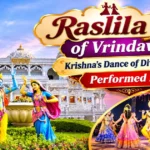
Quick answerRaslila is the dance of divine love, Krishna dancing with Radha and the gopis on the moonlit night of Sharad Purnima, as told in the Bhagavata Purana. In Vrindavan it lives on as a sacred dance-drama, the Braj Rasleela, begun as a staged tradition in the early 15th century at Vamshivat. It is traditionally performed by young boys who take the swarup, the sacred form, of Krishna, Radha and the gopis and who are honoured as the deities themselves while in costume. A performance has two parts: the formal nitya ras dance and a changing lila, a dramatised episode of Krishna’s life. Performances run nightly through the festival season, above all around Janmashtami. To plan a Vrindavan visit around the Raslila, call or WhatsApp +91-7302265809. |
Most travellers know Vrindavan for its temples, but there is another way Krishna’s story is kept alive here, not in stone but in living performance. For five centuries, troupes in Braj have staged the Raslila, the dance of divine love, with small boys dressed as Krishna and Radha whom the audience worships as the Lord himself. To sit before a Raslila on a festival night is to watch Vrindavan’s deepest stories come off the temple walls and move. Here, from a guide born in Braj, is the verified story, how it is staged and where to see it, with the key details in tables. Plan your visit with our Mathura Vrindavan tour package.
Key takeaways
- Raslila is Krishna’s dance of divine love with Radha and the gopis, from the Bhagavata Purana.
- The Braj Rasleela dance-drama began as a staged tradition in the early 15th century at Vamshivat, Vrindavan.
- It is traditionally performed by young boys who take the swarup of Krishna, Radha and the gopis.
- While in costume, the boy playing Krishna or Radha is honoured as the deity.
- A performance has two parts: the formal nitya ras dance and a changing lila episode.
- Over a hundred ras mandalis (troupes) keep the tradition, performing nightly in the season.
- It is seen most around Janmashtami, Sharad Purnima and in Kartik; entry is often free.
I am Gurudutt, born in Gokul in the Mathura district, guiding pilgrims through Braj since 2018, more than 50,000 of them. The Raslila is one of the experiences I most want travellers to catch, because it is Vrindavan’s faith made visible, so let me set out the story and where to see it, in tables.
Raslila at a glance
| Detail | Information |
| What it is | The dance of divine love of Krishna with Radha and the gopis |
| As a performance | The Braj Rasleela, a sacred dance-drama of Vrindavan |
| Meaning | Ras means nectar or sweetness, lila means play or dance |
| Began | Early 15th century, at Vamshivat, Vrindavan |
| Performers | Young boys taking the swarup of Krishna, Radha and the gopis |
| Two parts | Nitya ras (the formal dance) and lila (a changing episode) |
| Best season | Janmashtami, Sharad Purnima and Kartik |
| Entry | Often free at temples and ashrams |
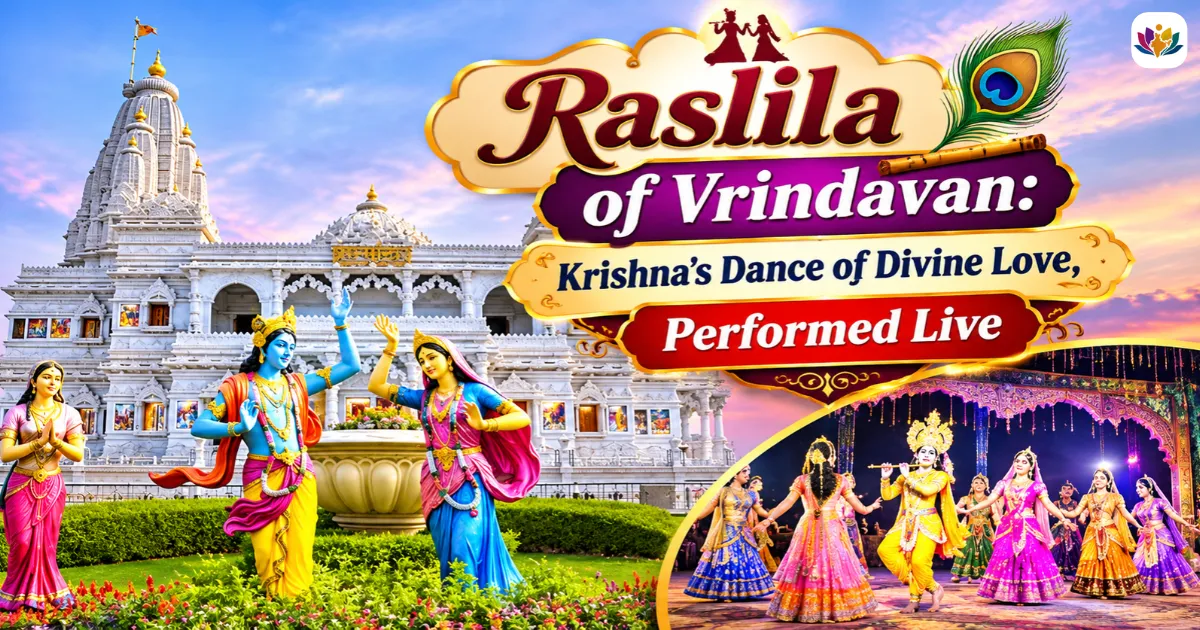
The story behind the Raslila
The Raslila comes from the most tender chapter of Krishna’s life. On the full-moon night of autumn, Sharad Purnima, Krishna played his flute in the forest of Vrindavan and the gopis, hearing it, left their homes and their duties and came to him. There, on the banks of the Yamuna, they danced. So that no gopi would feel apart from him, Krishna is said to have multiplied himself, taking a form beside each one and he stretched that single night to the length of an age. It is not a story of ordinary romance but of the soul’s longing for the divine, the highest love the scriptures know.
For devotees, Vrindavan is where this happened and, in a sense, still happens; the grove of Nidhivan is believed to host Krishna’s raslila every night even now. For the wider town and its mysteries, see our guide to why Vrindavan is famous.
How the Braj Rasleela is performed
What makes the Vrindavan Raslila so moving is who performs it and how. The staged tradition was begun in the early 15th century at Vamshivat in Vrindavan and grew through the 16th and 17th centuries with the Bhakti movement.
The performers are traditionally young boys, who take on the swarup, the sacred form, of Krishna, Radha and the gopis. Here is the heart of it: once a boy dresses and sits as Krishna or Radha, the audience sees the deity rather than a child actor and honours and garlands him as the Lord himself. The organisers carefully select and train these boys, while everyone treats the costumes, peacock crown and flute as sacred objects.
A full performance usually has two parts:
| Part | What it is |
| Nitya ras | The formal, unchanging dance of Krishna and the gopis in a circle, the devotional core |
| Lila | A dramatised episode from Krishna’s life that changes each time, such as the butter theft, Govardhan or a Radha-Krishna pastime |
The troupes that keep this alive are the ras mandalis and there are over a hundred of them touring Braj and beyond. Their gurus, the rasdharis, pass the roles and songs down through generations.
Takeaway: come to a Raslila ready to see worship, not theatre. The boy on the swing is Krishna to everyone around you and that shared seeing is the real experience.
Where and when to see Raslila in Vrindavan
Raslila is performed most through the festival season, when troupes stage it nightly in temples, ashrams, courtyards and decorated halls across Vrindavan and Mathura.
| To see Raslila | Note |
| Best season | Around Janmashtami (August to September), Sharad Purnima and Kartik |
| Venues | Temples, ashrams and halls; the ISKCON temple and others host performances |
| Nightly in season | Ras mandalis perform in the evenings during the festival weeks |
| Entry | Often free at temples; some staged shows may charge |
Because performances are spread across many venues and are not always advertised in English, this is one experience where knowing the right night and place matters. We keep track of who is performing where during the season.
The honest bit
Honest words from one born in Braj. The Raslila is a seasonal, living tradition, not a daily show with a box office. Outside the Janmashtami and Kartik seasons you may find few or no performances and even in season the venues and times shift from night to night, often announced only locally and in Hindi. If seeing a Raslila is important to you, plan your dates around the season and let someone local find you the right one.
Treat it as worship, because that is what it is. The audience honours the swarup boys as deities, so avoid pointing your feet at the stage or pushing forward to take photos. Always ask permission before filming, as some troupes prohibit it. A full Raslila can also run for two or three hours, and performers sing it in Braj Bhasha. Therefore, a little patience and a brief explanation beforehand can make all the difference.
Why Experience My India is the right choice
I was born in Gokul in the Mathura district, so I grew up with the ras mandalis and their gurus, not just the temples. Guiding since 2018, more than 50,000 pilgrims, 4.5 stars on Google, WhatsApp first, 8 AM to 9 PM daily. We can time your Vrindavan visit for the Raslila season, find which troupe is performing where on a given evening, explain the story so the Braj Bhasha does not leave you lost and seat your group comfortably for a performance that may run for hours. One clear fare and never a charge for free darshan.
Tip from Gurudutt: if the Raslila matters to you, come around Janmashtami or in Kartik and keep an evening free, since the best performances are at night. Ask us the day before which venue to head to, as it changes and eat early, because once the lila begins you will not want to leave.
Plan your Vrindavan visit
Tell me your dates and how you are arriving and I will build Vrindavan and a Raslila evening if your dates fall in the season, into your trip, for one clear price from ₹1,999 per person.
| Book Your Mathura – Vrindavan Trip Today
We Reply in 30 Minutes 📞 +91-7302265809 💬 WhatsApp: +91-7302265809 Packages start from ₹1,999/ person | Top Rated 4.5★ Explore all: Vrindavan Mathura Tour Packages Jai Shri Krishna 🙏 |
Frequently asked questions
What is the Raslila of Vrindavan?
Raslila is the dance of divine love of Krishna with Radha and the gopis, from the Bhagavata Purana. In Vrindavan it lives on as the Braj Rasleela, a sacred dance-drama begun in the early 15th century at Vamshivat, performed by young boys who take the swarup of Krishna, Radha and the gopis. It is seen most around Janmashtami. Experience My India can plan a visit to see it, call +91-7302265809.
What does Raslila mean?
Raslila joins ras, meaning nectar, sweetness or emotion and lila, meaning play or dance, so it is broadly the dance of divine love. It refers to Krishna’s moonlit dance with the gopis on Sharad Purnima, when he multiplied himself so each gopi felt him beside her, a symbol of the soul’s longing for the divine rather than ordinary romance.
Who performs the Raslila in Vrindavan?
The Braj Rasleela traditionally features young boys who take on the swarup, or sacred form, of Krishna, Radha and the gopis. Once they don their costumes, the audience honours them as the deities themselves. Ras mandalis perform these theatrical presentations under the guidance of gurus known as rasdharis, who pass down the roles and songs from generation to generation.
What are the two parts of a Raslila performance?
A full Raslila usually has two parts. The nitya ras is the formal, unchanging circle dance of Krishna and the gopis, the devotional core of the performance. The lila is a dramatised episode from Krishna’s life that changes each time, such as the butter theft, the lifting of Govardhan or a Radha-Krishna pastime. Experience My India can explain the story as you watch.
Where can I see Raslila in Vrindavan?
In the festival season, ras mandalis stage the Raslila nightly in temples, ashrams, courtyards and halls across Vrindavan and Mathura, with the ISKCON temple among the venues that host performances. The venues and times shift and are often announced only locally, so a local contact helps. Experience My India finds which troupe is performing where on a given evening, call +91-7302265809.
When is the best time to see Raslila?
Raslila is seen most around Janmashtami, in August or September, on Sharad Purnima and through the month of Kartik, when troupes perform nightly. Outside these seasons performances are few. If seeing a Raslila matters to you, plan your dates around the season. Experience My India can time your Braj trip for it.
Is there an entry fee for Raslila?
Many Raslila performances at temples and ashrams are free, offered as devotion, while some staged shows in halls may charge. It is a living religious tradition, not a ticketed tourist event, so treat it as worship. Experience My India can tell you which performances are free and which are ticketed and seat your group well, call +91-7302265809.
How long does a Raslila performance last?
A full Raslila can run for two to three hours, with the nitya ras followed by a longer dramatised lila, sung in Braj Bhasha. A little patience and a word of explanation beforehand make it far more rewarding. Eat before you go, as you will not want to leave once the lila begins. Experience My India explains the story so the language does not leave you lost.