
| Quick answer- Radha Raman Temple in Vrindavan enshrines a deity that is swayambhu, self-manifested from a shaligram shila in 1542, not carved by human hands. It was established by Gopala Bhatta Goswami, one of the six Goswamis of Vrindavan. It is the only one of the seven original Goswami deities that was never moved to Jaipur during Aurangzeb’s campaign, so it has been worshipped in the same place, unbroken, for nearly 485 years by the same family. There is no idol of Radha; her presence is shown by a crown placed beside the Lord. Entry is free. It sits near Keshi Ghat in old Vrindavan. Experience My India has guided 50,000 plus pilgrims since 2018, rated 4.5 stars. WhatsApp +91-7302265809. |
Introduction
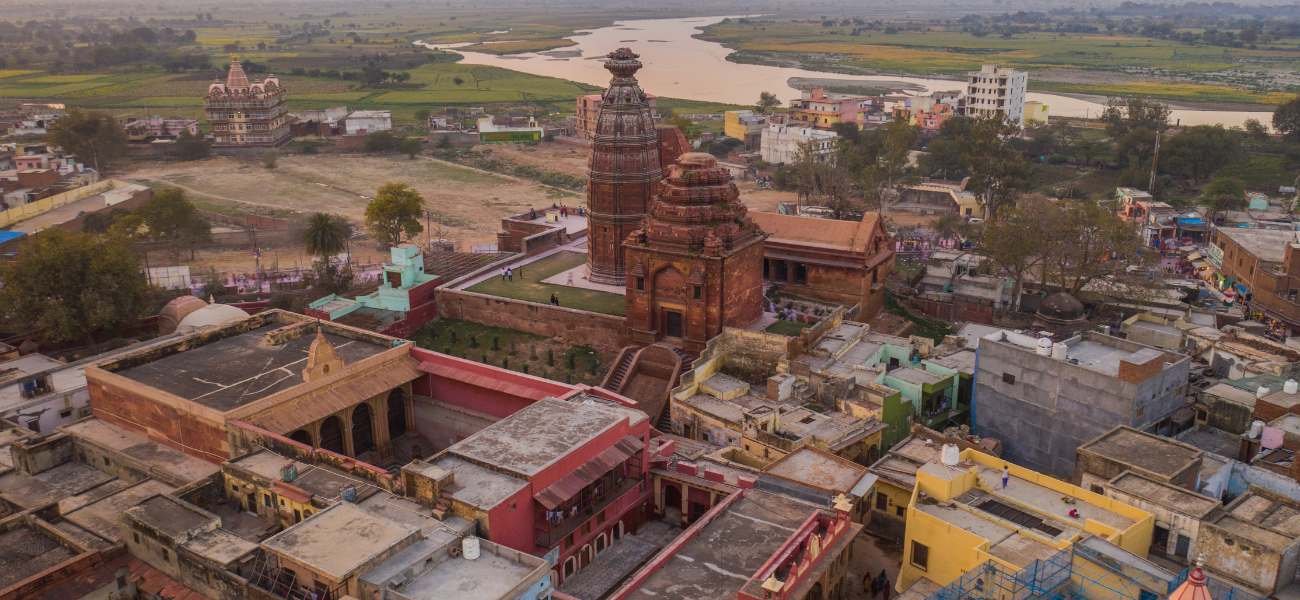
In the narrow lanes of old Vrindavan, not far from Keshi Ghat, there is a temple where the same fire has been tended and the same deity has been served, without a single break, since the year 1542. While emperors rose and fell, while other deities were carried hundreds of kilometres away to hide from Aurangzeb’s armies, this one deity never moved. It has been here the whole time.
That is Radha Raman, and it is, quietly, one of the most extraordinary temples in all of Braj.
I am Gurudutt. I was born in Braj Bhoomi and I have brought pilgrims to Radha Raman since 2018. This guide gives you the timings and the practical details, yes, but more than that it tells you what makes this temple genuinely unlike any other: a Lord who appeared on his own from a stone, a temple with no idol of Radha, and an unbroken thread of worship stretching back nearly five centuries.
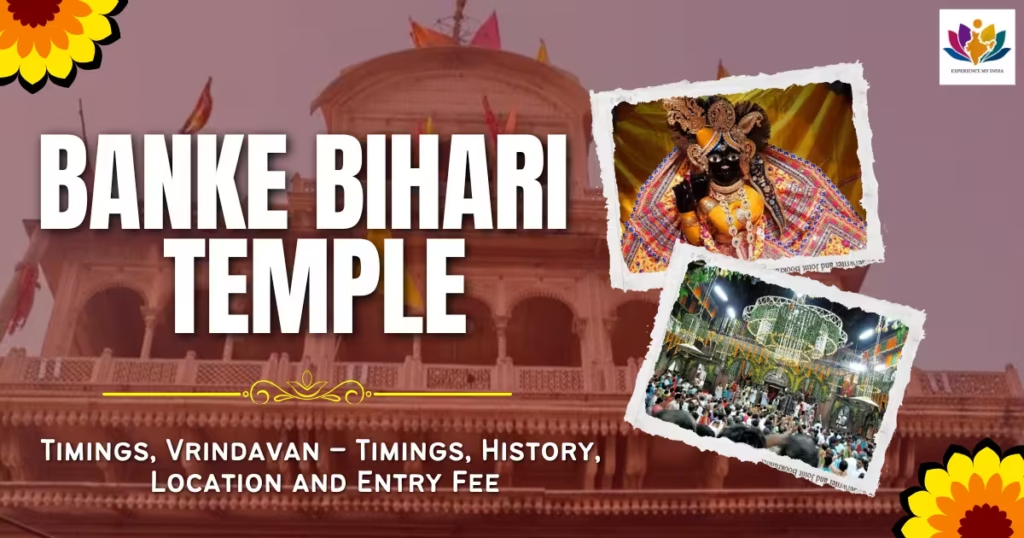
For the other great temples of the town, our Vrindavan temple timings guide covers them all, and the deity’s near neighbour is in our Banke Bihari temple guide.
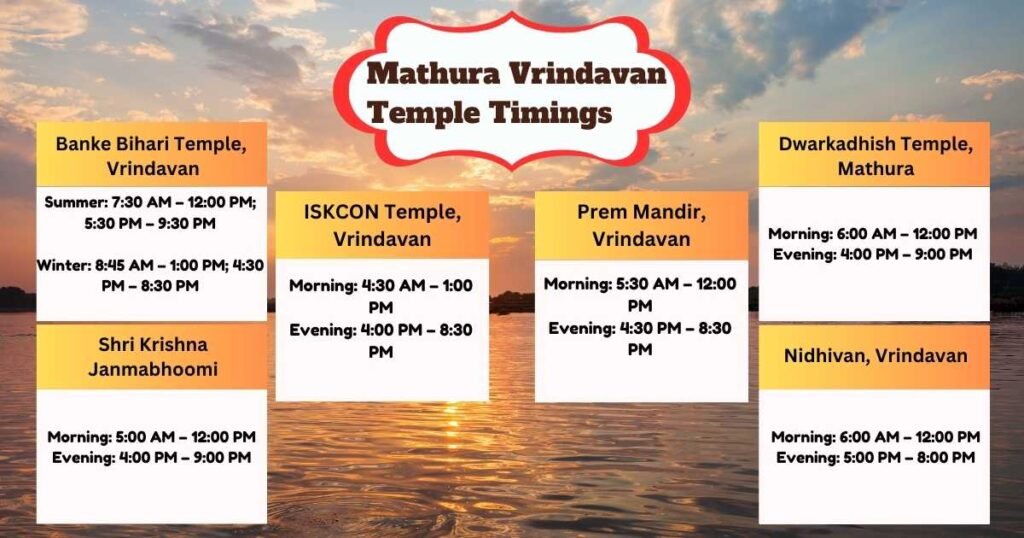
Radha Raman Temple Timings
| Session | Approximate timing |
| Early morning, Mangala Aarti | Around 4:00 to 5:00 AM |
| Morning darshan | Around 8:00 AM to 12:30 PM |
| Midday close | Around 12:30 to 6:00 PM |
| Evening darshan | Around 6:00 to 8:30 PM |
| Entry | Free |
The temple follows the traditional Ashtakala Seva, eight worship sessions through the day, so darshan opens and closes around these seva windows rather than staying open continuously. Timings shift with the season, opening and closing a little earlier in winter, and change on festival days.
Because the exact minutes vary by season and seva, confirm the day’s schedule before you visit. My team checks it before every tour. Call +91-7302265809 on the morning of your visit and we will give you the exact darshan and aarti times for that day. For how this fits with the other temples, see our Vrindavan temple timings guide.
The Deity That Never Left Vrindavan
This is the fact that sets Radha Raman apart from every other temple in Braj, and almost nobody tells it properly.
When Aurangzeb’s campaign threatened the great temples of Vrindavan in the 17th century, the deities of the other original temples were carried away to safety. Govind Dev Ji went to Jaipur, as our Govind Dev Ji temple guide explains. Madan Mohan and Gopinath were also moved. Their original deities never came back to Vrindavan.
Radha Raman alone stayed. The deity was never moved, never hidden away in another city, never replaced with a proxy. It has been worshipped in the very same spot, without a single break in the tradition, from 1542 to today. That is nearly 485 years of continuous, unbroken worship in one place.
And it is still served by the same family. The current priests are direct descendants of Gopala Bhatta Goswami, across more than sixteen generations. When you stand before Radha Raman, you are looking at an original Goswami deity in its original home, cared for by the bloodline that began its worship. There is almost nothing else like it in India.

The Self-Manifestation Story
The deity of Radha Raman was not carved. It appeared on its own, and the story of how is one of the most loved in Vrindavan.
Gopala Bhatta Goswami, one of the six Goswamis of Vrindavan and a close follower of Chaitanya Mahaprabhu, worshipped a set of shaligram shilas, sacred round black stones considered forms of the Lord. He had gathered twelve of them from the Kali-Gandaki river during a pilgrimage to Nepal.
One day, a wealthy devotee donated fine clothes and ornaments for the shilas. But shaligram stones are round, with no form to dress, so Gopala Bhatta felt a pang of longing: he wished he had a deity with hands and feet and a face that he could adorn and serve like the other Goswamis served theirs.
That night he performed his worship as always, covered the shilas with a wicker basket, and slept. When he uncovered them in the morning, one of the shilas, the Damodara shila, had transformed on its own into a beautiful three-bent form of Krishna, standing with a flute, smiling. On the back of the deity, the marks of the original shaligram stone can still be seen to this day.
This self-manifestation, swayambhu, is why Radha Raman is considered so sacred. The Lord was not made by an artist. He appeared, in answer to the pure longing of his devotee.
Why There Is No Idol of Radha
Visitors often notice something and ask about it, and it is worth explaining clearly because many people search for exactly this.
There is no separate idol of Radha in the Radha Raman temple. In a temple named for Radha’s beloved, this surprises people. The deity is Krishna alone, as Radha Raman, meaning the one who gives pleasure to Radha.
Radha’s presence is instead shown symbolically. A crown, or a flower garland, is placed beside the deity, on his left, to represent her. The tradition holds that Radha is present within Krishna himself, inseparable from him, so a full separate idol is not needed. The single crown beside him carries her whole presence.
For devotees, this is not an absence but a deeper truth: that Radha and Krishna are ultimately one. It is a quiet, beautiful piece of theology expressed in a single crown.
The Mystic Smile That Devotees Say Changes
People search for the Radha Raman face change and smile change, so let me address it honestly, as the living belief it is.
Devotees who spend time before the deity often describe his smile as seeming to change through the day and through the different aartis, gentle at one moment, radiant at another, almost playful at a third. Many long-time visitors speak of feeling that the expression shifts as they watch.
I share this the way I would share any deeply held devotional experience: with respect, and without either mocking it or claiming to prove it. What is certainly true is that the deity’s face carries a famously beautiful, subtle smile, and that the changing light of the lamps through the eight daily sevas plays across it in ways that move people profoundly. Whether one reads that as divine or as the play of light and devotion, the effect on those who stand there is real. Come and watch for yourself, quietly, and let it be what it is for you.
The Ashtakala Seva, Eight Daily Worships
Radha Raman is served according to the Ashtakala Seva, the system of eight daily worship periods that mark the deity’s day from waking to rest, just as one would care for a living beloved.
| Seva | Roughly |
| Mangala | Pre-dawn waking |
| Shringar | Morning dressing and adornment |
| Rajbhog | Midday offering |
| Through the day | Further sevas |
| Sandhya | Evening |
| Shayan | Night rest |
The standard of worship here is considered among the very highest in Vrindavan. The deity is bathed, dressed, fed, fanned and rested through the day with meticulous devotion, following rituals unbroken for centuries. This is part of why darshan opens and closes at intervals rather than staying continuously open, because the deity is being personally served between the public viewings.
The Aarti Schedule
The aartis at Radha Raman are among the most beautiful in Vrindavan, and unlike Banke Bihari, this temple does use bells and conches in its worship.
| Aarti | Roughly |
| Mangala Aarti | Pre-dawn, around 4:00 to 5:00 AM |
| Shringar Aarti | Morning, after dressing |
| Rajbhog Aarti | Around midday |
| Sandhya Aarti | Evening |
| Shayan Aarti | Before the deity rests at night |
The Mangala Aarti at dawn is the most atmospheric, when the temple is quiet and the day’s worship begins. The exact times shift with the season, so confirm on the day. Our best time to visit guide covers the wider festival calendar, and the temple’s grandest day is Vaishakha Purnima, its appearance anniversary, when the deity is bathed in milk and offerings in a great abhishek.
The Relic of Chaitanya Mahaprabhu
The temple holds a treasure that few visitors realise is there. Preserved within the complex is a garment said to have belonged to Chaitanya Mahaprabhu himself, the great 16th century saint whose movement inspired the six Goswamis and the whole devotional flowering of Vrindavan.
This relic, kept and shown on rare occasions, is an extraordinary physical link to the very source of the Gaudiya Vaishnava tradition. The complex also holds relics of Gopala Bhatta Goswami, and his samadhi stands beside the appearance of the deity, so the founder rests eternally next to the Lord who appeared to him. For the tradition’s living voice today, our Premanand Ji Maharaj guide covers a revered contemporary saint of Braj.
One of the Seven Original Temples of Vrindavan
Radha Raman is one of the Sapta Devalaya, the seven principal temples established by the Goswamis of Vrindavan in the 16th century under the inspiration of Chaitanya Mahaprabhu. Together they form the sacred devotional heart of the town.
| The seven original temples | Deity |
| Radha Raman | Self-manifested, never moved |
| Govind Dev Ji | Original deity now in Jaipur |
| Madan Mohan | Original deity now in Karauli |
| Gopinath | Original deity now in Jaipur |
| Radha Damodar | Served in Vrindavan |
| Radha Shyamsundar | Served in Vrindavan |
| Radha Gokulananda | Served in Vrindavan |
Of these seven, Radha Raman holds the unique distinction of the original deity remaining in its original place, continuously worshipped. This is what makes it, for many devotees, the most precious darshan in all of Vrindavan. The story of the deity that did leave is in our Govind Dev Ji temple guide.
How to Reach Radha Raman Temple
| From | Distance | Travel time |
| Banke Bihari Temple | About 300 metres | 5 minute walk |
| Keshi Ghat | About 500 metres | A short walk |
| Vrindavan Railway Station | About 1 km | A few minutes |
| Mathura Junction | About 11 to 12 km | 30 to 40 minutes |
Radha Raman sits in the heart of old Vrindavan, in the Keshi Ghat area, extremely close to Banke Bihari and Radha Raman Ghat. Like the other old town temples, the final approach is through narrow lanes where cars cannot go, so you will walk the last stretch or take an e-rickshaw to the nearest drop point. The address is Panchayat Mandir Shri Radharaman Ji Maharaj, Vrindavan, 281121.
Its closeness to Banke Bihari means the two are almost always visited together, along with Keshi Ghat and the evening Yamuna Aarti. From Mathura, the route is in our Mathura to Vrindavan distance guide.
The Best Time to Visit
| When | What it is like |
| Mangala Aarti, pre-dawn | The most beautiful and intimate, very few people |
| Weekday morning | Calm, unhurried darshan |
| Weekend and festivals | Busier, though never as crushed as Banke Bihari |
| Vaishakha Purnima | The appearance anniversary, the grandest day, very crowded |
The pre-dawn Mangala Aarti is the connoisseur’s choice, quiet and deeply moving. A weekday morning is the easiest calm darshan. Radha Raman is generally less overwhelming than Banke Bihari even at busy times, which makes it one of the more peaceful major darshans in Vrindavan. October to March is the best season overall, as our best time to visit guide explains.
Visiting With Elderly Parents
Radha Raman is more manageable for elderly visitors than Banke Bihari, though it shares the same old-town challenge of narrow approach lanes.
The temple itself is calmer and less crushed, so once inside, an elderly pilgrim can have a peaceful darshan. The difficulty is the walk in through the lanes, where cars cannot reach. We take senior pilgrims by e-rickshaw to the closest possible point, time the visit for a quiet hour, and keep the walking to a minimum.
Tell us your family’s needs on +91-7302265809 and we plan the old-town temples around the oldest traveller. The 4 Days Mathura and Vrindavan Tour is paced with exactly this in mind.
Ground Truth, What Nobody Tells You
- This deity never left Vrindavan, and that is unique. Of the seven original temples, only Radha Raman’s deity was never moved to escape Aurangzeb. Nearly 485 years of unbroken worship in one spot. Nothing else in Braj matches it.
- The deity appeared on its own. It was not carved. It self-manifested from a shaligram stone, and the marks of that stone are still visible on its back.
- There is no idol of Radha, and that is deliberate. A crown beside the Lord carries her presence, expressing that Radha and Krishna are one.
- It is calmer than Banke Bihari. A few hundred metres away but far more peaceful. If the Banke Bihari crush is too much, this is the darshan to prioritise.
- Come for the Mangala Aarti. The pre-dawn worship is the most beautiful thing here, and almost nobody tells visitors to come that early.
- The same family has served it for 16 generations. The priests are direct descendants of Gopala Bhatta Goswami. You are witnessing a living, unbroken lineage.
Know Before You Go
- The deity is self-manifested from a shaligram shila in 1542, not carved.
- It is the only one of the seven original Vrindavan deities never moved to Jaipur.
- There is no idol of Radha; a crown beside the Lord represents her.
- Entry is free. The temple follows Ashtakala Seva, eight daily worships.
- Timings shift by season and seva. Confirm on the day.
- The pre-dawn Mangala Aarti is the most beautiful darshan.
- It is about 300 metres from Banke Bihari, calmer and less crowded.
- Cars cannot reach the gate; you walk the last lanes.
- Vaishakha Purnima is the appearance anniversary and the grandest day.
- For the neighbouring temple, see our Banke Bihari guide.
Tour Packages by Experience My India
Radha Raman fits naturally with Banke Bihari and Keshi Ghat in the old-town cluster, and we include it in every Vrindavan itinerary.
| Package | Price per person | Covers |
| Same Day Mathura Vrindavan Tour | From ₹1,999 | The main temples including Radha Raman |
| 2 Days Mathura Vrindavan Tour | ₹3,999 | Unhurried, with the Mangala Aarti |
| 3 Days Mathura Vrindavan Tour | ₹5,999 | Adds Govardhan and Barsana |
| 4 Days Mathura and Vrindavan Tour | ₹7,999 | Full circuit, senior friendly pacing |
Call or WhatsApp +91-7302265809.
Related Guides
- Banke Bihari Temple Vrindavan
- Govind Dev Ji Temple Vrindavan
- Vrindavan Temple Timings 2026
- Keshi Ghat Vrindavan
- Places to Visit in Mathura and Vrindavan
Frequently Asked Questions
What are the Radha Raman Temple timings?
Radha Raman Temple follows the Ashtakala Seva, eight daily worship sessions, so darshan opens and closes around these windows. The pre-dawn Mangala Aarti is around 4:00 to 5:00 AM, morning darshan roughly 8:00 AM to 12:30 PM, and evening darshan around 6:00 to 8:30 PM, with the temple closed through midday. Timings shift by season and festival, so confirm on the day. Entry is free. Experience My India checks the schedule before every tour. Call +91-7302265809.
Why is there no idol of Radha in the Radha Raman Temple?
There is no separate idol of Radha because the tradition holds that Radha is present within Krishna himself, inseparable from him. Instead of a full idol, a crown or flower garland is placed beside the deity, on his left, to represent her eternal presence. In a temple named Radha Raman, meaning the one who gives pleasure to Radha, this expresses the deep truth that Radha and Krishna are ultimately one. Experience My India guides explain this on the visit.
What is special about the Radha Raman deity?
The Radha Raman deity is swayambhu, self-manifested, meaning it appeared on its own from a shaligram shila in 1542 rather than being carved by human hands. The marks of the original stone can still be seen on its back. It is also the only one of Vrindavan’s seven original Goswami deities that was never moved to Jaipur to escape Aurangzeb, so it has been worshipped in the same place, unbroken, for nearly 485 years. Experience My India includes it in every Vrindavan tour.
Who established the Radha Raman Temple?
Radha Raman Temple was established by Gopala Bhatta Goswami, one of the six Goswamis of Vrindavan and a close follower of Chaitanya Mahaprabhu, when the deity self-manifested from one of his shaligram shilas in 1542. His samadhi stands within the temple complex, beside the deity’s appearance place, and the temple is still served today by his direct descendants across more than sixteen generations. Experience My India guides tell the full story on site. Call +91-7302265809.
Is the Radha Raman deity really self-manifested?
According to tradition, yes. Gopala Bhatta Goswami longed for a deity with a form he could dress and serve, as his shaligram shilas were round stones. One morning, one of the shilas, the Damodara shila, had transformed on its own into the beautiful form of Krishna as Radha Raman. The marks of the original shaligram stone are still visible on the deity’s back, which devotees see as evidence of the self-manifestation. Experience My India shares this story with every group.
What is the story of the Radha Raman smile changing?
Devotees often describe the deity’s famous subtle smile as seeming to shift through the day and the different aartis, gentle at one moment, radiant at another. This is a deeply held devotional experience, shared here with respect rather than as a claim of proof. What is certain is that the deity’s face carries a beautiful smile, and the changing lamplight through the eight daily sevas plays across it in ways that move people profoundly. Come and watch quietly for yourself.
Is there an entry fee at Radha Raman Temple?
No. Entry to Radha Raman Temple is completely free, with no ticket, no donation counter and no paid VIP darshan. The temple is managed by the Goswami descendants of Gopala Bhatta Goswami and follows the traditional system of open public worship unbroken since 1542. Anyone charging you for entry or priority darshan is not official. Experience My India charges for transport, hotel and guiding, never for darshan. Call +91-7302265809.
How far is Radha Raman Temple from Banke Bihari?
Radha Raman Temple is only about 300 metres from Banke Bihari Temple, roughly a five minute walk through the old-town lanes, so the two are almost always visited together, along with nearby Keshi Ghat. Like Banke Bihari, cars cannot reach the gate, so you walk the last stretch or take an e-rickshaw to the closest point. Experience My India sequences the old-town temples together efficiently. Call +91-7302265809.
Which is the best aarti to attend at Radha Raman Temple?
The pre-dawn Mangala Aarti, around 4:00 to 5:00 AM, is the most beautiful and intimate, when the temple is quiet and the day’s worship begins. Unlike Banke Bihari, Radha Raman uses bells and conch in its worship, so the aarti is rich and traditional. The exact times shift by season, so confirm on the day. Experience My India can arrange an early start for the Mangala Aarti. Call +91-7302265809.
What relics are kept at Radha Raman Temple?
The temple preserves a garment said to have belonged to Chaitanya Mahaprabhu himself, the 16th century saint who inspired the six Goswamis, an extraordinary link to the source of the Gaudiya Vaishnava tradition, shown on rare occasions. The complex also holds relics of Gopala Bhatta Goswami and his samadhi, which stands beside the deity’s appearance place. Experience My India guides point these out on the visit. Call +91-7302265809.
Is Radha Raman Temple one of the seven temples of Vrindavan?
Yes. Radha Raman is one of the Sapta Devalaya, the seven principal temples established by the Goswamis of Vrindavan in the 16th century under Chaitanya Mahaprabhu’s inspiration. The others include Govind Dev Ji, Madan Mohan, Gopinath, Radha Damodar, Radha Shyamsundar and Radha Gokulananda. Of all seven, Radha Raman is unique in that its original deity was never moved and is still worshipped in its original place. Experience My India covers the key ones in its tours.
Conclusion
Of all the temples in Vrindavan, Radha Raman asks the least attention and rewards it the most. No towering spire, no light show, no vast marble courtyard. Just a small, self-manifested deity with a changing smile, served without a single break for nearly five centuries by the same family, in the same spot, while the world outside rose and fell.
Come at dawn for the Mangala Aarti. Stand quietly. Notice that there is no idol of Radha, only a crown that holds her whole presence. And remember that this one deity, alone among the seven, never fled and never left. It has simply been here, being loved, the entire time.
Since 2018, Experience My India has brought more than 50,000 pilgrims to Radha Raman and the temples around it, and we are rated 4.5 stars by the families who trusted us. We time it for the quiet hours and tell you the stories that make the darshan mean something.
|
Book Your Mathura – Vrindavan Trip Today We Reply in 30 Minutes 📞 +91-7302265809 💬 WhatsApp: +91-7302265809 Packages start from ₹1,999/ person | Rated 4.5★ / 204+ Reviews Explore all: Vrindavan Mathura Tour Packages Jai Shri Krishna 🙏 |