| Quick Answer – Govardhan in Mathura: Govardhan Hill is 25 km from Mathura, worshipped as a living incarnation of Lord Krishna (Giriraj Maharaj). The sacred Govardhan Parikrama is a 21 km circumambulation done on foot in 5–7 hours or by cab in 1.5-2 hours. Key stops include Radha Kund, Mansi Ganga, Kusum Sarovar and Daan Ghati Mandir. Entry and parikrama are completely free. Experience My India has guided 50,000+ pilgrims through Govardhan since 2018. Tours from ₹3,999. Call +91-7302265809. |
Introduction
Govardhan in Mathura sits 25 km west of Mathura city and it is the one place in all of Braj that Vaishnava scripture consistently places above every other site. Above Vrindavan, above Mathura itself. The reason is specific and theological: the Bhagavata Purana describes Govardhan Hill as a living embodiment of Lord Krishna – not a place associated with Krishna, but a physical form of Krishna himself. Pilgrims performing the 21 km parikrama around the hill are not circumambulating a monument. They are performing pradakshina of Krishna directly.
I am Gurudutt, born and raised in Braj Bhoomi and Experience My India has guided more than 50,000 pilgrims through Govardhan since 2018. I have walked this parikrama in October at 5 AM barefoot and in June at 7 AM with a group of senior citizens in a cab and I know exactly what each approach gives you and costs you.
This guide covers the full history of Govardhan Hill, the two parikrama options with realistic timings, every major waypoint and sacred kund on the route, the temples worth pausing at and the practical detail – distance, cost, mode, season – that most guides leave out. Start here before you plan.
Govardhan in Mathura – Quick Reference
| Detail | Information |
| Name | Govardhan Hill / Giri Govardhan / Giriraj Maharaj |
| Location | Govardhan town, Mathura District, Uttar Pradesh – 25 km from Mathura city |
| Significance | Living incarnation of Lord Krishna in Vaishnava tradition – most sacred site in Braj |
| Parikrama distance | 21 km (full) / 12 km (Badi Parikrama) / 9 km (Chhoti Parikrama) |
| Parikrama time (walking) | 5–7 hours (full, relaxed pace) / up to 10–12 hours with all temple stops |
| Parikrama time (by cab) | 1.5–2 hours with 4–5 major stops |
| Entry / parikrama fee | Free – no charge for parikrama or temple entry |
| Key sacred spots | Radha Kund, Shyam Kund, Mansi Ganga, Kusum Sarovar, Daan Ghati, Govind Kund |
| Best season | October to March (10–25°C) |
| Nearest city | Mathura (25 km) / Vrindavan (28–30 km) |
History of Govardhan Hill – Why It Is Worshipped
The story of Govardhan in Mathura is one of the most important episodes in the entire Krishna tradition and understanding it changes how the parikrama feels on foot.
According to the Bhagavata Purana, the residents of Braj – Nanda Maharaj, the gopas and gopis – traditionally worshipped Lord Indra, the god of rain and storms, to ensure good harvests. Seven-year-old Krishna challenged this. He argued that Indra deserved no special worship and that Govardhan Hill – which fed the cows with its grasses and sheltered the residents – was far more deserving of their devotion. He convinced the Vrajavasis to offer the harvest puja to Govardhan instead.
Indra, furious at being dishonoured, unleashed a catastrophic storm on Braj – seven days and nights of torrential rain and lightning aimed at destroying the town. Krishna responded by lifting Govardhan Hill on the little finger of his left hand, holding it up like an umbrella for the entire seven days, sheltering every resident of Braj beneath it. Indra eventually submitted and the hill has been worshipped as Giriraj Maharaj – the king of mountains, a living form of Krishna – ever since.
The present hill is built of sandstone, measures approximately 38 km in perimeter and stands about 25 metres at its highest visible point. Scriptures and local tradition hold that the hill is gradually descending into the earth – specifically that it shrinks by the width of a mustard seed per day, which is why in some older accounts it was described as much taller. Today, it is wide and low rather than towering, spread across the Braj landscape rather than rising sharply above it.
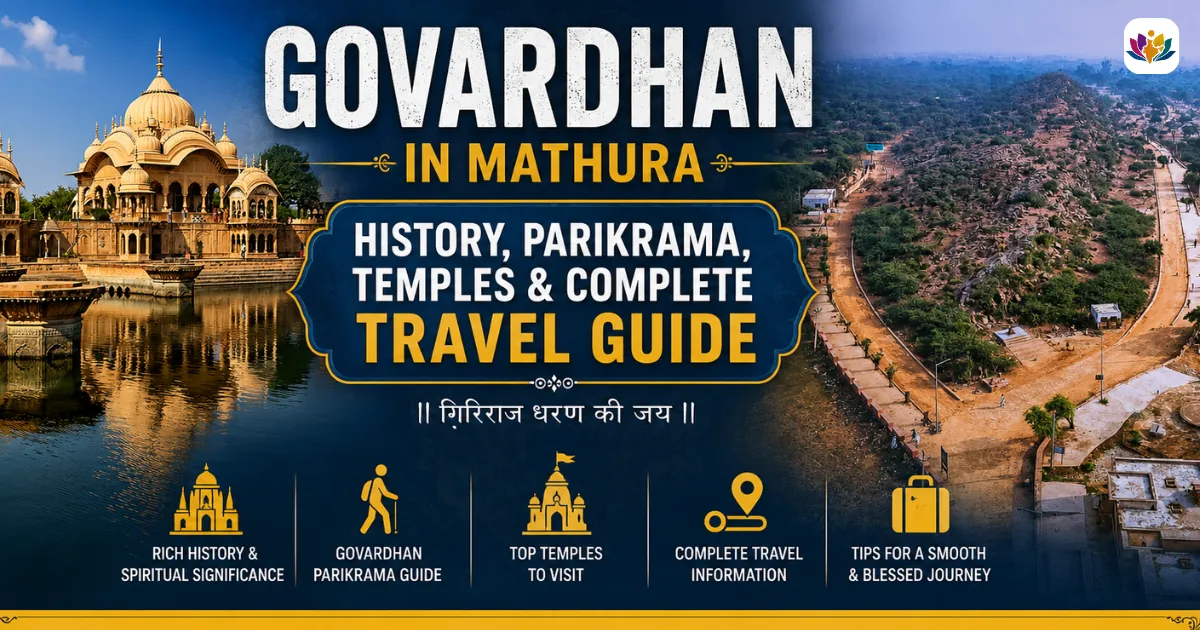
Govardhan Parikrama – Distance, Route & Two Options
The Govardhan Parikrama is a clockwise circumambulation of Govardhan Hill, traditionally walked barefoot. The full route is 21 km and constitutes what scriptures call the 7 Kos Parikrama (each kos being approximately 3 km). Most pilgrims start and end at either Daan Ghati Mandir or Mansi Ganga – both serve equally well as starting points.
| Parikrama Option | Distance | Time (Walking) | Best For |
| Full Parikrama (7 Kos) | 21 km | 5–7 hours at a devotional pace; 10–12 hours with all temple stops | Devotees committed to the complete sacred circumambulation |
| Badi Parikrama (outer) | 12 km | 3–4 hours | Pilgrims wanting the primary route without the full inner circuit |
| Chhoti Parikrama (inner) | 9 km | 2.5–3 hours | Includes Radha Kund area; suitable for elderly or time-limited pilgrims who want the most sacred section |
| Cab / vehicle parikrama | 21 km road (follows parikrama marg) | 1.5–2 hours with 4–5 stops | Senior citizens, families, anyone with mobility limitations – same sacred merit by tradition |
One important traditional note: some Vaishnava traditions hold that the Govardhan Parikrama performed by car or vehicle carries the same spiritual merit as walking, based on the principle of devotional intent. However Experience My India’s car parikrama service is frequently used by elderly pilgrim groups who have wanted to do Govardhan for decades but cannot walk 21 km. Both approaches are respected within the tradition.
Govardhan Parikrama Waypoints – Key Stops on the Route
Starting from Daan Ghati Mandir and moving clockwise, here are the major waypoints with approximate distances between them.
| Waypoint | Cumulative Distance | Significance |
| Daan Ghati Mandir (Start) | 0 km | Starting point. Temple where Krishna is said to have collected ‘daan’ (toll) from Radha and the gopis. Most pilgrims begin here. |
| Mansi Ganga | 2 km | Sacred lake believed to have been created by Krishna’s sankalpa (will). Starting point for some pilgrims. |
| Govind Kund | 4 km | Sacred tank where Indra bathed Krishna in repentance after the storm. Deeply significant for the parikrama narrative. |
| Punchari ka Lautha | 7 km | Famous Govardhan stone at the hill’s narrowest point. Pilgrims touch or prostrate before continuing. |
| Radha Kund | 13 km | Most sacred kund in Braj – formed from Radha Rani’s own teardrop. Adjacent to Shyam Kund. |
| Shyam Kund | 13 km | Krishna’s kund, side-by-side with Radha Kund. Bathing in both is considered highly auspicious. |
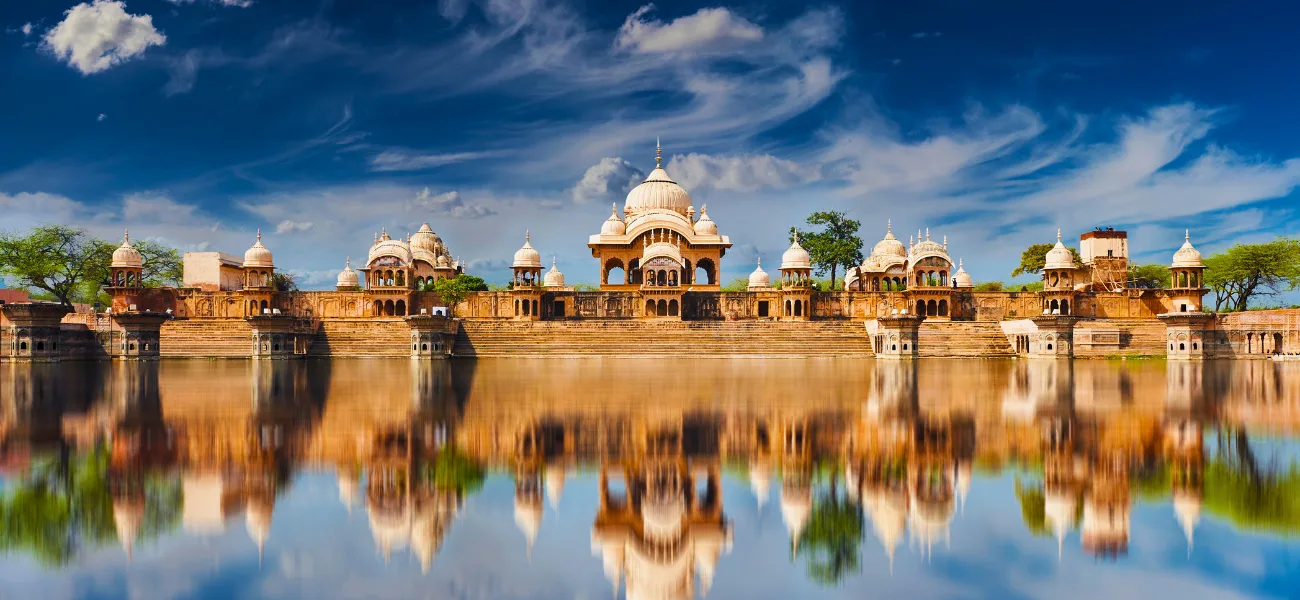
| Kusum Sarovar | 15 km | 60-foot deep, 450-foot long heritage step-well. One of the most visually striking sites on the parikrama. |
| Mukharvind | 18 km | The ‘face’ of Govardhan Hill – the most sacred point of direct darshan of Giriraj Maharaj. |
| Daan Ghati Mandir (End) | 21 km | Parikrama completes where it began. |
Parikrama rule: The circumambulation is always performed clockwise (keeping Govardhan Hill to your left). Reversing direction, even partially, is considered disrespectful within the tradition. If you start from Mansi Ganga instead of Daan Ghati, the same clockwise rule applies.
Sacred Kunds of Govardhan – Radha Kund, Shyam Kund & More
The kunds (sacred tanks or ponds) along the Govardhan Parikrama route are, for many pilgrims, the most spiritually powerful moments of the entire circumambulation. Here is the complete reference.
| Kund | Location on Parikrama | Significance | Bathing Merit |
| Radha Kund | 13 km from Daan Ghati | Believed to have appeared from Radha Rani’s own teardrop after Vrisha-Asura’s defeat. Considered the holiest kund in all of Braj. | Bathing considered equal in merit to a month’s parikrama |
| Shyam Kund | Adjacent to Radha Kund | Krishna’s kund – formed simultaneously with Radha Kund. Side by side, separated only by a narrow path. | Bathing with Radha Kund – most auspicious together |
| Mansi Ganga | 2 km from Daan Ghati | Appeared when Krishna willed the Ganga to come to Govardhan during Kartik Amavasya. Considered as sacred as the actual Ganga. | Bathing here equivalent to Ganga snan in tradition |
| Govind Kund | 4 km from Daan Ghati | Where Indra and Surabhi (the divine cow) bathed Krishna to cleanse the karma of challenging him. | Sacred darshan – less commonly bathed in |
| Kusum Sarovar | 15 km from Daan Ghati | 60-foot deep heritage step-well. Used by Radha and her sakhis for flower-picking (kusum = flowers). Now a heritage conservation site. | Heritage site – darshan rather than bathing |
Major Temples in Govardhan
The temples on and around the Govardhan Parikrama route are each connected to a specific moment in the Krishna leela narrative. These are the ones worth pausing at rather than passing through.
| Temple | Location | Opening Hours | What Makes It Distinctive |
| Daan Ghati Mandir | Start/end of parikrama | 5:00 AM – 12:00 PM; 5:00 PM – 9:00 PM | Scene of Krishna’s ‘toll-collection’ from Radha and gopis. Starting point for most pilgrims. |
| Mukharvind Temple | 18 km into parikrama | 5:00 AM – 12:00 PM; 4:00 PM – 9:00 PM | The ‘face’ of Govardhan Hill. Devotees whisper their wishes directly into a carved stone ear believed to connect to Giriraj Maharaj himself. |
| Mansi Ganga Temple | 2 km from Daan Ghati | 6:00 AM – 12:00 PM; 4:00 PM – 8:00 PM | Temple on the bank of the sacred kund; evening aarti on the lake is one of the most serene moments of the parikrama. |
| Radha Kund Shrines | 13 km mark | 5:00 AM – 1:00 PM; 4:30 PM – 8:30 PM | Multiple small shrines around the kund, dedicated to Radha Rani and the Goswamis who revived the site in the 16th century. |
| Giriraj Maharaj Temple (main) | Near Daan Ghati | 5:30 AM – 12:00 PM; 5:00 PM – 9:00 PM | Direct darshan of Giriraj Maharaj – a natural stone revered as the physical form of Govardhan Hill. No photography inside. |
Experience My India’s guided parikrama tours include stops at all five temples above, with timing planned around each temple’s open sessions so you never arrive at a closed gate. Call +91-7302265809 to book a guided Govardhan Parikrama tour.
On Foot, By Cab or By Palki – Choosing Your Parikrama Mode
| Mode | Time to Complete | Cost | Best For | Experience My India Service |
| Walking (barefoot) | 5–7 hours full; 2.5–3 hrs Chhoti | Free | Devoted pilgrims able to walk; October to March season | Guide walks with group; rest points pre-planned |
| Walking (footwear) | 5–7 hours full; 2.5–3 hrs Chhoti | Free | Comfortable for most healthy adults; all seasons | Same as barefoot – footwear allowed on paved sections |
| Cab / private car | 1.5–2 hours | ₹500–₹1,000 for cab hire | Senior citizens, families with children, anyone unable to walk | Included in Experience My India Govardhan packages – no separate hiring needed |
| Electric e-rickshaw (shared) | 2–3 hours with stops | ₹30–₹60 per person | Budget solo travellers or small groups | Self-arranged from Govardhan town |
A note on barefoot: the parikrama path includes paved sections, sandy stretches and some gravel – especially near the hillside. Barefoot walking is the traditional form and is considered more meritorious. In summer (April–June), the paved sections can be very hot between 10 AM and 4 PM. If doing the summer parikrama, start before 6 AM and carry a water bottle.
Best Time to Visit Govardhan in Mathura
| Season | Months | Temperature | Parikrama Suitability | Special Events |
| Best (Winter) | October–March | 10–25°C | Ideal for walking parikrama – cool temperature, manageable crowds on regular days | Govardhan Puja (October/November after Diwali) – most spiritually charged but very crowded |
| Manageable (Monsoon) | July–September | 28–35°C, humid | Paved sections fine; some sandy stretches muddy; greener landscape | Jhulan Yatra, Janmashtami (September 2026 in Mathura) |
| Challenging (Summer) | April–June | 35–44°C | Walking parikrama possible only before 8 AM and after 5 PM; cab parikrama manageable all day | Adhik Maas (May–June 2026) draws special pilgrim footfall |
| Most Auspicious | Ekadashi (11th lunar day each fortnight) | Any season | Largest regular pilgrim gathering – plan for slower movement | Ekadashi and Purnima draw the heaviest monthly crowds |
Experience My India adjusts every Govardhan itinerary by season – summer groups start at 5:30 AM, winter groups can be more flexible. Call +91-7302265809 for a seasonally-adjusted plan for your travel dates.
How to Reach Govardhan
| From | Distance | Travel Time | Best Mode |
| Mathura Junction (railway station) | 25 km | 35–50 minutes | Taxi, auto or shared e-rickshaw. Bus available but slower. |
| Vrindavan | 28–30 km | 40–55 minutes | Private cab – most practical since Vrindavan has no direct public transport to Govardhan |
| Delhi (via Yamuna Expressway) | 200 km | 3.5–4.5 hours | Road – most pilgrims combine this with a Mathura Vrindavan tour |
| Agra | 60 km | 1.5–2 hours | Private cab via Mathura is most practical |
| Barsana | 35–40 km | 50–60 minutes | Private cab – Barsana and Govardhan are commonly paired on the same day |
From Govardhan town itself, e-rickshaws and autos ply the parikrama road and can be hired for the circuit. Experience My India arranges cab pickup from Mathura, Vrindavan or Delhi for all Govardhan tours. Call +91-7302265809 to arrange transport.
Know Before You Plan
- The Govardhan Parikrama is free – there is no entry fee, parikrama fee or ticket of any kind. Anyone collecting money at the start of the parikrama is not an official source.
- The traditional direction is clockwise – keeping Govardhan Hill to your left throughout. Never walk counter-clockwise, even to catch a temple you missed.
- The full 21 km walking parikrama takes 5–7 hours at a devotional pace. If you have temple stops at Radha Kund, Mansi Ganga and Mukharvind, add 1–2 more hours. Start before 7 AM to complete comfortably.
- Barefoot walking is the traditional and most meritorious form, but is entirely optional. Footwear is permitted on the paved sections and genuinely needed on gravel and in summer heat.
- Govardhan Puja (the day after Diwali, October/November) is the single most crowded day of the year on the parikrama route. Lakhs of pilgrims walk simultaneously – movement slows significantly after 8 AM.
- Radha Kund is approximately 13 km into the parikrama – plan a 20–30 minute rest here. It is the spiritual highlight of the route for most serious pilgrims.
- Drinking water points are available along the parikrama route, but carry a reusable bottle particularly for the Punchari ka Lautha to Radha Kund stretch which has fewer facilities.
- Senior citizens and pilgrims with mobility concerns should use the cab parikrama – it covers the same route with stops at all major waypoints in 1.5–2 hours. Experience My India arranges this for every group that needs it.
- Govardhan is best combined with Barsana (35 km away) and Nandgaon (30 km away) on a 3-day Braj circuit. Call +91-7302265809 for a combined itinerary.
Ground Truth – What Nobody Tells You About Govardhan
After 2018 and 50,000+ pilgrims guided through Govardhan, here are five things that consistently determine whether the parikrama is transformative or exhausting.
- The walk from Radha Kund to Kusum Sarovar (2 km) is the quietest and most beautiful stretch of the entire parikrama.
Most groups rush it. The path here has trees, fewer pilgrims and the combination of the two kunds within sight of each other gives the section a stillness that the busier sections near Daan Ghati don’t have. Plan to slow down here specifically.
- Govardhan Puja is the most spiritually significant visit – and the hardest logistically.
Lakhs of pilgrims perform the parikrama on Govardhan Puja (day after Diwali). The road becomes so dense by 9 AM that movement slows to a shuffle. Experience My India’s Govardhan Puja packages start the group at 4 AM specifically to complete the parikrama before the main crowd arrives.
- The hill is wider than it is tall – and this surprises almost every first-time visitor.
People arrive expecting a prominent hill and find a low, wide sandstone ridge. The height is approximately 25 metres at its peak, but the perimeter is 38 km. It is a geological curiosity – broad and sprawling rather than vertical. The spiritual significance is in the circumambulation, not the summit.
- Mukharvind is the emotionally most powerful stop – and most guides don’t explain why.
At the Mukharvind Temple, there is a carved stone ear of Giriraj Maharaj. Pilgrims whisper their prayers directly into this ear, believing they are heard by the hill itself – by Krishna in his physical Govardhan form. Experience My India’s guides explain this tradition before the stop; without context, pilgrims often just pass by.
- Completing the Chhoti Parikrama (9 km) is not a compromise – it is sometimes the more devotionally focused choice.
The Chhoti Parikrama covers the Radha Kund area, the most sacred section of the full route. A slow, attentive 9 km walk with time at each kund can be more meaningful than a rushed 21 km race. Experience My India recommends the Chhoti Parikrama specifically for first-time walkers and pilgrims with 3–4 hours available.
Related Tour Packages by Experience My India
All packages include AC cab, Braj-born guide, darshan timed to temple schedules. Rated 4.5★ by 204+ pilgrims.
3-Day Braj Circuit – Mathura, Vrindavan, Govardhan & Barsana
From ₹4,999 per person
Three properly paced days covering Mathura, Vrindavan, Govardhan Parikrama and Barsana. Govardhan is covered on Day 2 with time at Radha Kund, Mansi Ganga and Kusum Sarovar. Most popular package for Braj pilgrims who want Govardhan done properly.
2-Day Mathura Vrindavan Tour Package
From ₹4,999 per person
Two-day Mathura and Vrindavan circuit – Govardhan can be added as a half-day extension on Day 2 for groups with an extra morning available.
Same Day Mathura Vrindavan Tour
From ₹2,999 per person
Single-day circuit from Delhi. Govardhan addition, possible for early-departure groups, adds approximately 3 hours to the schedule.
Govardhan Puja Special Package
From ₹5,999 per person
Dedicated Govardhan Puja package starting at 4 AM on Puja day – walk the parikrama before the main crowd arrives. Limited spots. Call 4–6 weeks ahead to check availability.
📞 Book any package: Call or WhatsApp +91-7302265809
Frequently Asked Questions
How far is Govardhan from Mathura?
Govardhan is 25 km from Mathura city centre, approximately 35–50 minutes by road depending on traffic. From Vrindavan, it is slightly further at 28–30 km (40–55 minutes). Experience My India arranges cab pickup from Mathura, Vrindavan or Delhi directly to the Govardhan Parikrama starting point – call +91-7302265809 to arrange.
How long does the Govardhan Parikrama take?
The full 21 km Govardhan Parikrama takes 5–7 hours at a devotional walking pace with short pauses. With full stops at Radha Kund, Mansi Ganga, Mukharvind and Kusum Sarovar, allow 8–10 hours. By cab with 4–5 stops, the same circuit takes 1.5–2 hours. The Chhoti Parikrama (9 km) takes 2.5–3 hours walking. Experience My India plans Govardhan tours around whichever format fits your group.
Can the Govardhan Parikrama be done by car?
Yes. The parikrama road follows the circumambulation route and is accessible by vehicle with stops at all major temples and kunds. A cab parikrama with 4–5 stops takes 1.5–2 hours. Vaishnava tradition holds that the car parikrama carries the same spiritual merit as walking when performed with devotional intent. Experience My India regularly arranges cab parikramas for elderly pilgrims and families. Call +91-7302265809 to book.
Is Govardhan Parikrama done barefoot?
Walking barefoot is the traditional form of the Govardhan Parikrama and is considered the most meritorious. However, it is not mandatory – footwear is permitted and commonly worn, especially on gravel sections and in summer heat. Experience My India recommends footwear for anyone who is not accustomed to barefoot walking, as some sections of the 21 km route have uneven ground.
What is the best time for Govardhan Parikrama?
October to March is the most comfortable season for walking the Govardhan Parikrama – temperatures stay 10–25°C. Govardhan Puja (day after Diwali, October/November) is the most spiritually charged but the most crowded. Start before 7 AM on regular days for the calmest experience. Summer walking is possible only before 8 AM or after 5 PM. Experience My India adjusts start times seasonally for every group.
What are the must-visit places in Govardhan Mathura?
The essential stops in Govardhan are: Daan Ghati Mandir (starting point), Mansi Ganga (sacred lake), Govind Kund (where Indra bathed Krishna), Radha Kund and Shyam Kund (most sacred kunds in Braj), Kusum Sarovar (heritage step-well) and Mukharvind (the face of Giriraj Maharaj where pilgrims whisper prayers). Experience My India’s guided tours stop at all six with specific context at each.
What is Govardhan Puja and when is it in 2026?
Govardhan Puja is celebrated the day after Diwali – in 2026, this falls in late October or early November (exact date depends on Panchang calculation – confirm closer to the date). The festival celebrates Krishna’s lifting of Govardhan Hill and his instruction to the Vrajavasis to worship the hill rather than Indra. Lakhs of pilgrims perform the parikrama on this day. Experience My India runs a special Govardhan Puja package from ₹5,999.
What is Radha Kund and why is it significant?
Radha Kund is a sacred tank approximately 13 km into the Govardhan Parikrama route, believed to have appeared from Radha Rani’s own teardrop after the defeat of the Vrisha demon. It is considered the holiest kund in all of Braj – bathing in Radha Kund on Bahula Ashtami (the most auspicious day) is described in scripture as equal in merit to a month’s parikrama. Shyam Kund, Krishna’s kund, sits immediately adjacent. Experience My India includes Radha Kund darshan in every Govardhan tour.
Can senior citizens do the Govardhan Parikrama?
Yes – by cab. The cab parikrama covers the full 21 km route with stops at Radha Kund, Mansi Ganga, Kusum Sarovar and Mukharvind in 1.5–2 hours. This is a completely valid and respected form of the parikrama. Experience My India runs senior citizen-specific Govardhan packages with AC cab support, pre-arranged rest stops and a guide who walks with the group at every stop. Call +91-7302265809 to plan.
How do I reach Govardhan from Delhi?
Delhi to Govardhan is approximately 200 km via the Yamuna Expressway toward Mathura, then 25 km west on the Govardhan road. Travel time is 3.5–4.5 hours. Experience My India provides AC cab service from any Delhi location directly to the Govardhan Parikrama starting point – call +91-7302265809 to arrange. Most Delhi pilgrims combine this with a 2–3 day Mathura Vrindavan tour.
Visit Govardhan with Experience My India
Govardhan in Mathura is not simply another temple stop on the Braj circuit. In the Vaishnava tradition it sits at the centre of everything – the hill Krishna lifted, the ground he walked, the physical form of Giriraj Maharaj whom pilgrims consider Krishna himself. The 21 km parikrama, the whisper at Mukharvind, the still water at Radha Kund – these are not theatrical moments. They are the quiet, specific experiences that Govardhan offers to people who arrive with some preparation and enough time.
Experience My India has been walking this parikrama with pilgrims since 2018. If you want the route, the timing and the transportation handled so the devotion can stay at the centre, call us.
|
Book Your Mathura – Vrindavan Trip Today We Reply in 30 Minutes 📞 +91-7302265809 💬 WhatsApp: +91-7302265809 Packages start from ₹1,999/ person | Rated 4.5★ / 204+ Reviews Explore all: Vrindavan Mathura Tour Packages Jai Shri Krishna 🙏 |