| Quick answer. The famous food of Mathura and Vrindavan is Mathura peda, the signature khoya sweet said to be Krishna’s favourite, kachori and bedai with spicy aloo sabzi for breakfast, thick kulhad lassi, jalebi, rabri, chaat and makhan mishri. Everything is pure vegetarian, most of it cooked without onion or garlic in the sattvic tradition, and much of it is offered to the deity as bhog before it reaches you. The food follows the temple day: kachori in the morning, lassi at midday, thali houses after evening aarti. Experience My India has guided 50,000 plus pilgrims since 2018, rated 4.5 stars. WhatsApp +91-7302265809. |
Introduction
When the first light touches the temple tops in Mathura, the city does not smell of incense first. It smells of ghee.
Somewhere a halwai is stirring milk into peda. Somewhere a kachori is going into hot oil with a hiss. A devotee is sipping tea by the ghat. This is Braj waking up, and food here is not a separate thing from the pilgrimage. It is part of it. Almost everything you eat has first been offered to Krishna, which is why people say the food here does not just fill you, it blesses you.
I am Gurudutt. I was born in Braj Bhoomi and I have eaten in these lanes my whole life, and guided pilgrims through them since 2018. This is not a list copied from other lists. It is what I would tell you to eat, when to eat it, and where, if you were walking beside me.
For everything else to see between meals, our places to visit in Mathura and Vrindavan guide covers both towns.
The Food Follows the Temple Day
Here is the one thing that turns a good eating day into a great one. In Braj, food is not a restaurant scene. It is a rhythm tied to the temple day, and if you eat with that rhythm you eat well.
| Time | What to eat | Why then |
| Early morning | Kachori, bedai, jalebi | The kachori pan is hottest and freshest before mid morning |
| Late morning | Peda, milk sweets | The halwais have fresh khoya ready |
| Midday | Kulhad lassi, light chaat | The lassi is a mercy in the heat, and temples are closed anyway |
| Evening | Chaat, snacks | The lanes come alive again after the temples reopen |
| After evening aarti | Thali at a bhojanalaya | The thali houses fill after darshan |
The temples close roughly from noon to 4:30 PM, as our Vrindavan temple timings guide explains, so the middle of the day is exactly when you want a cool lassi and a sit down. The food and the darshan fit together if you let them.
Mathura Peda, the Edible Identity of Braj
If Braj has one flavour, it is the peda.
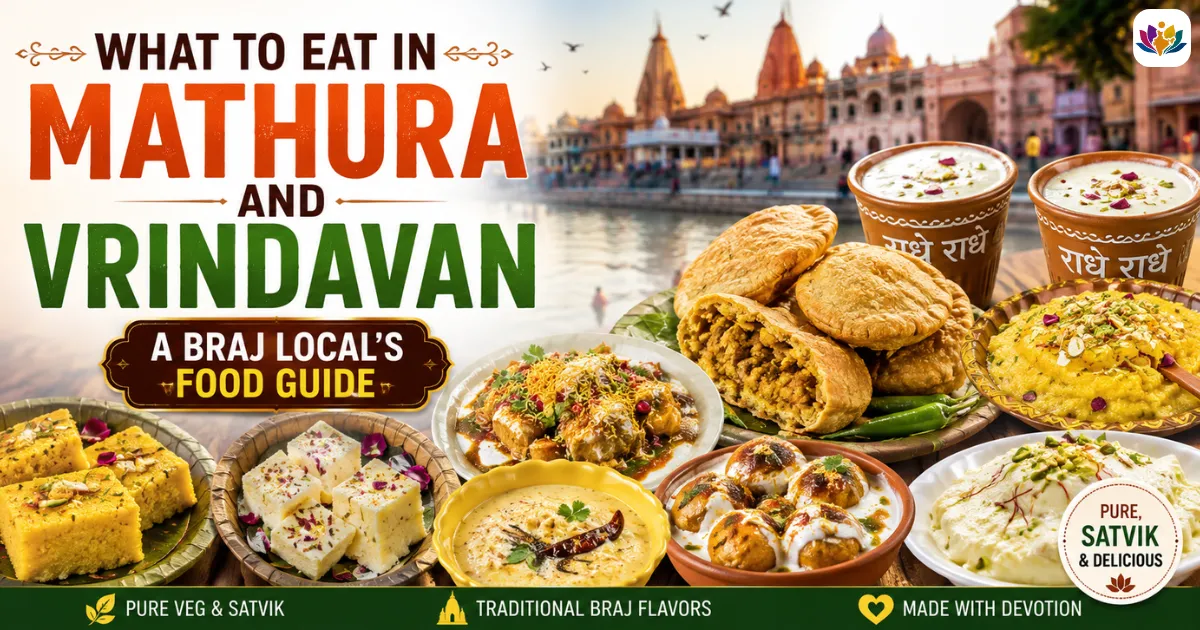
Mathura peda is made from khoya, milk cooked down slowly until it thickens and browns, then sweetened, pressed into small discs, and finished with cardamom and a dusting of bhura sugar. It is soft, grainy, and rich, and it is said to be Lord Krishna’s own favourite sweet, which is why it is offered in the temples and carried home by every pilgrim.
How to spot a good one. Look for daanedar peda, the textured, grainy kind. The darker and grainier it is, the longer the khoya was cooked, and the better it tastes and keeps. A pale, smooth, over-sweet peda is the tourist version. The real one tastes intensely of milk, not just sugar.
Where. Brijwasi Mithai Wala and Shankar Mithai Wala in Mathura are the names locals trust, along with the sweet shops around Holi Gate and Chowk Bazaar. In Vrindavan, the shops around Loi Bazaar and the ISKCON gate.
You cannot leave Braj without a box of peda. It is the souvenir, the prasad and the memory all in one.
Kachori, Bedai and the Braj Breakfast
Ask a Mathura local about breakfast and their whole face changes. This is the meal they are proud of.
Kachori is a crisp, deep-fried puri stuffed with spiced lentils, moong or urad dal, served with a thin, spicy potato curry. Bedai is its close cousin, a crispier lentil-stuffed puri, served with dubki wale aloo, a thin, tangy potato curry made, like almost everything here, without onion or garlic.
Eaten hot, in the morning, standing in a lane with the oil still crackling behind you, this is one of the great breakfasts in India, and hardly anyone outside the region knows it.
The classic pairing is kachori with jalebi. Spicy and sweet, crisp and syrup-soaked, eaten together. It sounds strange until you try it, and then it makes perfect sense.
Where. Oma Pehalwan’s kachori shop is a Mathura institution. The stalls opposite Vishram Ghat, and the lanes near Banke Bihari in Vrindavan, serve it fresh through the morning. Go before mid morning, when the pan is at its hottest.
Kulhad Lassi, the Midday Mercy
By noon, when the temples close and the heat builds, there is only one right thing to drink, and it is lassi.
Braj lassi is thick, served in a kulhad, a clay cup, and topped with a layer of malai and sometimes a little saffron or cardamom. It is closer to a meal than a drink. On a hot Braj afternoon, a kulhad of cold lassi is one of the small perfect experiences of the trip.
The clay cup matters. It keeps the lassi cool, adds a faint earthy note, and you throw it away after, so there is no question of hygiene. Ask for a sweet lassi unless you prefer salted.
Where. Sweet shops and stalls throughout both towns, particularly near Vishram Ghat, the ISKCON road, and Loi Bazaar.
The Sweets of Braj
Braj is a milk country, and its sweets go far beyond the peda.
| Sweet | What it is |
| Peda | The signature khoya disc, Krishna’s favourite |
| Rabri | Thick, slow-reduced sweetened milk, served cool |
| Khurchan | Delicate scraped layers of milk, a Mathura speciality |
| Milk cake | Firm, golden-topped, intensely milky |
| Jalebi | Crisp spirals soaked in syrup, best hot in the morning |
| Malpua | Soft, syrup-soaked pancake, often at temples |
| Gulab jamun and barfi | The familiar favourites, done well here |
| Kheer Mohan | A hidden treasure of Mahaban and Gokul, juicy or dry |
The milk here is special, from the cows of the Braj region, and you taste it. A good rabri or khurchan in Mathura is different from the same sweet made anywhere else, because the milk itself is better.
Chaat and Street Snacks
Between the sweets and the thalis, Braj has a lively chaat and snack culture, especially in the evenings when the lanes fill again after darshan.
Look for kachori chaat, crisp kachoris topped with curd, chutneys and masala, tikki, samosa, and the usual North Indian chaat, all of it vegetarian and often more inventive than you expect. Thandai, a spiced milk drink with dry fruits, is a Braj speciality, especially around Holi and in the summer months, and it is worth seeking out.
Where. The chaat stalls near Prem Mandir, around Krishna Nagar, and along the ISKCON road come alive in the evenings.
Makhan Mishri and Temple Prasad
Some of the most meaningful food in Braj is not sold at all. It is prasad, offered to the deity and then shared with devotees.
Makhan mishri, fresh white butter with sugar crystals, is the most beloved. It was Krishna’s favourite as a child, the butter he famously stole, and it is offered at temples across Braj. The makhan mishri of Dauji, the temple of Balram, is especially loved.
At Banke Bihari, the makhan mishri prasad carries its own significance. At ISKCON, the Govinda’s kitchens serve full sattvic prasadam meals, cooked with devotion and offered before serving, and eating there is a lovely, calm experience in itself. Peda and ladoo are distributed as prasad at many temples.
Prasad is not a snack. It is blessed food, received with the right hand and with a moment of gratitude. Your guide will show you the etiquette.
The Sattvic Tradition, No Onion, No Garlic
One thing surprises many first time visitors. Most of the food in Braj is cooked without onion or garlic.
This is the sattvic tradition. In Vaishnav practice, onion and garlic are considered tamasic and rajasic, foods that agitate the mind, and so they are left out of food that will be offered to Krishna. Since so much of Braj food is first offered as bhog, the whole cuisine has grown up around this principle.
You will not miss them. The food is built around the flavours of ghee, milk, cardamom, ginger, asafoetida and fresh spice, and it is rich and satisfying in its own right. And everything, without exception, is vegetarian. There is no non-vegetarian food in these towns, and alcohol has no place here at all. Do not ask for either, as it causes genuine offence in a sacred town.
Where to Eat, Area by Area
| Area | What to find there |
| Holi Gate and Chowk Bazaar, Mathura | Peda, the classic sweet shops, kachori |
| Near Vishram Ghat, Mathura | Kachori, lassi, morning breakfast stalls |
| Near Dwarkadhish, Mathura | Chaat, jalebi, street snacks |
| Loi Bazaar, Vrindavan | Peda, rabri, kulfi, sweets and shopping together |
| ISKCON road, Vrindavan | Govinda’s sattvic thalis, lassi, snacks |
| Near Banke Bihari, Vrindavan | Morning kachori and bedai in the lanes |
| Near Prem Mandir, Vrindavan | Evening chaat stalls |
For a full meal, the bhojanalayas, the traditional thali houses, fill after evening aarti and serve unlimited sattvic thalis, the honest, filling, home-style food that ends a temple day perfectly. Brijwasi Bhojanalaya in Mathura is a well known name.
Winter Specials, Gajak and Rewari
If you visit between October and March, Braj has a set of winter treats you will not find in summer.
Gajak, a crisp sesame and jaggery brittle that shatters when you bite it, and rewari, little sesame and sugar candies, appear throughout Mathura and the Braj region from October onward. They are energy-rich, made naturally without artificial ingredients, and often distributed as prasad around Makar Sankranti in January.
They also make excellent take-home gifts, because they keep fresh for weeks. If you are visiting in winter, buy a box.
Eating Safely, an Honest Word on Hygiene
Street food in Braj is one of its great pleasures, and I want you to enjoy it without a bad stomach. A few honest rules.
- Eat where the crowd is. A busy stall has fast turnover and fresh food. An empty one may have food that has been sitting.
- Eat it hot. Freshly fried kachori and hot jalebi are safe. Food that has cooled and been sitting out is the risk.
- The kulhad is your friend. Lassi in a fresh clay cup avoids the question of washed glasses entirely.
- Sweets from a busy, reputed shop are safe, since the turnover is high and the milk is fresh.
- Carry your own water, and prefer sealed bottled water.
- Ease in. If you are not used to Indian street food, start gentle on the first day and let your stomach adjust.
Follow these and you can eat freely. Our guides know which stalls are the clean, busy, trusted ones, which is exactly the kind of local knowledge that keeps a trip happy.
What to Take Home
| Item | Why it travels well |
| Mathura peda | The signature souvenir, keeps for days, the daanedar kind keeps longest |
| Gajak and rewari | Winter treats, keep fresh for weeks |
| Milk cake and barfi | Firm sweets that travel better than soft ones |
| Dry kheer mohan from Gokul | A hidden Braj treasure, less known, keeps well |
Buy sweets toward the end of your trip so they are fresh when you get home, and from a busy, reputed shop. A box of good daanedar peda is the taste of Braj that you carry back.
Know Before You Eat
- All food in Mathura and Vrindavan is pure vegetarian. There is no non-veg, and no alcohol. Do not ask for either.
- Most food is cooked without onion or garlic, in the sattvic tradition.
- Eat kachori and bedai in the morning, when the pan is hottest.
- Drink kulhad lassi at midday, when the temples are closed anyway.
- Peda is the signature. Look for the grainy daanedar kind.
- Thali houses fill after evening aarti. That is when to have your main meal.
- Eat hot, fresh, and where the crowd is, for safe street food.
- Winter brings gajak and rewari. Buy a box.
- Buy take-home sweets near the end of your trip, from a busy shop.
Tour Packages by Experience My India
Food and darshan fit together in Braj, and we build the right stops into every tour.
| Package | Price per person | Covers |
| Same Day Mathura Vrindavan Tour | From ₹1,999 | Both towns, with time for a proper Braj breakfast |
| 2 Days Mathura Vrindavan Tour | ₹3,999 | Unhurried, with the food lanes and thali houses |
| 3 Days Mathura Vrindavan Tour | ₹5,999 | Adds Govardhan, Barsana and Gokul, and their local sweets |
| 4 Days Mathura and Vrindavan Tour | ₹7,999 | The full circuit, senior friendly pacing |
Tell us you want to eat your way through Braj and we will make sure the right stops are on the route. WhatsApp +91-7302265809.
Related Guides
- Places to Visit in Mathura and Vrindavan
- Where to Stay in Mathura and Vrindavan
- Vrindavan Temple Timings 2026
- Best Time to Visit Mathura Vrindavan
- Gokul, Brahmand Ghat and Raman Reti
Frequently Asked Questions
What is the famous food of Mathura and Vrindavan?
The most famous food is Mathura peda, a khoya milk sweet said to be Krishna’s favourite. Alongside it are kachori and bedai with spicy aloo sabzi for breakfast, thick kulhad lassi, jalebi, rabri, khurchan, chaat and makhan mishri. Everything is pure vegetarian, mostly cooked without onion or garlic, and much of it is offered to the deity as bhog first. Experience My India builds food stops into its tours. Call +91-7302265809.
What is Mathura peda and where can I buy it?
Mathura peda is a soft, grainy milk sweet made from khoya cooked down slowly, sweetened, and finished with cardamom, said to be Lord Krishna’s favourite. Look for the daanedar, or textured, kind, which is darker, richer and keeps longest. Trusted names include Brijwasi Mithai Wala and Shankar Mithai Wala in Mathura, and the shops around Holi Gate and Loi Bazaar. Experience My India guides know the best shops. Call +91-7302265809.
What should I eat for breakfast in Mathura?
The classic Braj breakfast is kachori or bedai, a crisp lentil-stuffed puri, served with a thin spicy potato curry called dubki wale aloo, made without onion or garlic. The traditional pairing is kachori with jalebi, spicy and sweet together. Eat it hot in the morning when the pan is freshest. Oma Pehalwan’s in Mathura and the stalls near Banke Bihari are local favourites. Experience My India includes a morning food stop. Call +91-7302265809.
Is the food in Mathura and Vrindavan vegetarian?
Yes, completely. All food in Mathura and Vrindavan is pure vegetarian, with no non-vegetarian food anywhere in these sacred towns, and alcohol has no place here either. Most dishes are also cooked without onion or garlic, following the sattvic Vaishnav tradition, because so much of the food is first offered to Krishna as bhog. Please do not ask for non-veg or alcohol, as it causes offence. Experience My India books only vegetarian stops.
Why is the food cooked without onion and garlic?
Much of Braj food follows the sattvic tradition, in which onion and garlic are considered rajasic and tamasic, foods that agitate the mind, and so they are left out of food offered to Krishna. Since so much Braj food is prepared as bhog for the deity before being served, the whole cuisine has grown up around this principle. The food is rich and satisfying without them, built on ghee, milk and spice. Experience My India explains the tradition on tour.
What is makhan mishri?
Makhan mishri is fresh white butter mixed with sugar crystals, the food Krishna famously stole and loved as a child, and it is offered as prasad at temples across Braj. The makhan mishri of Dauji, the temple of Balram, is especially loved, and it is offered at Banke Bihari too. It is blessed food, received as prasad rather than bought as a snack. Experience My India guides show the etiquette of receiving prasad. Call +91-7302265809.
Where can I eat a good thali in Vrindavan?
The traditional bhojanalayas, or thali houses, serve unlimited sattvic thalis and fill after the evening aarti, which is the perfect time for a main meal. ISKCON’s Govinda’s kitchens serve sattvic prasadam meals in a calm setting. Brijwasi Bhojanalaya in Mathura is a well known name. These serve honest, filling, home-style vegetarian food. Experience My India includes a thali stop in its longer tours. Call +91-7302265809.
Is street food safe to eat in Mathura and Vrindavan?
Yes, if you follow a few rules. Eat where the crowd is, since a busy stall means fast turnover and fresh food. Eat it hot, freshly fried, not sitting out. Choose lassi in a fresh kulhad clay cup to avoid washed glasses. Buy sweets from busy, reputed shops. Carry sealed bottled water. Ease in gently if you are not used to Indian street food. Experience My India guides know the clean, trusted stalls. Call +91-7302265809.
What sweets should I take home from Mathura?
Mathura peda is the signature take-home, especially the grainy daanedar kind, which keeps for days. In winter, gajak and rewari, sesame and jaggery treats, keep fresh for weeks and make excellent gifts. Milk cake and barfi travel better than soft sweets, and the dry kheer mohan of Gokul is a lesser-known Braj treasure that keeps well. Buy near the end of your trip from a busy shop. Call +91-7302265809.
What is special about the milk sweets in Braj?
The milk in Braj comes from the cows of the region, part of the land’s deep association with Krishna the cowherd, and the quality shows in every bite. Sweets like rabri, khurchan, milk cake and peda taste more intensely of milk here than the same sweets made elsewhere. This is dairy country, and the milk-based sweets are its pride. Experience My India includes the best sweet shops on its routes. Call +91-7302265809.
What is thandai?
Thandai is a chilled, spiced milk drink blended with dry fruits, almonds, fennel, and aromatic spices, a Braj speciality especially popular around Holi and in the hot summer months. It is refreshing and rich, and you will find it at stalls and sweet shops across both towns. It is entirely vegetarian and non-alcoholic. Experience My India can point you to good thandai on a summer or Holi tour. Call +91-7302265809.
Conclusion
You could visit Mathura and Vrindavan and eat only at your hotel, and you would miss half of Braj. The food here is not a sideshow to the pilgrimage. It is part of it, offered to Krishna before it reaches you, made with the milk of his own land, eaten in the same lanes where the darshan happens.
Start your morning with hot kachori and jalebi. Drink a kulhad of lassi when the temples close at noon. End your day with a thali after the evening aarti. And carry home a box of grainy daanedar peda, so the taste of Braj goes with you.
Since 2018, Experience My India has walked these lanes with more than 50,000 pilgrims, and we are rated 4.5 stars by the families who trusted us. We know which stall is freshest and which sweet shop is honest, and we build the right stops into every tour.
|
Book Your Mathura – Vrindavan Trip Today We Reply in 30 Minutes 📞 +91-7302265809 💬 WhatsApp: +91-7302265809 Packages start from ₹1,999/ person | Rated 4.5★ / 204+ Reviews Explore all: Vrindavan Mathura Tour Packages Jai Shri Krishna 🙏 |