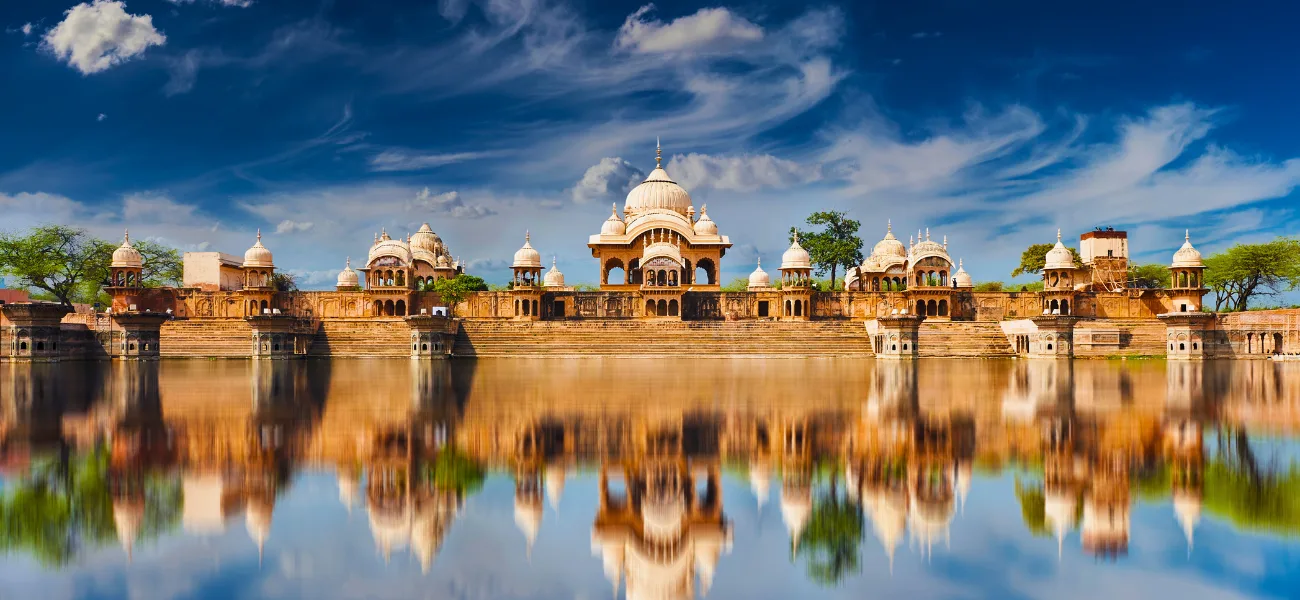
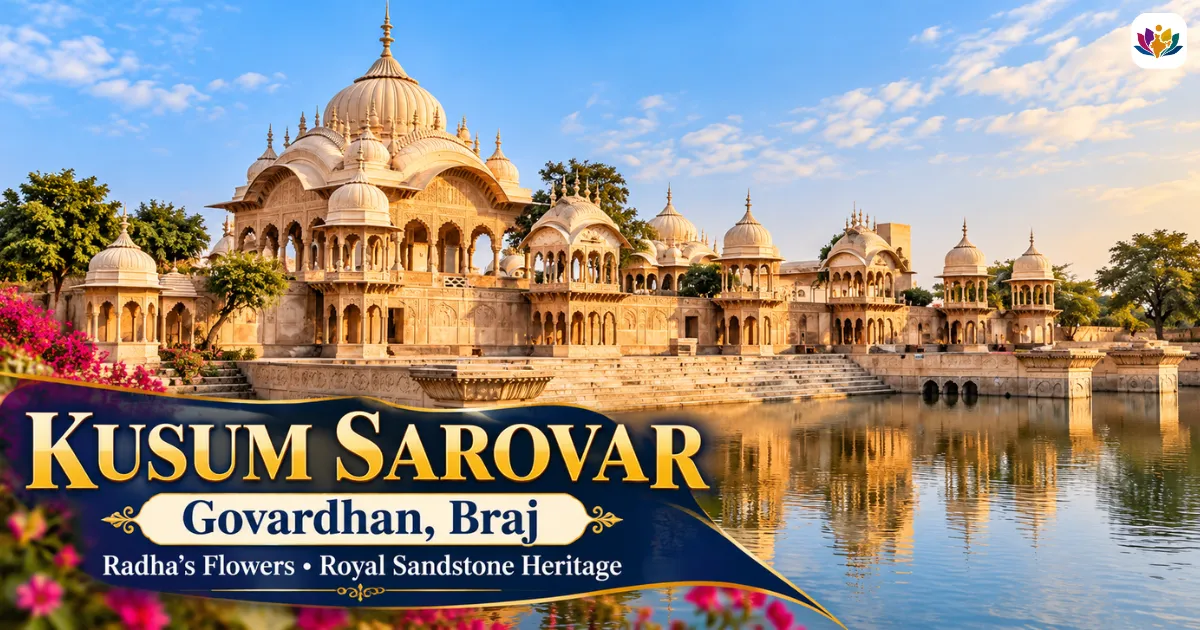
Quick answerKusum Sarovar is a sacred sandstone-ghat lake on Govardhan Hill, between Mansi Ganga and Radha Kund, about 24 km from Mathura. Kusum means flower and this is where Radha came to gather flowers for her garlands and secretly met Krishna. The lake is ringed by beautiful Rajasthani-style sandstone ghats and chhatris built in the 18th century by Raja Jawahar Singh of Bharatpur in memory of his father, Maharaja Suraj Mal. It is one of the loveliest spots in all of Braj, famous for its sunset and devotees believe a dip here grants pure love of Krishna. Entry is free; open about 6:00 AM to 6:00 PM. To include it in your Govardhan visit, call or WhatsApp +91-7302265809. |
Of all the places on the Govardhan circuit, this is the one that makes first-time visitors stop and catch their breath. Kusum Sarovar is where devotion and architecture meet: a still lake where Radha once gathered flowers, framed by honey-coloured sandstone pavilions that glow at sunset. Here, from a guide born in Braj, is the verified story, the heritage, the timings and how to reach it, with the key details in tables. Plan your visit with our Mathura Vrindavan tour package, which can include Govardhan.
Key takeaways
- Kusum Sarovar is a sacred lake on Govardhan Hill, between Mansi Ganga and Radha Kund, about 24 km from Mathura.
- Kusum means flower; Radha came here to gather flowers and secretly met Krishna.
- The sandstone ghats and chhatris were built by Raja Jawahar Singh of Bharatpur in memory of his father Maharaja Suraj Mal (18th century).
- The central cenotaph honours Suraj Mal; two smaller ones honour his queens, Kishori and Hansiya.
- Narada Kund, linked to the Bhakti Sutra, is part of the site.
- It is one of Braj’s most beautiful spots, famous for its sunset.
- Entry is free; open about 6:00 AM to 6:00 PM.
I am Gurudutt, born in Gokul in the Mathura district, guiding pilgrims through Braj since 2018, more than 50,000 of them. The Kusum Sarovar is where I bring pilgrims who think Govardhan is “just temples” because it is also the most beautiful piece of heritage on the whole circuit, so let me give you the story and the practical details in tables.
Kusum Sarovar at a glance
| Detail | Information |
| Location / Address | Kusum Sarovar, Govardhan, Mathura district, Uttar Pradesh 281502 |
| What it is | A sacred lake ringed by sandstone ghats and chhatris |
| Meaning | Kusum = flower; where Radha gathered flowers |
| Built by | Raja Jawahar Singh of Bharatpur, for his father Maharaja Suraj Mal (18th c.) |
| Entry fee | Free |
| On | Govardhan Hill, between Mansi Ganga and Radha Kund |
| Distance from Mathura | About 24 km |
| Famous for | The flower leela; the sandstone chhatris; the sunset |
Kusum Sarovar timings
The site is open through the day, best enjoyed in the soft light of early morning or at sunset.
| Session | Indicative timing |
| Opening | Around 6:00 AM |
| Closing | Around 6:00 to 7:00 PM |
| Best light | Sunrise and sunset |
| Days open | All year, 365 days |
Entry is free. Because the site closes around sunset, plan to arrive by late afternoon if the sunset view is your aim. Timings vary a little by season, so treat these as a guideline. For the wider list, see our Mathura temple timings guide.
The story: the lake of flowers
The name carries the leela. Kusum means flower and this is where Radha and her sakhis would come to gather flowers to weave into garlands for Krishna. It was a meeting place as much as a flower garden: here Radha and Krishna would secretly meet away from watchful eyes.
The stories told on these ghats are among the sweetest in Braj. In one, Radha’s dress caught on the thorns of a flowering bush and Krishna disguised as a gardener appeared to free it, teasing her all the while. In another, the two played hide-and-seek among the groves and Krishna himself gathered flowers to make Radha’s garland. When Chaitanya Mahaprabhu visited, the lake was also called Suman Sarovar, suman being another word for flower. Devotees believe that a bath in these waters grants prema, pure love for Krishna. For the story of the hill itself, read our history of Govardhan and why Krishna lifted it.
Narada Kund
Part of the same site is Narada Kund, where tradition says the sage Narada composed or received the verses of the Bhakti Sutra, the great aphorisms on devotion. The nearby Radha Bana Bihari temple completes the cluster.
The heritage: the chhatris of Suraj Mal
Here is what most pilgrims do not realise and it is worth knowing before you arrive: the stunning honey-coloured pavilions around the lake are not ancient temples, they are 18th-century royal cenotaphs and they are the reason Kusum Sarovar looks like nowhere else in Braj.
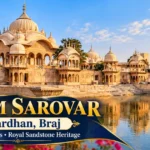
They were built by Raja Jawahar Singh, the Jat ruler of Bharatpur, in memory of his father, Maharaja Suraj Mal, the warrior-king who built Bharatpur’s power and its great fort. The central chhatri is Suraj Mal’s memorial; two smaller ones on either side honour his queens, Kishori and Hansiya. Inside, the ceilings are painted with scenes of Radha–Krishna pastimes and of Suraj Mal’s own court and the walls carry delicate pierced-stone (jali) work in the Rajasthani style. The ghats run some 450 feet with steps descending on all sides. It is a place where Braj devotion and Rajasthani royal architecture meet in one frame.
| Feature | Detail |
| Central chhatri | Memorial to Maharaja Suraj Mal |
| Two side chhatris | Queens Kishori and Hansiya |
| Style | Rajasthani sandstone; jali (pierced-stone) work |
| Ceilings | Radha–Krishna pastimes and Suraj Mal’s court scenes |
| Ghats | About 450 feet, steps on all sides |
Takeaway: come for the leela, stay for the stonework Kusum Sarovar is the one stop on the Govardhan circuit where the history is written in architecture, not just story.
Location and how to reach
Kusum Sarovar sits on Govardhan Hill between Mansi Ganga and Radha Kund, reached by road from Mathura or Vrindavan.
| From | Distance and mode |
| Radha Kund | About 1 km, a short ride or walk |
| Mansi Ganga / Govardhan town | A few km along the marg |
| Mathura Junction | About 24 km, by auto, taxi or cab |
| Vrindavan | About 22 km, by taxi or shared auto |
| Delhi | About 170 km, 3.5 to 4 hours via the Yamuna Expressway |
| Nearest airports | Agra (~70 km), Delhi (~170 km) |
Most pilgrims reach Kusum Sarovar on the Govardhan circuit, alongside Mansi Ganga, Govind Kund and Radha Kund. Our Gokul and Govardhan combo tour groups them so you are not backtracking and times the stop for the best light.
Best time to visit
Come sunset it is what Kusum Sarovar is famous for, when the sandstone turns gold and the reflection fills the still water. Sunrise is almost as lovely and far quieter. October to February is the comfortable season across Braj. The site fills on Govardhan Puja, Annakut and through Kartik month; those days are powerful but busy. For photographs and calm, a weekday late afternoon outside festivals is ideal just remember the gates close around sunset.
The honest bit
Honest words from one born in Braj. Two things to know. First, Kusum Sarovar is a lake and like Braj’s other kunds its water is not always clean; if you wish to take a dip, check the water first and many pilgrims simply take a respectful sprinkle instead. Second, because it is so photogenic, the ghats can get busy with photo shoots and the odd tout offering to “guide” you around the chhatris for a fee you do not need one; the site is free and open and this guide tells you what you are looking at.
The real tip is about time of day. Most tours rush through Kusum Sarovar at midday, in flat, harsh light and pilgrims leave wondering what the fuss was. Come in the last hour before the gates close, sit on the warm stone and watch the light change. That is the Kusum Sarovar people remember for life.
Why Experience My India is the right choice
I was born in Gokul in the Mathura district and Kusum Sarovar is the stop I deliberately save for the golden hour. Guiding since 2018, more than 50,000 pilgrims, 4.5 stars on Google, WhatsApp first, 8 AM to 9 PM daily. We time your visit for the best light, tell both the flower leela and the story of Suraj Mal’s chhatris on the ground and plan the Govardhan circuit, on foot or by car, to suit you. One clear fare and never a charge for free darshan.
Tip from Gurudutt: pair Kusum Sarovar with Radha Kund, which is barely a kilometre away and reach Kusum Sarovar for the last hour of daylight. Do the kunds and temples earlier and let this be the place where your Govardhan day ends, at sunset.
Plan your Govardhan visit
Tell me your dates and how you are arriving and I will build Kusum Sarovar and the Govardhan circuit into your trip, timed for the best light, for one clear price from ₹1,999 per person.
|
Book Your Mathura – Vrindavan Trip Today We Reply in 30 Minutes 📞 +91-7302265809 💬 WhatsApp: +91-7302265809 Packages start from ₹1,999/ person | Rated 4.5★ / 204+ Reviews Explore all: Vrindavan Mathura Tour Packages Jai Shri Krishna 🙏 |
Frequently asked questions
What is Kusum Sarovar in Govardhan?
Kusum Sarovar is a sacred lake on Govardhan Hill, between Mansi Ganga and Radha Kund, about 24 km from Mathura. Kusum means flower and it is where Radha gathered flowers and secretly met Krishna. It is ringed by beautiful 18th-century sandstone ghats and chhatris. Entry is free. Experience My India can include it in your Govardhan visit call +91-7302265809.
Who built the chhatris at Kusum Sarovar?
The sandstone ghats and chhatris were built by Raja Jawahar Singh, the Jat ruler of Bharatpur, in the 18th century in memory of his father, Maharaja Suraj Mal. The central cenotaph honours Suraj Mal and two smaller ones honour his queens, Kishori and Hansiya. The ceilings are painted with Radha–Krishna pastimes and court scenes.
Why is Kusum Sarovar famous?
Kusum Sarovar is famous for two reasons: it is where Radha gathered flowers and met Krishna, so devotees believe a dip grants pure love of Krishna; and it is one of the most beautiful heritage sites in Braj, with Rajasthani sandstone chhatris that glow at sunset. It is a highlight of the Govardhan circuit. Experience My India times the visit for the best light.
What are the Kusum Sarovar timings?
Kusum Sarovar is open daily, roughly 6:00 AM to 6:00 or 7:00 PM, all year round. Because it closes around sunset, arrive by late afternoon if you want the famous sunset view. Entry is free. Timings vary slightly by season, so confirm before travel. Experience My India checks live timings on +91-7302265809.
Is there an entry fee at Kusum Sarovar?
No, entry is free. There is no ticket to see the lake or the chhatris. You do not need a paid guide; be wary of anyone offering “special” access for a fee, as the site is open to all. Experience My India keeps all tour costs transparent and includes the real history on its guided visits.
How far is Kusum Sarovar from Mathura?
Kusum Sarovar is about 24 km from Mathura, roughly a 45 to 60 minute drive and about 22 km from Vrindavan. It sits between Mansi Ganga and Radha Kund, which is barely a kilometre away. The nearest airports are Agra (~70 km) and Delhi (~170 km). Experience My India arranges doorstep AC-car pickup from Mathura, Vrindavan or Delhi.
Can you take a dip at Kusum Sarovar?
Pilgrims do take a dip, following the belief that bathing here grants pure love of Krishna. As with Braj’s other kunds, the water is not always clean, so check it first or take a respectful sprinkle instead. Use the ghat steps carefully. Experience My India can plan a comfortable visit for the best time of day call +91-7302265809.
What is the best time to visit Kusum Sarovar?
Sunset is the best time the sandstone turns gold and reflects in the still water. Sunrise is nearly as beautiful and quieter. October to February is the comfortable season. Govardhan Puja, Annakut and Kartik month are the most crowded. For calm and photographs, come on a weekday late afternoon and leave before the gates close. Experience My India plans around light and crowds.