| Quick answer- Dwarkadhish Temple in Mathura, also called Jagat Mandir, is one of the city’s largest and most important temples, where Krishna is worshipped not as the child of Gokul but as Dwarkadhish, the majestic King of Dwarka, a black-stone deity in a golden crown. It was built in 1814 by Seth Gokul Das Parikh, treasurer of the Gwalior State, and follows the Pushtimarg tradition. It stands near Vishram Ghat, about 4 km from Mathura Junction. Summer timings are roughly 6:00 to 10:30 AM and 4:00 to 7:30 PM; winter roughly 6:30 AM to 1:00 PM and 4:00 to 7:00 PM, closed 12:00 to 4:00 PM. Entry is free. Its signature festival is the 13-day Hindola swing festival. Experience My India has guided 50,000 plus pilgrims since 2018, rated 4.5 stars. WhatsApp +91-7302265809. |
Introduction
In Gokul, Krishna steals butter. In Vrindavan, he plays the flute and dances with the gopis. And in Barsana, he teases Radha. Across Braj, he is the child and the beloved, all sweetness and mischief.
Then you step into Dwarkadhish Temple in Mathura, and everything changes. Here he sits crowned and majestic, a king on his throne, and the mood is not sweetness but grandeur. This is Krishna as Dwarkadhish, the ruler of Dwarka, and it is a completely different darshan from anywhere else in Braj.
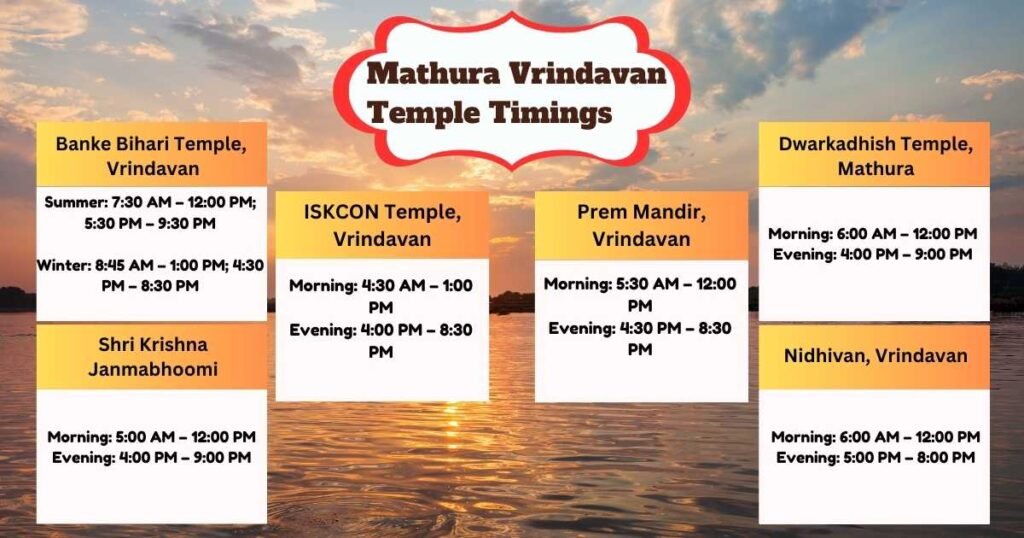
I am Gurudutt. I was born in Braj Bhoomi and I have brought pilgrims to Dwarkadhish since 2018. This guide gives you the timings, explains why the King of Dwarka is worshipped here in Krishna’s birthplace, and shows you how this grand temple fits into a Mathura pilgrimage. For the city’s other sites, our Mathura temple timings guide covers them all.
Dwarkadhish Temple Timings
| Session | Summer | Winter |
| Morning | 6:00 to 10:30 AM | 6:30 AM to 1:00 PM |
| Afternoon closure | 12:00 to 4:00 PM | 1:00 to 4:00 PM |
| Evening | 4:00 to 7:30 PM | 4:00 to 7:00 PM |
| Entry | Free | Free |
The temple closes through the middle of the day, when the deity is believed to rest, so plan your darshan for the morning or the evening. Dwarkadhish follows the Pushtimarg system of eight daily worship sessions, so darshan opens and closes around these seva windows, and the deity is revealed in a series of jhankis rather than a single continuous view.
The exact minutes shift with the season and the seva schedule, and extend on festival days. Confirm before you visit. Call +91-7302265809 and we will give you the current day’s darshan and aarti times. For how it fits with the other Mathura temples, see our Mathura temple timings guide.
Why Krishna Is Worshipped Here as a King
This is the question that makes Dwarkadhish special, and the answer is beautiful.
Krishna’s life had many phases. He was born in Mathura, grew up as a cowherd child in Gokul and Vrindavan, returned to Mathura as a young man to defeat Kansa, and finally went west to establish his own kingdom at Dwarka, on the coast of present-day Gujarat, where he reigned as a king. Dwarkadhish means Lord of Dwarka.
So why is the King of Dwarka worshipped back in Mathura, his birthplace? Because Mathura is the foundation of his whole story, the place it all began, and it is fitting that the city of his birth should also honour him in his full royal majesty, not only as the child who once played there. The temple lets devotees complete the arc: they can worship the infant at Krishna Janmabhoomi, the child across Braj, and the crowned king here at Dwarkadhish, all within the same sacred land.
In the language of devotion, most Braj worship Krishna in madhurya, sweetness and intimacy. Dwarkadhish worships him in aishwarya, majesty and lordship. Standing before the crowned king after the tender child of Gokul is a profound contrast, and it is the whole point of coming here.
The Deity and the Darshan
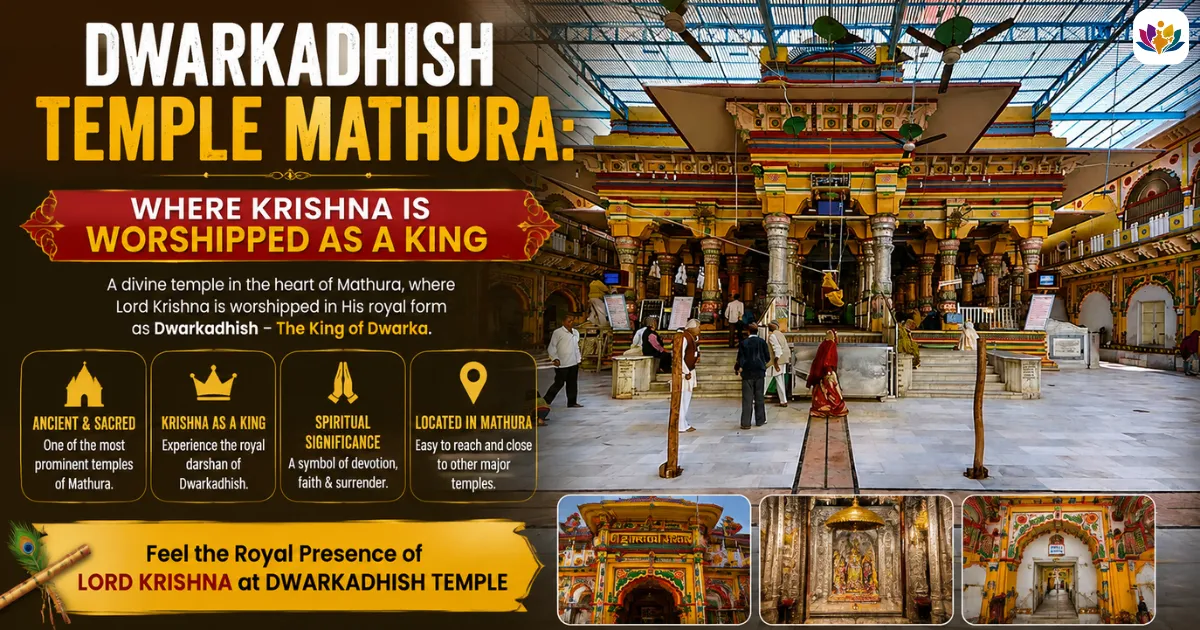
The presiding deity is Lord Dwarkadhish, a form of Krishna as the King of Dwarka, carved in black stone, kala patthar, and adorned with a golden crown and elaborate, changing shringar, the ornamentation and dress that Pushtimarg worship is famous for. Beside him is his divine consort, revered as Radharani.
The darshan here is a feast for the eyes. Under Pushtimarg worship, the deity is dressed and decorated with extraordinary richness that changes through the day and the seasons, in themed colours for festivals. The black stone, the gold, the fine clothes and jewels, and the play of lamplight make this one of the most visually opulent darshans in Braj, in keeping with the kingly mood of the temple.
Who Built It, and When
Dwarkadhish Temple was built in 1814 by Seth Gokul Das Parikh, the treasurer of the Gwalior State under the Scindia dynasty, with the approval and support of the Maharaja of Gwalior, Daulatrao Scindia.
Gokul Das was a devout follower of the Pushtimarg tradition and a devotee of the Dwarkadhish deity of Kankroli in Rajasthan, and he built this grand temple in Mathura to honour Krishna in his royal form. In 1930 the temple was entrusted to the Pushtimarg Acharya from Kankroli for its worship, and it has been served in that tradition ever since. During the upheaval of the 1857 Revolt, the temple is said to have served as a spiritual sanctuary that helped protect the Vaishnav traditions of Mathura.
At more than 200 years old, it is not as ancient as some Braj shrines, but it quickly became one of the largest and most important temples in Mathura, and it remains beautifully maintained and thronged with devotees to this day.
The Pushtimarg Worship and the Aartis
Dwarkadhish belongs to the Pushtimarg, the path of grace established by Vallabhacharya, and the style of worship here reflects that tradition’s love of rich, personal service to the Lord.
The deity is served through eight daily sessions, the Ashtayaam or Ashtakala Seva, from waking to rest, with several aartis through the day.
| Aarti or seva | Roughly |
| Mangala | Early morning, waking |
| Shringar | The grand dressing and adornment |
| Rajbhog | Midday offering, before the closure |
| Evening darshan | After the temple reopens |
| Shayan | Before the deity rests at night |
The Shringar darshan, when the king is dressed and bejewelled, is the most beautiful, and the morning aartis are the most atmospheric. Because the deity is served between public viewings, darshan comes in jhankis, so time your visit to catch an aarti or darshan window rather than the gaps between them.
The Hindola Festival, the Temple’s Signature
If there is one time the whole of Mathura points you toward Dwarkadhish, it is the Hindola festival, the temple’s signature celebration.
Hindola, also called the swing festival, runs for thirteen days in the month of Shravana, usually July or August, during the monsoon. The deities of Dwarkadhish and Radharani are taken from the sanctum and placed in a beautifully decorated jhoola, a swing adorned with gold and silver, for a special darshan, and the temple is decorated in changing theme colours each day. It is one of the most beautiful festivals in all of Mathura, and it is distinctive to this temple.
Beyond Hindola, Dwarkadhish celebrates Janmashtami, Radhashtami, Holi, Diwali and Annakut with great splendour. Janmashtami and Holi in particular draw enormous crowds, as our best time to visit guide explains. The temple’s Holi, played with colours and flowers before the king, is famous across Braj.
The Architecture and the Ranga Mahal
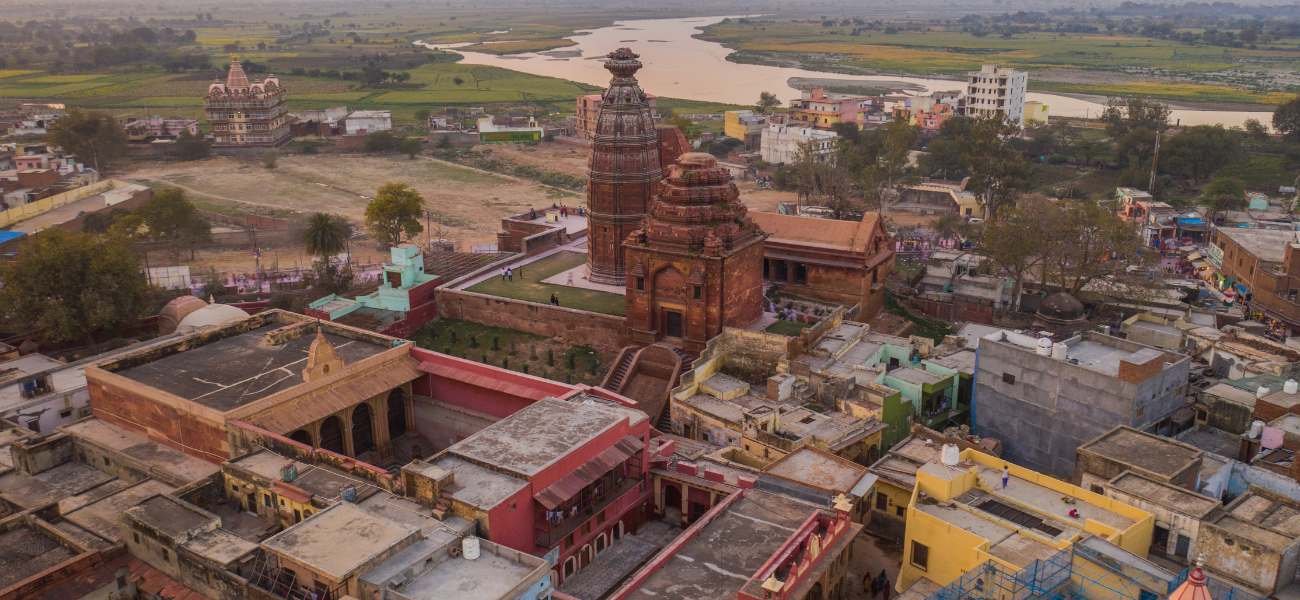
Dwarkadhish is an architectural jewel, blending Rajasthani and Mughal styles in a way that suits its kingly deity.
The temple stands on a raised platform, with an ornate entrance and a facade covered in intricate carvings. Inside, the walls and ceilings are painted with fine murals depicting scenes from Krishna’s life, so vivid that visitors often stop simply to look up. The main hall, known as the Ranga Mahal, is the decorated heart of the temple, richly adorned and coloured.
It is a temple built to impress, as befits the abode of a king, and the craftsmanship rewards a slow, attentive visit rather than a quick darshan and exit.
The Mathura Sacred Circuit
Dwarkadhish sits at the heart of the classic Mathura sacred circuit, and this is how you should visit it.
Within a short distance of each other lie three of Mathura’s most important sites, and together they make a perfect morning:
| Stop | What it is | From Dwarkadhish |
| Krishna Janmabhoomi | The exact birthplace of Krishna | About 2.5 km |
| Dwarkadhish Temple | Krishna as the King of Dwarka | The centre |
| Vishram Ghat | The Yamuna ghat where Krishna rested after slaying Kansa | About 5 minutes |
The natural flow is Krishna Janmabhoomi first, then Dwarkadhish, then Vishram Ghat for the Yamuna and the aarti. This is exactly how we sequence a Mathura morning before moving on to Vrindavan, and it is laid out in our Mathura sightseeing in one day guide.
How to Reach Dwarkadhish Temple
| From | Distance | Travel time |
| Mathura Junction | About 3 to 4 km | 10 to 15 minutes |
| Vishram Ghat | About 5 minutes walk | Very close |
| Krishna Janmabhoomi | About 2.5 km | 10 to 15 minutes |
| Vrindavan | About 12 km | 30 to 40 minutes |
| Delhi | About 150 km | 3 to 3.5 hours |
Dwarkadhish is in the heart of old Mathura, near the Yamuna and Vishram Ghat, about 3 to 4 km from Mathura Junction. The final approach is through the busy bazaar lanes of Vishram Bazar, so you may walk or take an e-rickshaw the last stretch. The address is Vishram Ghat, Vishram Bazar, Mathura 281001. From Vrindavan it is about 12 km, covered in our Mathura to Vrindavan distance guide, and from the capital in our Delhi to Vrindavan guide.
Where to Stay Nearby
Because Dwarkadhish sits in the old city near Vishram Ghat, staying nearby puts you within walking distance of the Yamuna and the main Mathura temples.
The area around Vishram Ghat and the old city has dharamshalas and budget hotels, convenient for early morning darshan, while more comfortable hotels sit toward Mathura Junction and the outskirts. For how to choose the right area in Mathura and what to expect, our where to stay in Mathura and Vrindavan guide covers it in full.
The Best Time to Visit
| When | What it is like |
| Early morning | The best, the Shringar darshan, shorter queues |
| Evening | Atmospheric aartis, busier |
| Hindola, Shravana | The signature swing festival, beautiful and busy |
| Janmashtami and Holi | Spectacular and extremely crowded |
| October to March | The most comfortable season |
Come early in the morning for the Shringar darshan and the calmest experience, avoiding weekends and festival peaks if you want quiet. The Hindola festival in the monsoon and Holi are the most spectacular times, though very crowded. October to March is the most comfortable season overall, as our best time to visit guide explains.
Ground Truth, What Nobody Tells You
- Here Krishna is a king, not a child. This is the whole point of the temple and the thing that makes it different from everywhere else in Braj. Come expecting majesty, not the sweetness of Gokul.
- It closes from noon to 4:00 PM. The deity rests. Plan darshan for morning or evening, never the middle of the day.
- Darshan comes in jhankis. Under Pushtimarg worship the deity is revealed in sessions, richly dressed, so time your visit to an aarti window.
- It is part of a three-temple circuit. Krishna Janmabhoomi, Dwarkadhish and Vishram Ghat sit close together. Do them as one Mathura morning.
- Look up at the murals. The painted ceilings and the Ranga Mahal are as much the attraction as the deity. Do not rush past them.
- Hindola is the signature festival. If you can visit during the thirteen-day swing festival in Shravana, the deity on the golden jhoola is unforgettable.
Know Before You Go
- Dwarkadhish worships Krishna as the majestic King of Dwarka, not the child of Gokul.
- It was built in 1814 by Seth Gokul Das Parikh and follows the Pushtimarg tradition.
- Summer timings roughly 6:00 to 10:30 AM and 4:00 to 7:30 PM; winter opens 6:30 AM.
- Closed 12:00 to 4:00 PM when the deity rests. Entry is free.
- Darshan comes in jhankis around eight daily sevas. Time your visit to an aarti.
- The signature festival is the 13-day Hindola swing festival in Shravana.
- It sits near Vishram Ghat, about 4 km from Mathura Junction.
- Visit it with Krishna Janmabhoomi and Vishram Ghat as one Mathura morning.
- Dress modestly. Look up at the murals and the Ranga Mahal.
- For the wider city, see our Mathura temple timings guide.
Tour Packages by Experience My India
We include Dwarkadhish in every Mathura tour, sequenced with Krishna Janmabhoomi and Vishram Ghat for a complete Mathura morning.
| Package | Price per person | Covers |
| Same Day Mathura Vrindavan Tour | From ₹1,999 | Dwarkadhish and the main Braj sites |
| 2 Days Mathura Vrindavan Tour | ₹3,999 | Unhurried Mathura and Vrindavan |
| 3 Days Mathura Vrindavan Tour | ₹5,999 | Adds Govardhan and Barsana |
| 4 Days Mathura and Vrindavan Tour | ₹7,999 | Full circuit, senior friendly pacing |
Call or WhatsApp +91-7302265809.
Related Guides
- Krishna Janmabhoomi Mathura
- Mathura Temple Timings 2026
- Mathura Sightseeing in One Day
- Places to Visit in Mathura and Vrindavan
- Where to Stay in Mathura and Vrindavan
Frequently Asked Questions
What are the Dwarkadhish Temple Mathura timings?
Dwarkadhish Temple is open roughly 6:00 to 10:30 AM and 4:00 to 7:30 PM in summer, and about 6:30 AM to 1:00 PM and 4:00 to 7:00 PM in winter, closed 12:00 to 4:00 PM when the deity rests. Entry is free. It follows the Pushtimarg system of eight daily sevas, so darshan comes in jhankis around aarti windows. Timings shift by season and festival, so confirm before visiting. Experience My India checks the day’s schedule. Call +91-7302265809.
Who built the Dwarkadhish Temple in Mathura?
Dwarkadhish Temple was built in 1814 by Seth Gokul Das Parikh, the treasurer of the Gwalior State under the Scindia dynasty, with the support of Maharaja Daulatrao Scindia. A devout follower of the Pushtimarg tradition and the Dwarkadhish deity of Kankroli in Rajasthan, he built this grand temple to honour Krishna in his royal form. In 1930 it was entrusted to the Pushtimarg Acharya from Kankroli. Experience My India guides tell the full story on site. Call +91-7302265809.
Why is Krishna worshipped as Dwarkadhish in Mathura?
Krishna was born in Mathura, grew up in Gokul and Vrindavan, and later ruled as king at Dwarka in Gujarat, where he was called Dwarkadhish, Lord of Dwarka. He is worshipped in this royal form back in Mathura because his birthplace is the foundation of his whole story, so it honours him in his full majesty as well as his childhood. Most of Braj worships Krishna in sweetness; here he is worshipped as a king. Experience My India explains this on the visit.
Is there an entry fee for Dwarkadhish Temple?
No, entry to Dwarkadhish Temple is free for all devotees. There is no ticket and no official paid darshan. The temple simply follows a dress code of modest, traditional clothing, and darshan comes in timed jhankis around the eight daily sevas. Anyone charging you for entry or priority access is not official. Experience My India charges for transport, hotel and guiding, never for darshan. Call +91-7302265809.
What is the Hindola festival at Dwarkadhish Temple?
The Hindola, or swing festival, is the signature celebration at Dwarkadhish, running for thirteen days in the month of Shravana, usually July or August. The deities of Dwarkadhish and Radharani are placed in a beautifully decorated golden and silver jhoola, or swing, for special darshan, and the temple is decorated in changing theme colours each day. It is one of Mathura’s most beautiful festivals and distinctive to this temple. Experience My India can time a visit for it. Call +91-7302265809.
How do I reach Dwarkadhish Temple from Mathura Junction?
Dwarkadhish Temple is about 3 to 4 km from Mathura Junction, roughly 10 to 15 minutes by auto, e-rickshaw or car. It sits in the old city near Vishram Ghat, so the final approach is through the Vishram Bazar lanes, where you may walk or take an e-rickshaw the last stretch. It is close to Krishna Janmabhoomi and Vishram Ghat, making a natural circuit. Experience My India arranges transport and sequences the Mathura sites. Call +91-7302265809.
What is special about the Dwarkadhish deity?
The deity is Krishna as Dwarkadhish, the King of Dwarka, carved in black stone and adorned with a golden crown and rich, changing shringar, with his consort Radharani beside him. Under Pushtimarg worship, he is dressed and decorated with extraordinary opulence that changes through the day and seasons, making this one of the most visually rich darshans in Braj, in keeping with the kingly mood. Experience My India includes it in every Mathura tour. Call +91-7302265809.
What should I see near Dwarkadhish Temple?
Dwarkadhish is the centre of the Mathura sacred circuit. Krishna Janmabhoomi, the birthplace, is about 2.5 km away, and Vishram Ghat, where Krishna is said to have rested after slaying Kansa, is a five-minute walk, with its evening Yamuna aarti. Together they make a perfect Mathura morning. The Gita Mandir is also nearby. Experience My India sequences all of them before continuing to Vrindavan. Call +91-7302265809.
When is the best time to visit Dwarkadhish Temple?
Early morning is best, for the Shringar darshan when the king is dressed and bejewelled, and for the shortest queues. The evening aartis are atmospheric but busier. The Hindola swing festival in the monsoon and Holi are the most spectacular times, though very crowded, and October to March is the most comfortable season. The temple closes 12:00 to 4:00 PM. Experience My India plans early visits for a calm darshan. Call +91-7302265809.
What is the architecture of Dwarkadhish Temple like?
Dwarkadhish blends Rajasthani and Mughal styles, standing on a raised platform with an ornate entrance and a facade of intricate carvings. Inside, the walls and ceilings are covered with fine murals of scenes from Krishna’s life, and the decorated main hall is known as the Ranga Mahal. It is a temple built to impress, befitting the abode of a king, and rewards a slow, attentive visit. Experience My India guides point out the finest details. Call +91-7302265809.
Is Dwarkadhish Temple worth visiting?
Yes. Dwarkadhish is one of the largest and most important temples in Mathura, and it offers something no other Braj temple does: darshan of Krishna as the majestic King of Dwarka rather than the child of Gokul. With its opulent Pushtimarg worship, beautiful murals, the signature Hindola festival, and its place in the Mathura circuit beside Krishna Janmabhoomi and Vishram Ghat, it is a highlight of any Mathura visit. Experience My India includes it in every tour. Call +91-7302265809.
Conclusion
Across Braj you meet Krishna the child and Krishna the beloved, barefoot in the dust of Gokul, flute at his lips in the groves of Vrindavan. Then you come to Dwarkadhish, and you meet him crowned, throned and majestic, the king he became. To see both, the tender child and the sovereign king, within a few kilometres of each other, is to see the whole sweep of his life in a single morning.
Come early, when the king is freshly dressed in gold. Look up at the painted ceilings. Then walk on to Vishram Ghat and the birthplace, and let Mathura give you Krishna in all his forms.
Since 2018, Experience My India has brought more than 50,000 pilgrims to Dwarkadhish and the temples around it, and we are rated 4.5 stars by the families who trusted us. We sequence the Mathura circuit so you see the child and the king in the right order, unhurried.
|
Book Your Mathura – Vrindavan Trip Today We Reply in 30 Minutes 📞 +91-7302265809 💬 WhatsApp: +91-7302265809 Packages start from ₹1,999/ person | Rated 4.5★ / 204+ Reviews Explore all: Vrindavan Mathura Tour Packages Jai Shri Krishna 🙏 |