

Quick answerJatipura Mukharvind is the shrine of the mukharvind, the lotus face of Giriraj Ji, on the south-western side of Govardhan Hill in Jatipura village, about 24 km from Mathura. Here Giriraj is worshipped as a sacred rock with a face and the great ritual is the dugdh abhishek, where devotees pour pots and buckets of milk over the rock in memory of the celestial cow Surabhi who bathed Krishna here. Jatipura is the most important seat of the Vallabh (Pushtimarg) tradition at Govardhan and is revered as the place where Shrinathji manifested before being taken to Nathdwara. Entry is free. To include it in your Govardhan visit, call or WhatsApp +91-7302265809. |
On the quieter, south-western side of Govardhan Hill, away from the Daan Ghati crowds, is the spot that the Vallabh tradition holds most sacred of all: the place where Giriraj shows his face. This is Jatipura Mukharvind, where milk is poured over the living rock of Govardhan morning after morning and where, Pushtimarg devotees believe, Shrinathji himself rose out of the hill. Here, from a guide born in Braj, is the verified story, the timings, the milk abhishek and how to reach it, with the key details in tables. Plan your visit with our Mathura Vrindavan tour package, which can include Govardhan.
Key takeaways
- Jatipura Mukharvind is on the south-western side of Govardhan Hill, in Jatipura village, about 24 km from Mathura.
- Mukharvind means the lotus face or mouth of Giriraj Ji; the rock here is worshipped as that face.
- The signature ritual is the dugdh abhishek devotees pour milk over the rock, recalling the celestial cow Surabhi.
- Jatipura is the chief seat of the Vallabh (Pushtimarg) tradition at Govardhan, with its havelis.
- It is revered as the place where Shrinathji manifested before being moved to Nathdwara in Rajasthan.
- It is the Jatipura-side starting point of the 21 km Govardhan Parikrama, including the strict dandavati parikrama.
- Entry is free; the temple runs morning and evening sessions, with the milk abhishek in the morning.
I am Gurudutt, born in Gokul in the Mathura district, guiding pilgrims through Braj since 2018, more than 50,000 of them. Jatipura is where I bring pilgrims who want to see the real heart of Govardhan worship, not just the parikrama gate, so let me give you the story and the practical details in tables.
The Jatipura Mukharvind at a glance
| Detail | Information |
| Location / Address | Giriraj Mukharvind, Jatipura, Govardhan town, Mathura, Uttar Pradesh 281502 |
| Deity | Giriraj Ji Maharaj the mukharvind (lotus face) of Govardhan, worshipped as a form of Krishna |
| Meaning | Mukharvind = mukh (face/mouth) + aravind (lotus); the lotus face of the Lord |
| Signature ritual | Dugdh abhishek pouring milk over the sacred rock |
| Tradition | Vallabh (Pushtimarg); linked to Shrinathji and Vallabhacharya |
| Entry fee | Free |
| On | The south-western side of Govardhan Hill, between Jatipura and Mansi Ganga |
| Distance from Mathura | About 24 to 26 km |
| Famous for | The milk abhishek; the manifestation of Shrinathji; Annakut |
Jatipura Mukharvind timings and aarti
The temple runs a morning and an evening session, with the milk abhishek in the morning after the first puja.
| Session or ritual | Indicative timing |
| Morning darshan & dugdh abhishek | 5:30 AM to around 12:00 PM |
| Midday | Shrine rests in the early afternoon |
| Evening darshan | 4:00 PM to 8:30 PM |
| Shayan (night) darshan | Around 8:30 PM |
Entry is free. Timings vary by source and season; some describe near all-day access, others a strict morning-and-evening split so treat these as a guideline and confirm on the day. Annakut and Makar Sankranti extend the hours greatly. For the wider list, see our Mathura temple timings guide.
The story: the lotus face of Giriraj
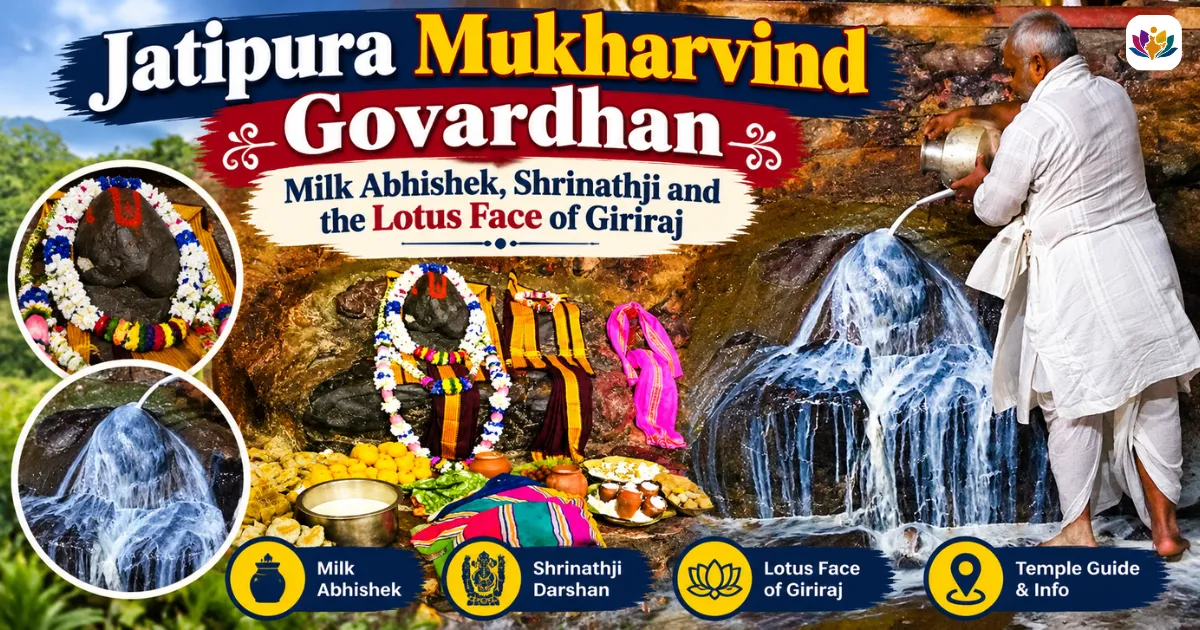
In Braj, Govardhan Hill is not a mountain with a temple on it; the hill is the Lord, worshipped as Giriraj Ji Maharaj. And if the whole hill is the Lord, then this is the place where he turns and shows his face. Mukharvind joins two words mukh, the face or mouth and aravind, the lotus so the mukharvind is the lotus face of Giriraj. The rock worshipped here, with its distinctive marked face, is that very darshan.
Why milk is poured here
The ritual that defines Jatipura is the dugdh abhishek. Each morning the rock is left bare for puja and devotees pour milk over it from pots and buckets, letting it run down the stone. The story behind it is one of the loveliest in Braj: when Krishna lifted Govardhan and defeated Indra’s pride, the celestial cow Surabhi came down from the heavens with Indra to honour the boy and bathed him in a stream of her own milk a govinda abhishek, a coronation in milk. Pilgrims at Jatipura repeat that bathing to this day. The marks of Surabhi, of Krishna’s cows, his footprint and his fingerprints are all pointed out on the rocks here.
Shrinathji and the Vallabh tradition
Jatipura is the great seat of the Vallabh sampradaya, the Pushtimarg founded by Shri Vallabhacharya. Devotees of this tradition believe that Shrinathji the child-form of Krishna with his arm raised to lift Govardhan rose out of this very hill, his lotus face appearing first and that Vallabhacharya recognised and established his worship here. Centuries later, to protect the deity, Shrinathji was carried west and finally enshrined at Nathdwara in Rajasthan, where he remains. The rock at Jatipura stands as his seat at Govardhan and the village keeps three havelis of the tradition. For the story of the hill itself, read our history of Govardhan and why Krishna lifted it.
Location and how to reach
Jatipura sits on the south-western edge of Govardhan Hill, between the hill and Mansi Ganga, reached by road from Mathura or Vrindavan.
| From | Distance and mode |
| Daan Ghati Mandir | A short ride around the hill |
| Mansi Ganga | Close by, same town |
| Mathura Junction | About 24 to 26 km, by auto, taxi or cab |
| Vrindavan | About 24 km, by taxi or shared auto |
| Delhi | About 170 km, 3.5 to 4 hours via the Yamuna Expressway |
Most pilgrims reach Jatipura as part of a Govardhan circuit alongside Daan Ghati Mandir and Mansi Ganga. Our Gokul and Govardhan combo tour covers the approach and groups the stops sensibly.
Daan Ghati or Jatipura: where to start the parikrama
Both are starting points for the 21 km Govardhan Parikrama and pilgrims often ask which to choose.
| Daan Ghati | Jatipura Mukharvind | |
| Side of hill | North-east (Mathura side) | South-west |
| Best known for | The Daan Leela; busiest start | The milk abhishek; Shrinathji |
| Tradition | General Braj worship | Vallabh (Pushtimarg) |
| Crowd | Heaviest | Quieter, deeply devotional |
| Strict dandavati parikrama | Less common | Traditionally begins here |
Takeaway: if you want the lively, classic start, begin at Daan Ghati. If you want the devotional heart of Govardhan and the milk abhishek, come to Jatipura.
Best time to visit
Come in the morning, when the milk abhishek is performed and the rock is bathed; it is the whole point of Jatipura. October to March is the comfortable season across Braj. The most charged days are Annakut and Govardhan Puja (the day after Diwali), when Jatipura is the single most prestigious place in Braj for the festival and Gokulnathji is brought in procession from Gokul and Makar Sankranti. These are glorious but extremely crowded; a weekday morning outside festivals gives you a calmer darshan.
The honest bit
Honest words from one born in Braj. Jatipura is less polished and less signposted than the big temples and the milk and crowds can make the floor slippery and chaotic to watch your step, especially with elders. You will also see milk running to waste and dogs lapping it up; some visitors are startled by this, but it is simply part of the open, living ritual here, not neglect.
And a word of care: because this is a deeply devout Vallabh centre, treat it with the quiet respect of a working shrine, not a sightseeing stop. Pour your milk with feeling, take an unhurried darshan of the mukharvind and do not treat the sacred rocks as photo props. Come for the bhaav and Jatipura will give you the most moving darshan in all of Govardhan.
Why Experience My India is the right choice
I was born in Gokul in the Mathura district and Jatipura is where I bring pilgrims who want to understand Govardhan, not just circle it. Guiding since 2018, more than 50,000 pilgrims, 4.5 stars on Google, WhatsApp first, 8 AM to 9 PM daily. We bring you here at the right hour for the milk Abhishek, tell the story of Surabhi and Shrinathji on the ground where it happened, arrange the darshan of Giriraj Ji and plan the parikrama, on foot or by car, to suit you. One clear fare and never a charge for free darshan.
Tip from Gurudutt: carry a small pot of milk for the abhishek and come in the morning, when the rock is bathed. Take the darshan of the mukharvind unhurried, then step across to Daan Ghati and Mansi Ganga to complete the Govardhan heart, keeping the full parikrama for a cool dawn start.
Plan your Govardhan visit
Tell me your dates and how you are arriving and I will build Jatipura Mukharvind and the Govardhan Parikrama into your trip, on foot or by car, for one clear price from ₹1,999 per person.
|
Book Your Mathura – Vrindavan Trip Today We Reply in 30 Minutes 📞 +91-7302265809 💬 WhatsApp: +91-7302265809 Packages start from ₹1,999/ person | Rated 4.5★ / 204+ Reviews Explore all: Vrindavan Mathura Tour Packages Jai Shri Krishna 🙏 |
Frequently asked questions
What is Jatipura Mukharvind?
Jatipura Mukharvind is the shrine of the mukharvind, the lotus face of Giriraj Ji, on the south-western side of Govardhan Hill. Giriraj is worshipped here as a sacred rock with a face and devotees perform the dugdh abhishek, pouring milk over it. It is the chief Vallabh (Pushtimarg) seat at Govardhan. Experience My India can include it in your Govardhan visit call +91-7302265809.
What is the dugdh abhishek at Jatipura?
The dugdh abhishek is the ritual of pouring milk over the Giriraj rock, done each morning after the first puja. It recalls the celestial cow Surabhi, who bathed Krishna in milk after he lifted Govardhan. Pilgrims bring pots and buckets of milk for it. It is the signature ritual of Jatipura. Experience My India can arrange your visit for the morning abhishek on +91-7302265809.
What does Mukharvind mean?
Mukharvind joins mukh, meaning face or mouth and aravind, meaning lotus so it means the lotus face of the Lord. At Jatipura, the sacred rock of Govardhan is worshipped as the mukharvind, the face of Giriraj Ji Maharaj, who is himself a direct form of Krishna in the Braj tradition.
Is Jatipura connected to Shrinathji?
Yes. The Vallabh (Pushtimarg) tradition holds that Shrinathji, the child-Krishna lifting Govardhan, manifested from this hill, his lotus face appearing first and that Vallabhacharya established his worship here. Shrinathji was later moved to Nathdwara in Rajasthan for safekeeping. Jatipura remains his seat at Govardhan and the centre of Pushtimarg worship there.
What are the Jatipura Mukharvind timings?
The temple is broadly open 5:30 AM to around 12:00 PM for morning darshan and the milk abhishek and 4:00 PM to about 8:30 PM in the evening. Timings vary by source and season and festivals extend them, so confirm before you travel. Entry is free. Experience My India confirms live timings on +91-7302265809.
Is there an entry fee at Jatipura Mukharvind?
No, entry and darshan are free. You may offer milk for the abhishek or sweets to Giriraj if you wish and donations at the temple are voluntary. As at Govardhan’s temples generally, be wary of anyone demanding money for “special darshan.” Experience My India keeps all tour costs transparent and never charges for free darshan.
How far is Jatipura from Mathura?
Jatipura Mukharvind is about 24 to 26 km from Mathura, on the south-western side of Govardhan Hill, a 50 to 70 minute drive. From Vrindavan it is roughly 24 km and from Delhi about 170 km via the Yamuna Expressway. Experience My India arranges doorstep AC-car pickup from Mathura, Vrindavan or Delhi call +91-7302265809.
When is the best time to visit Jatipura?
Come in the morning for the milk abhishek, which is the heart of Jatipura. October to March is the comfortable season. Annakut and Govardhan Puja after Diwali and Makar Sankranti, are the most sacred but most crowded days, when Jatipura is the prime place in Braj for Annakut. A weekday morning outside festivals is calmest. Experience My India plans around both crowds and weather.