

| Quick answer |
| Rangji Temple, also called Sri Ranganatha or Rangnath Mandir, is the largest temple in Vrindavan and the only one built in the South Indian Dravidian style. It was constructed between 1845 and 1851 by the Seth brothers Govind Das and Radha Krishna and is dedicated to Lord Ranganatha, a reclining form of Vishnu, with Goddess Andal. It is generally open for darshan around 6:00 AM to 12:00 PM and 3:00 to 8:00 PM, entry is free and its grandest event is the 10-day Brahmotsav (Rath ka Mela) in March or April. Non-Hindus may enter up to the courtyard. To include it in your Vrindavan visit, call or WhatsApp +91 7302265809. |
Most pilgrims come to Vrindavan for Banke Bihari and Prem Mandir and never realise that the town’s largest temple and its most unusual, is a South Indian marvel sitting quietly nearby. Rangji Temple is unlike anything else in Braj: a towering Dravidian gopuram, a gold flag pillar and a reclining Vishnu worshipped in the Tamil tradition, in the heart of Krishna’s land. Here, from a guide born in Braj, is the verified Rangji Temple timing, history, architecture and its grand Brahmotsav. Plan your visit with our Mathura Vrindavan tour package.
Key takeaways
- Rangji Temple is the largest temple in Vrindavan and its only Dravidian, South Indian, style shrine.
- Built between 1845 and 1851 by Seth Govind Das and Seth Radha Krishna, under Sri Rangadeshik Swami.
- Dedicated to Lord Ranganatha, a reclining form of Vishnu, with Goddess Andal (Goda).
- Highlights: a seven-storey gopuram, a 50-foot gold-plated Dhwaja Stambh and a large temple tank.
- Inspired by the Sri Ranganathaswamy Temple of Srirangam, Tamil Nadu.
- Its grandest festival is the 10-day Brahmotsav, the Rath ka Mela, in March or April.
- Entry is free; non-Hindus may enter up to the courtyard and photography is not allowed inside.
I am Gurudutt, born in Gokul in the Mathura district, guiding pilgrims through Braj since 2018, more than 50,000 of them. Rangji is the temple I most often have to talk visitors into seeing and the one they most often thank me for afterwards, so let me give you its timing and its remarkable story.
Rangji Temple timings and entry
The temple keeps a morning and an evening darshan block, like most in Braj.
| Session | Timing |
| Morning darshan | 6:00 AM to 12:00 PM |
| Evening darshan | 3:00 PM to 8:00 PM |
Timings are indicative and shift by season and on festival days, so confirm before you travel. Entry is free; non-Hindus may enter up to the courtyard and outer gateways and photography is not allowed inside. Our Mathura temple timings guide keeps the wider list.
The history of Rangji Temple
The Seth brothers, Govind Das and Radha Krishna, built Rangji Temple between 1845 and 1851. They belonged to the wealthy Seth Lakhmi Chand family and spent around 45 lakh rupees on the construction, an enormous amount for that time. Their guru, Sri Rangadeshik Swami, guided the project. A Sanskrit scholar and follower of the South Indian Sri Vaishnava tradition, he helped shape the temple’s religious and architectural vision.
Their vision was unusual and bold: to bring the grandeur of a great South Indian temple, modelled on the Sri Ranganathaswamy Temple of Srirangam in Tamil Nadu, into the very heart of North India’s Krishna country. The result is a rare meeting of South and North Indian devotion found nowhere else in Braj.
The architecture: Vrindavan’s only Dravidian temple
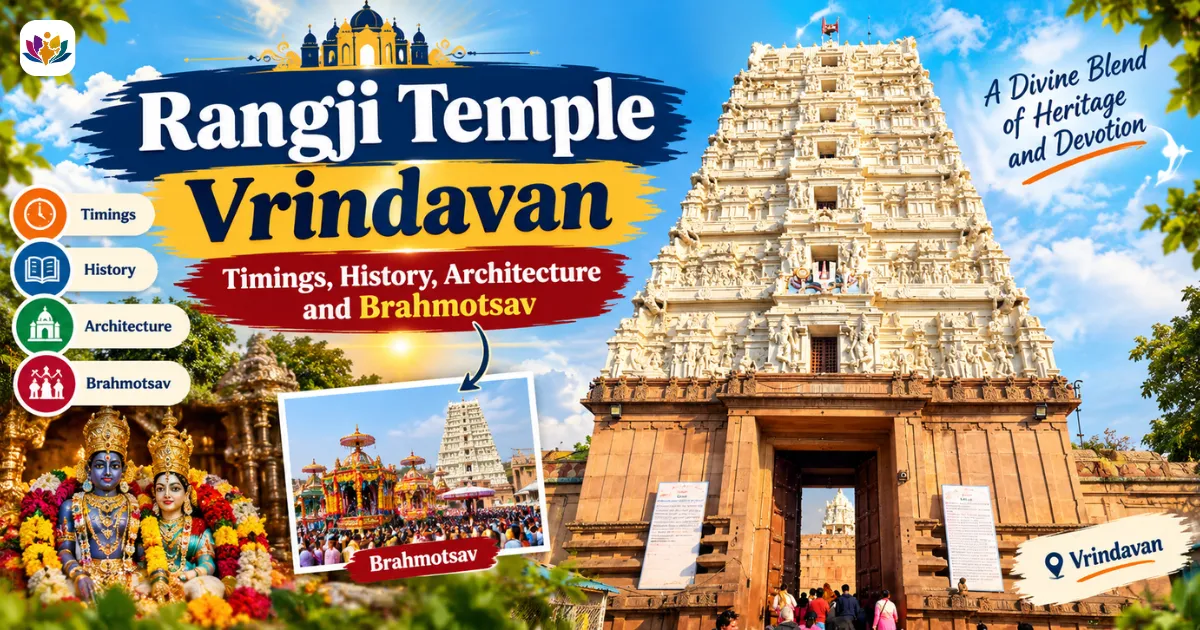
This is what makes Rangji unforgettable. Spread over a vast walled expanse, it is built in the South Indian Dravidian style blended with Rajasthani work. A towering seven-storey Rajagopuram, the great gateway tower, rises over the sanctum, guarded by the figures of Jaya and Vijaya and the garbha griha sits within five concentric rectangular enclosures in the classic Dravidian plan. Two beautiful stone gates, carved in Jaipur style, stand on the eastern and western sides. The single most striking feature is the 50-foot gold-plated Dhwaja Stambh, the flag pillar, which shines above the complex and is unlike anything in the other temples of Braj. Within the grounds lie a large sacred tank, the Pushkarni and a peaceful garden, where you can sit on the steps and take in a calm the busy temples never offer.
The deity: Lord Ranganatha and Goda (Andal)
The presiding deity is Lord Ranganatha, worshipped here as Sri Goda-Rangamannar, a reclining form of Vishnu resting on the coils of the serpent Sesha, in the Sheshashayi pose. Beside him is Goddess Andal or Goda, the eighth-century Tamil Vaishnava saint who composed the Tiruppavai hymns, worshipped here as his bride. The temple also holds shrines to Narasimha, Rama with Sita and Lakshman, Venugopala and the great acharya Ramanuja. The rituals follow strict South Indian Sri Vaishnava Vedic norms and the chief priests are South Indian brahmins, so a visit here feels like stepping briefly into Tamil Nadu in the middle of Braj.
Brahmotsav: the Rath ka Mela
Rangji Temple’s grandest days are its 10-day Brahmotsav, held in the month of Chait, around March or April and known locally as the Rath ka Mela. On the eighth day, devotees bring the deities out on a huge 50-foot wooden chariot and pull it along the road to the temple garden. Thousands of devotees join the procession, creating a spectacular scene that attracts enormous crowds.
A special and much-loved feature here is playing Holi with the Lord during the festival. The temple also celebrates the Jal Vihar festival and Vaikuntha Ekadashi with great fervour. If you can time your visit to Brahmotsav, it is one of the finest festival experiences in all of Vrindavan.
Entry rules and dress code
A few points are worth knowing before you go. Entry is free, but by long tradition, only Hindus may enter up to the inner sanctum; non-Hindu visitors may go as far as the courtyard and outer gateways and non-Indian visitors up to the first two gateways. You can view a small moving diorama at the second gateway for a nominal charge. The temple does not allow photography inside. As with other Braj temples, visitors should wear modest traditional clothing that covers their shoulders and knees. You can also visit nearby Banke Bihari and Prem Mandir to complete your Vrindavan day.
Rangji Temple location and how to reach
Rangji sits centrally in Vrindavan, more accessible than the deep old-town lanes.
- Location: Sri Rangji Temple, Vrindavan, Mathura district, Uttar Pradesh 281121
- From Vrindavan Railway Station: about 1.5 km
- From Mathura Junction: about 12 to 14 km
- Nearby: Keshi Ghat, Banke Bihari and the old-town temples
How to reach
You can easily reach the temple by road using a car, cab, auto-rickshaw, or e-rickshaw. Its convenient location near Vrindavan’s old-town temple cluster also lets you combine your visit with Banke Bihari and Keshi Ghat.
From Mathura Junction it is about 12 to 14 km; our Mathura to Vrindavan distance and route guide covers the approach and the Vrindavan tour guide shows how it fits a full day.
Best time to visit
For a calm visit, come on a weekday morning in the October to March season, when the weather is pleasant and the temple, being off the main tourist rush, is quiet enough to take in its architecture properly. For the spectacle, plan your trip around the Brahmotsav Rath ka Mela in March or April or Vaikuntha Ekadashi, when the temple comes alive with processions, flowers and lights. See how it fits the wider circuit in our places to see in Vrindavan and Mathura guide.
The honest bit
Honest words from one born in Braj. Rangji is the temple most day-trippers skip and it is a genuine mistake, because it is both the largest temple in Vrindavan and the most different, a piece of Tamil Nadu set down in Krishna’s land. Go for the architecture as much as the darshan: the gopuram, the gold flag pillar, the tank and the garden reward a slow, unhurried visit that the crowded temples cannot. Two practical notes. Non-Hindu travellers should know in advance about the sanctum rule, so it is not a surprise at the gate. And if you have any choice of dates, coming during Brahmotsav turns a fine temple visit into an unforgettable festival.
Why Experience My India is the right choice
I was born in Gokul in the Mathura district and Rangji is one of the temples I most want first-time pilgrims to see. Guiding since 2018, more than 50,000 pilgrims, 4.5 stars on Google, WhatsApp first, 8 AM to 9 PM daily. We build Rangji into your Vrindavan day, tell the story of its unusual South Indian roots on the ground, pair it with Banke Bihari and Keshi Ghat nearby and time it around the Brahmotsav for those who want the festival. One clear fare and never a charge for free darshan.
Tip from Gurudutt: give Rangji twenty unhurried minutes for the grounds, not just the darshan. Walk to the temple tank, look up at the seven-storey gopuram and the gold Dhwaja Stambh and sit a moment in the garden. It is the one temple in Vrindavan where the architecture itself is the experience and rushing it is the only way to be disappointed.
Plan your Vrindavan visit
Tell me your dates and how you are arriving and I will build Rangji into your Vrindavan day, pair it with the nearby temples and time it around Brahmotsav if you wish, for one clear price from ₹1,999 per person. A few good places to start:
|
Book Your Mathura – Vrindavan Trip Today We Reply in 30 Minutes 📞 +91-7302265809 💬 WhatsApp: +91-7302265809 Packages start from ₹1,999/ person | Rated 4.5★ / 204+ Reviews Explore all: Vrindavan Mathura Tour Packages Jai Shri Krishna 🙏 |
Frequently asked questions
What is Rangji Temple Vrindavan?
Rangji Temple, also called Sri Ranganatha or Rangnath Mandir, is the largest temple in Vrindavan and the only one built in the South Indian Dravidian style. It is dedicated to Lord Ranganatha, a reclining form of Vishnu, with Goddess Andal and blends South and North Indian temple traditions.
What are the Rangji Temple timings?
Rangji Temple is generally open for darshan around 6:00 AM to 12:00 PM and 3:00 PM to 8:00 PM, with the exact times shifting by season and on festivals. Entry is free, so confirm the day’s timing before you visit.
Who built Rangji Temple and when?
It was built between 1845 and 1851, over six years and at a cost of around 45 lakh rupees, by the Seth brothers Govind Das and Radha Krishna, under the guidance of their guru Sri Rangadeshik Swami. It is modelled on the Sri Ranganathaswamy Temple of Srirangam.
What is special about the architecture of Rangji Temple?
It is Vrindavan’s only Dravidian, South Indian, style temple, with a seven-storey gopuram, five concentric enclosures around the sanctum, Rajasthani-carved stone gates, a large sacred tank and a striking 50-foot gold-plated Dhwaja Stambh or flag pillar, unlike anything else in Braj.
Which deity is worshipped at Rangji Temple?
Lord Ranganatha, worshipped as Sri Goda-Rangamannar, a reclining form of Vishnu on the serpent Sesha, together with Goddess Andal (Goda). The temple also holds shrines to Narasimha, Rama, Venugopala and Ramanuja and follows the South Indian Sri Vaishnava tradition.
What is the Brahmotsav at Rangji Temple?
Brahmotsav, locally called the Rath ka Mela, is a grand 10-day festival held in Chait, around March or April. On the eighth day the deities are pulled through the streets on a huge 50-foot wooden chariot. Playing Holi with the Lord is a special feature of the festival here.
Can non-Hindus enter Rangji Temple?
By tradition, only Hindus may enter up to the inner sanctum. Non-Hindu visitors may go as far as the courtyard and outer gateways and non-Indian visitors up to the first two gateways. Modest traditional dress is expected and photography is not allowed inside.
How do I reach Rangji Temple?
Rangji Temple is centrally located in Vrindavan, about 1.5 km from Vrindavan Railway Station and 12 to 14 km from Mathura Junction, reachable by car, cab, auto or e-rickshaw. It sits close to Keshi Ghat and Banke Bihari, so it pairs easily with the old-town temples.
Can you arrange a Rangji Temple visit?
Yes. Tell us your dates and we will build Rangji into your Vrindavan day, pair it with the nearby temples and time it around Brahmotsav if you wish, from ₹1,999 per person. WhatsApp +91 7302265809, daily 8 AM to 9 PM.